

By Henrietta Heald
As Andy Burnham basks in the glory of his victory in the Makerfield by-election, he may like to reflect on a political battle that took place in the constituency a century ago - one that concerned the daughter of North East engineering giant Sir Charles Parsons, inventor of the steam turbine.
A towering figure in this story is Stephen Walsh, Labour MP for Ince (as the constituency was then called, before boundary changes) from 1906 until his death in 1929. He entered Parliament in the same year that the Labour Party became the Labour Party, changing its name from the Labour Representation Committee, with Keir Hardie as leader.
In 1863, three-year-old Stephen Walsh had been found by a policeman wandering the streets of Liverpool, a homeless orphan. At the age of 10, he began work in the Wigan coalfield. From this unpropitious start, Walsh – an articulate and charismatic self-taught man – would go on to become a leading light in both the National Union of Mineworkers and the Labour Party, eventually serving as deputy leader of both organisations and, later, as Secretary of State for War. An obituary in the New York Times described him as ‘a gold mine of humor’ and ‘the idol of Lancashire for a generation’.
Over the course of 23 years, Walsh secured the Ince seat for Labour in seven successive general elections. In the election of December 1923, called by Prime Minister Stanley Baldwin – leader of the ruling, but deeply divided, Conservative Party – Walsh’s opponent was, of all things, a woman. In the event, the national vote would lead to the first Labour government, a minority administration under Ramsay Macdonald, which, following the ‘red scare’ provoked by publication of the Zinoviev letter, lasted a mere nine months.
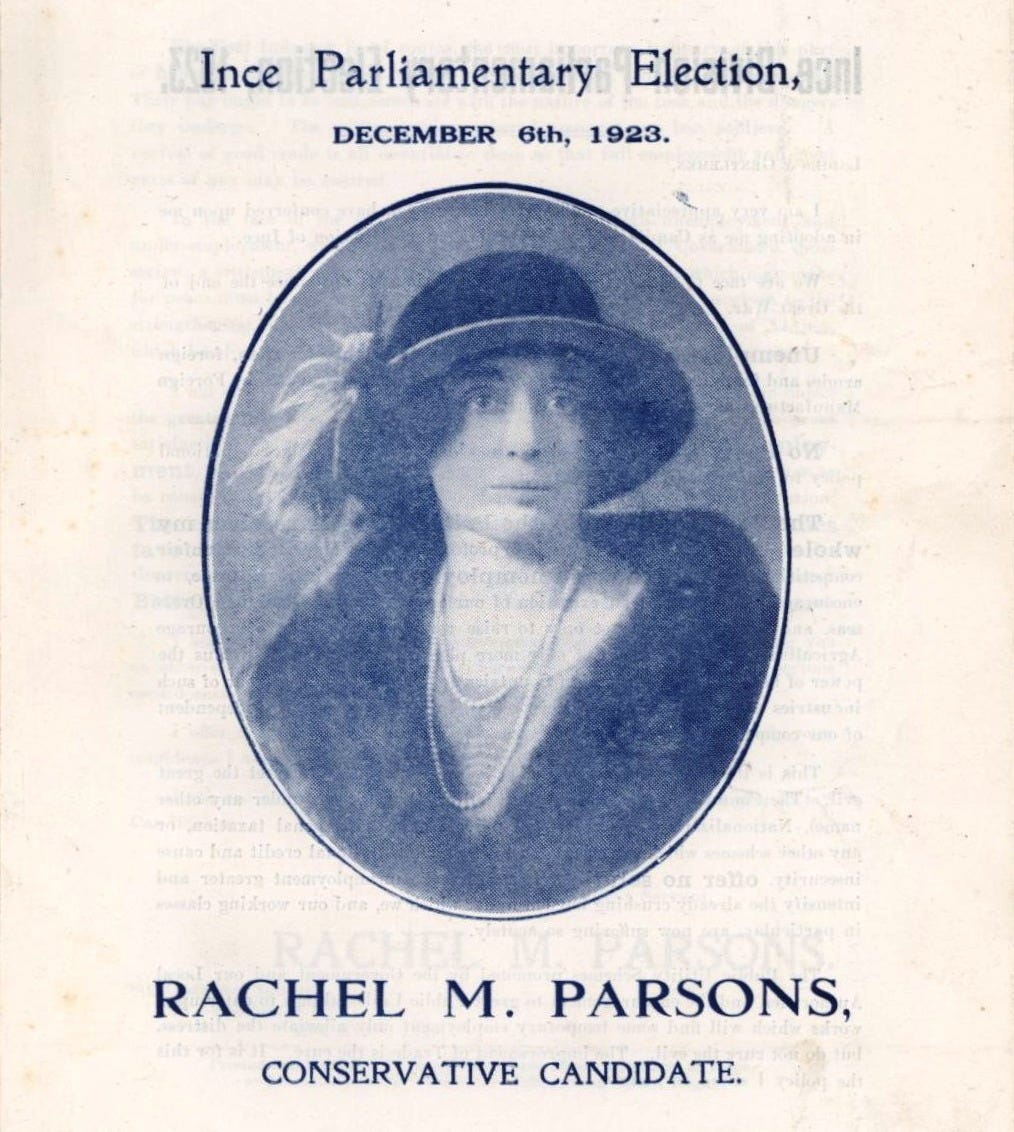
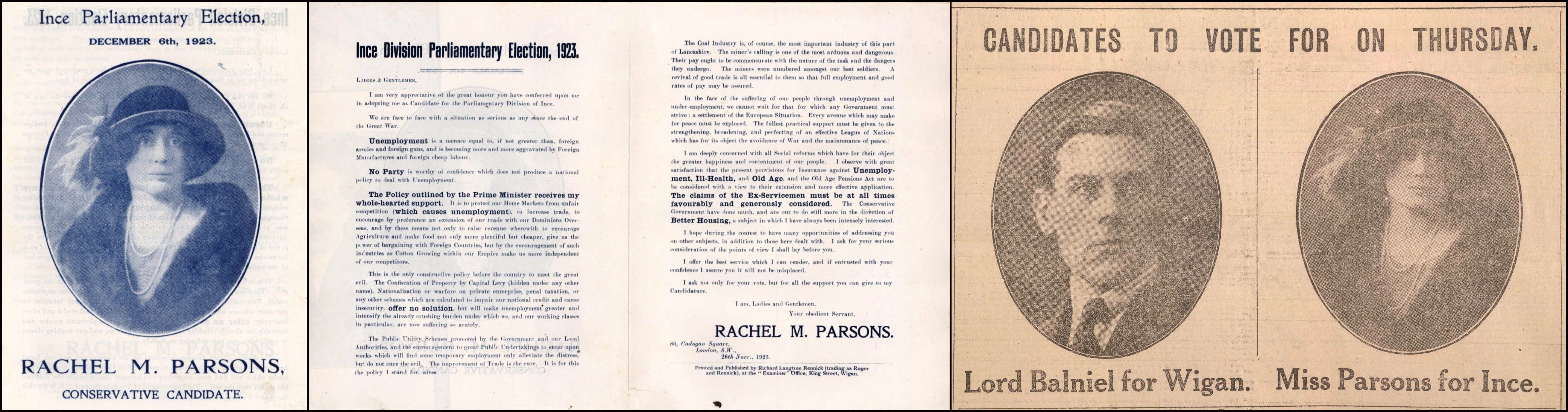
The woman chosen by the Conservatives to stand against Walsh in Ince in 1923 was Rachel Parsons, the founding president of the Women’s Engineering Society. It was just five years since women had first been allowed to take part in parliamentary elections, and there were only three sitting female MPs, all elected in seats vacated by their husbands: Nancy Astor and Mabel Philipson for the Conservatives, and Margaret Wintringham for the Liberals.
Rachel Parsons was one of the few female members of the London County Council, where she was an active member of the Highways Committee and the Electricity Supply Committee. Daughter of renowned inventor and industrialist Sir Charles Parsons and his wife Katharine, Rachel had become, in 1910, the first woman to study mechanical engineering at Cambridge University. During the First World War, she was appointed a director of her father’s firm, C. A. Parsons & Co, on Tyneside; she joined the Ministry of Munitions, and instructed hundreds of women across the country in munitions work.
After the war, when female workers were told to go back to the home – and a law was introduced to ban most of them from working in industry – Rachel and her mother founded the Women’s Engineering Society in 1919, the first professional organisation in the world to campaign for women’s employment rights, including equal pay with men. Rachel articulated its great rallying cry: ‘Women have won their political independence. Now is the time for them to achieve their economic freedom too.’ It was barely a year after British women with the correct qualifications had been granted the right to vote and to stand for Parliament.
In 1923, just two weeks before the December poll, Rachel Parsons was selected as the Conservative candidate for Ince. The reputation and influence of her father Charles clearly played a part in persuading the party to adopt her in this traditional industrial and mining constituency, but the activists were also impressed by her presidency of the Engineering Society – and they would be even more impressed by her energetic campaiging and her oratory.
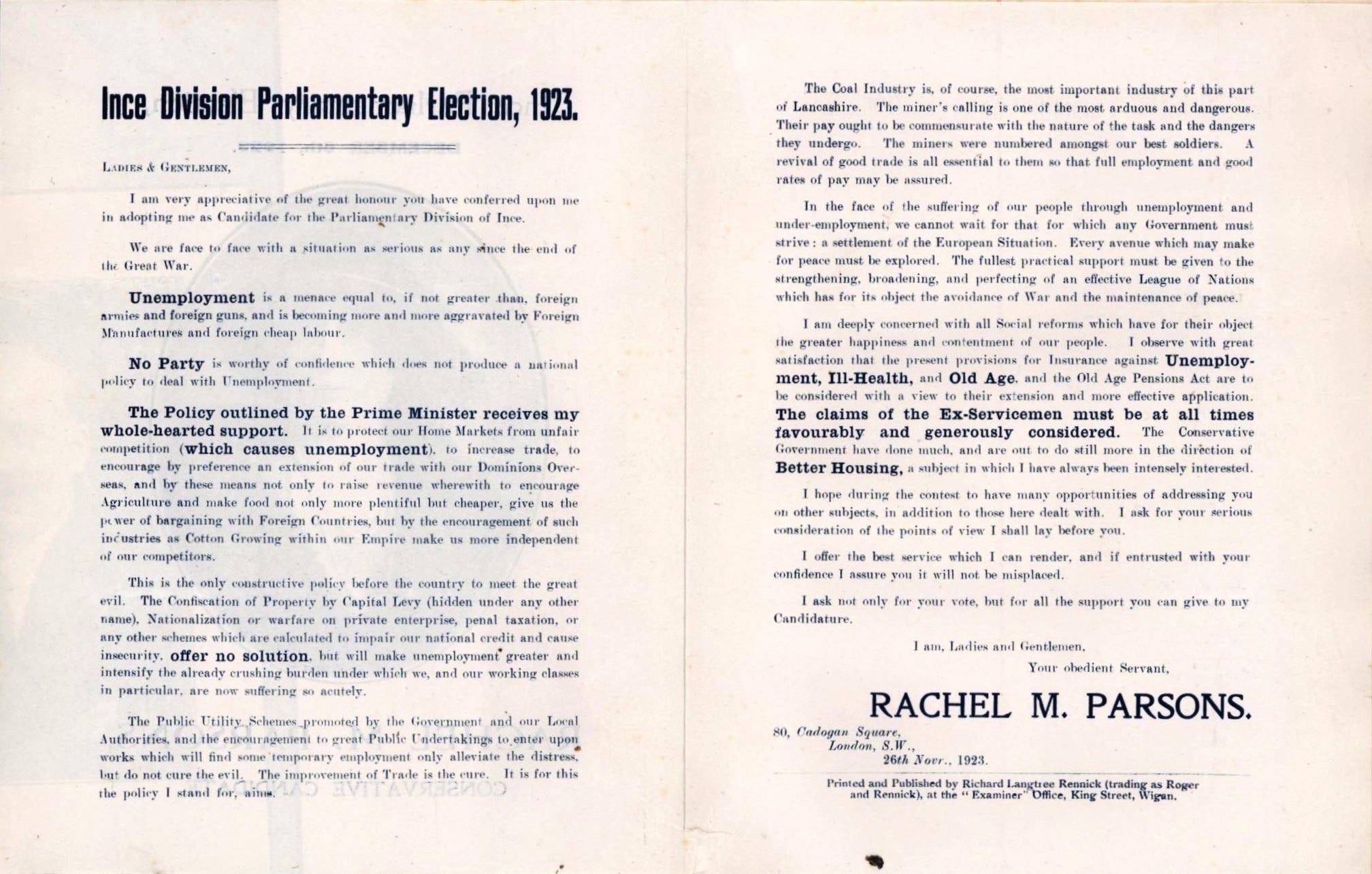
In several rousing speeches, Rachel dwelt on the dire state of the postwar British economy and the fact that unemployment had now reached two million. The situation in the country was so serious that it needed women as well as men to solve it. “In the war the women came forward and helped the men in the factories and workshops,” she said. “They went to France to drive the motor-cars and take care of the wounded, and why should they not come forward now in this terrible time of unemployment and again lend a helping hand?”
Reminding the audience of her roots in Northumberland, “a county of great industries and a mining county, too”, with many similarities to Lancashire, Rachel described her distress on a recent trip along the Tyne at witnessing the silence of the shipyards and the fact that ships were lying idle in the river. The Conservative Party was going to the country entirely on the question of unemployment, she said, because the time had come for a radical change of direction.
It was vital, Rachel insisted, that there were more women in Parliament to tackle the many subjects they knew more about than men. Women were often the ‘chancellors of the exchequer’ at home, in charge of the family budget, and why shouldn’t they look after the national money, too?
While Rachel’s words were warmly applauded by her audiences in Lancashire, they did not capture the prevailing mood of a nation bitterly divided over Baldwin’s proposals for import tariffs. In the event, the Conservatives lost 87 seats, although they were still the largest party; Labour and the Liberals gained enough ground to produce a hung parliament – and Ramsay MacDonald formed a short-lived minority Labour administration.
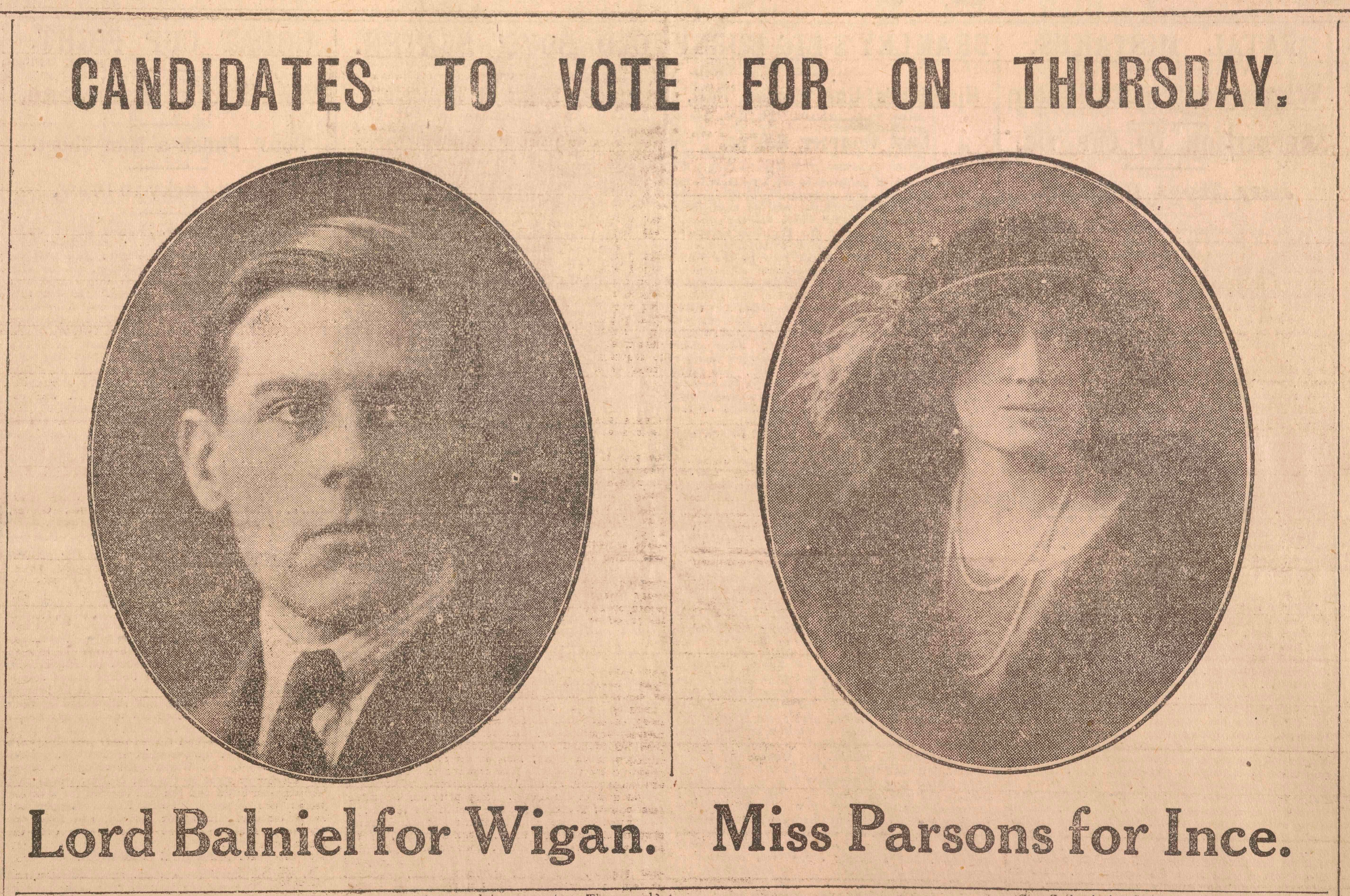
Even though Rachel’s attempt to enter Parliament could hardly have taken place in more challenging circumstances, her campaign in Ince achieved a creditable outcome. Evoking the atmosphere that built up before the result was announced, the Wigan Examiner described a crowd gathering outside the polling station at 8.30pm in thick fog. Most were supporters of the Labour candidate, Stephen Walsh, whose victory was never in doubt, “and their only anxiety was to know by how many lengths he had won”. The result, declared at 11.15pm, was as follows: Stephen Walsh (Labour) 17,365; Miss Parsons (Conservative) 6,262.
The vote for Walsh had hardly changed since the previous election, but it was remarkable in this case that Miss Parsons had achieved the level of support she had. Thirty-four women had stood in the 1923 poll and eight were successful: three Conservatives, two Liberals and three Labour. Out of the 615 seats in the House of Commons, 607 were still held by men.
The situation had improved little by the end of the decade. From the late 1920s until the mid-1970s, says the political historian Patricia Hollis, between 20 and 30 women were elected to each parliament: ‘More women stood; no more were elected.’ They simply failed, again and again, to be adopted in winnable seats. Even today, after the advances of the past 50 years, women still make up only 41% of the House of Commons, and women continue to be under-represented in all positions of power in public life.
Whatever Mr Burnham may think on this subject, I think he will agree that the time has again arrived for a radical change of direction.
Henrietta Heald is a writer whose work on William Armstrong and the Parsons family has made her a leading authority on the North East’s industrial heritage. She is the author of Magnificent Women and Their Revolutionary Machines, a history of the Women’s Engineering Society which is still going strong today.