


Eyes & Ears is now officially a year old. And, as I said a couple of days ago, I have turned on the payments for anyone who wants to be a monthly or annual subscriber.
It’s not a paywall, because everyone will continue to get every edition I send out.
Think of it more as a recognition of the value you get from reading Eyes & Ears every week. It’s like you saying ‘love what you do, have a drink on me’.
I’ve said that the monthly fee is the cost of a small glass of wine - but I’ve already been taken to task by people pointing out that many places charge more than £6.99. I need to get out more.
Good news is that my battles with the chatbots of Substack’s robotworld appear to be over, so feel free to join the growing ranks of paying subscribers.
I have plans to grow Eyes & Ears in 2026. I think you’ll like them. You can help me.
The long and the short of it
Ronnie Campbell and his widow Deirdre. Reform UK and flags on lamp-posts in Blyth. Hostility towards Keir Starmer. The green energy revolution. Reopening mines. Viscount Ridley. The industrial revolution. Dodging a bullet with Britishvolt. And a certain Northumberland councillor called Barry Elliott.
That, ladies and gentlemen, is a 42-word summary of an article written by journalist and author James Meek for the London Review of Books - an essay that runs to 13,724 words.
Meek said he did not intend to have such a focus on politics when he set out on his first trip to Blyth. “I’d come to satisfy my curiosity about a fantastical factory that at one time was set to be built nearby, a huge new manufacturing plant that was going to make batteries for electric cars and bring thousands of jobs to the area. Three thousand, according to some reports. Eight thousand, according to the more imaginative.”
With that Britishvolt dream now dead, the Cambois site is where QTS are building a £10 billion data centre. The author seems far less impressed at the prospect than many of us: “Blyth will live under the flyover of an energy-AI superhighway”.
Having used the Northumberland Line to get to Blyth, Meek’s first port of call was the home of Labour activist Deirdre Campbell, widow of the former left wing Labour MP Ronnie. He also spoke to, among others, Blyth and Ashington Labour MP Ian Lavery, and Viscount Ridley, who sat on the Conservative benches at the House of Lords for several years.

Before May’s council elections, Blyth’s eight seats on Northumberland County Council were split four for Labour, three Tory and one Lib Dem. Today there is one Tory councillor and seven from Reform.
Meek endeavoured to talk to them. The only one who made the time to do so was B&B owner Aiden Campbell - the youngest son of Ronnie and Deirdre.
It’s here that we come to the past, present and future of Blyth.
It was a skilled labourer’s town - and nobody epitomised that more than Ronnie Campbell. It’s now firmly in the grip of Reform - with Ronnie’s son a councillor representing the party of Nigel Farage. And it is part of the green industrial revolution - with Meek questioning if that matters much to the people of the town.
“Reform isn’t just the anti-immigration party,” he writes. “It’s also the anti-net-zero party.”
Meek highlighted the two landmarks that dominate the town’s skyline. One is an obsolete offshore wind turbine fixed to the north quay of the harbour for technicians to train on. The other is the great corrugated shed of the ORE Catapult facility, designed to test offshore wind farm blades.
“Together, the wind turbine and the Catapult building advertise Blyth’s centrality to the carbon-free economy of the future. They advertise it, but I don’t quite believe it, and neither, judging by the local popularity of Reform, does Blyth,” he said.
“What struck me when I asked Aiden Campbell about this wasn’t that he was opposed to the development, more that he was unimpressed – by the meagre scale of it all, and its lack of connection to what he sees as the life of the nation.
“Brexit and the prospect of an immigrant purge arouse him; a role for Britain in protecting humanity from the consequences of its fossil fuel dependency leaves him cold, even though he’s getting plenty of business from visitors on renewables-related training courses.”
This also came up in Meek’s lunch with Viscount Ridley.
“Wasn’t it strange, I said, that Blyth was so keen on an anti-net-zero political party, when the town had become so economically dependent on green energy investment? ‘It’s quite paradoxical, isn’t it?’ Ridley replied. ‘Because the biggest industry in Blyth is very dependent on net zero,’ he said. ‘Net zero can be very beneficial for some people, even if they don’t believe in climate change’.”
I couldn’t possible sum up such a lengthy essay in a dozen or so paragraphs. But if you enjoy quality writing and have the slightest interest in politics, history and green energy then you should give this a read. You’ll even find out what the chopsticks headline refers to.
As something of a PS: I remember once getting a phone call late at night from a successful businessman who was ringing to tell me, after a few sherbets, that he objected to my business editor calling him a ‘colourful’ character (the language was colourful as well).
Barry Elliott sounds a colourful character.
It’s a good start


The Government’s long-awaited National Child Poverty Strategy has finally been announced with measures on childcare, housing, temporary accommodation, formula costs, and joined‑up local services.
Most of the headline impact - lifting 550,000 children out of poverty - comes from policies already announced like scrapping the two‑child benefit cap and expanding free school meals, something that was noted by Nursery World.
New elements include pilots on emergency accommodation, the legal duty for councils to notify schools and GPs when a child enters temporary housing, and targeted action on powdered milk costs.
Beth Farhat, Chair of the North East Child Poverty Commission, pointed out that it’s the first UK-wide child poverty strategy for the best part of a decade “and this alone feels like a huge step forward,” she said.
“The wide-ranging package of measures will undoubtedly make a significant difference to children and families here in the North East, lifting tens of thousands out of poverty altogether – and meaning tens of thousands more will be in less deep poverty and experience less acute hardship as a result.
“The strategy provides an important platform from which even more ambitious action can be built – and we look forward to working with Government to ensure this strategy can press on and reach as many babies, children and young people as possible here in the North East.”
North East mayor Kim McGuinness made tackling child poverty one of her priorities and introduced a £28.6m action plan.
“It’s welcoming to see how committed the Government is to tackling child poverty, and that we’re working towards the same goals - increasing household incomes, reducing essential costs, and strengthening local services,” she said.
“But this national strategy must only be the start. There’s more to do to address some of the issues affecting families in the North East, for example by ensuring that parents on universal credit do not face any barrier to getting help with childcare costs.
“Combining national policy with local innovation, we can create a fairer future for every child in our region, and ensure that every child is supported to thrive and achieve their potential, regardless of their background or where they live.”
Matty finish
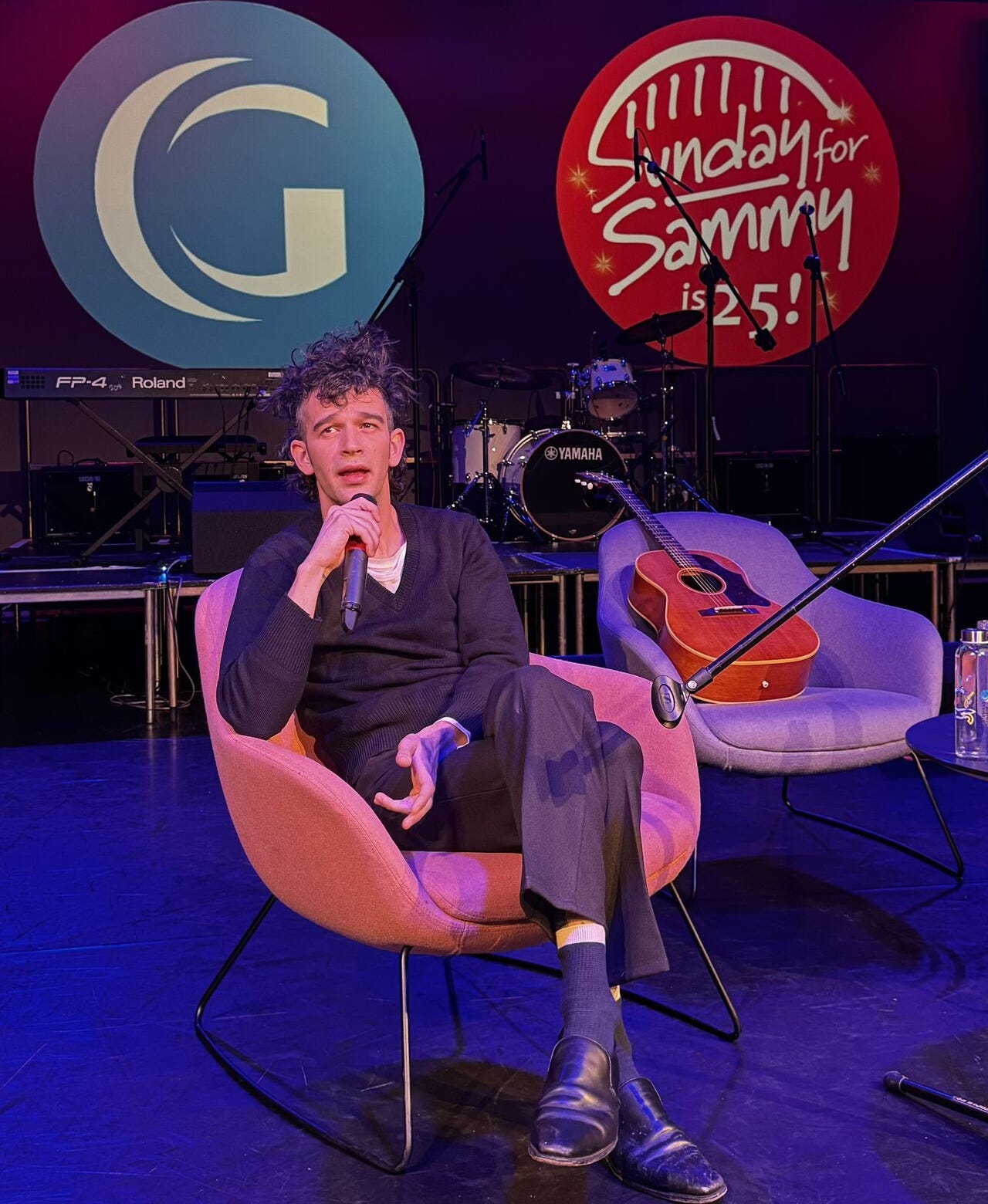
Matty Healy has announced he will take to the Sunday for Sammy stage in February 2026, performing at the beloved North East fundraising concert as it marks its 25th anniversary, writes Sam Wonfor.
The frontman of The 1975 revealed the news during a surprise appearance at Gateshead College on Tuesday morning, where students from the music, performing arts and media courses had gathered expecting a Zoom call – only for Matty to walk on stage in person, flanked by his dad, actor Tim Healy, and Sunday for Sammy producer and Lindisfarne legend Ray Laidlaw.
The gig, affectionately known as the Geordie Command Performance, returns to Newcastle’s Utilita Arena next year for its first outing since 2020. For Brit and Ivor Novello award winner Matty, who grew up steeped in the charity his dad co-founded, the moment marks a homecoming.
Once the surprise had landed and the cheers had settled, Tim and Ray took seats in the audience to leave Matty to take part in an in-conversation-cum-masterclass that veered between creative insight, song-writing demonstration, and a mini jam session with five students who probably thought they were in a collective fever dream.
Nadine Hudspeth, the college’s director of brand and learner experience, said on her LinkedIn: “It wasn’t the celebrity factor that stood out, it was his honesty, generosity and the reminder of why opportunities like this genuinely matter for young people. Safe to say our students (and staff ) will not forget it.”
Look what’s in store

We hear too many stories about bank closures, but Metro Bank has opened its first North East branch - although they seem to prefer to call it a store.
The bank has a strategy to expand its presence in communities across the country. Metro Bank Gateshead, based in Retail World Team Valley, opened on Friday and is the bank’s 78th ‘store’.
North East Local Director Kristi Capaldi-Brown said: “As someone born and raised in the North East, it makes me incredibly proud that Metro Bank now has a physical presence here. Our relationship-led approach to banking is at the heart of what we do and I’m looking forward to working with local businesses of all sizes.”
‘Get tough on criminal landlords’
Councils and police forces are failing to crack down on criminal landlords operating at the margins of the private rented sector, according to research involving a criminology expert from Northumbria University.
The research found that civil penalties are quicker and have high fines, but criminal prosecutions, which are required to secure banning orders to force criminal landlords out of the market, are too slow, under-resourced and often result in minimal penalties.
In some cases, landlords convicted of illegal eviction were fined as little as £100. And there have been times when the police have inadvertently assisted unlawful evictions due to unclear procedures and lack of collaboration and oversight.
Georgios Antonopoulos, Professor of Criminology at Northumbria University, said: “This research demonstrates that the current system enables criminality.” He said multiple weak points allow offences to go unpunished, including informal letting arrangements, lack of enforcement, and minimal penalties.
Homecoming
Trevor Horn has always been a man ahead of his time. Video Killed The Radio Star was the first video to be broadcast on MTV. After The Buggles, he became a sought-after music producer, working with the likes of Frankie Goes to Hollywood, ABC and Seal.
Horn, born in Hetton-le-Hole, near Durham, in 1949, will be performing at Newcastle’s O2 City Hall on December 18 and has invited players from local group The Welfare Collective to join him.
The band members grew up in Hetton-le-Hole and were taught music by trombonist David Smith’s mum at Hetton Lyons Primary School. He said: “It’s a venue we never dreamt we’d play. We’re buzzing. Any other plans have been cancelled - someone was supposed to be working in Manchester, others have a wedding that day but are coming back for the concert.”