

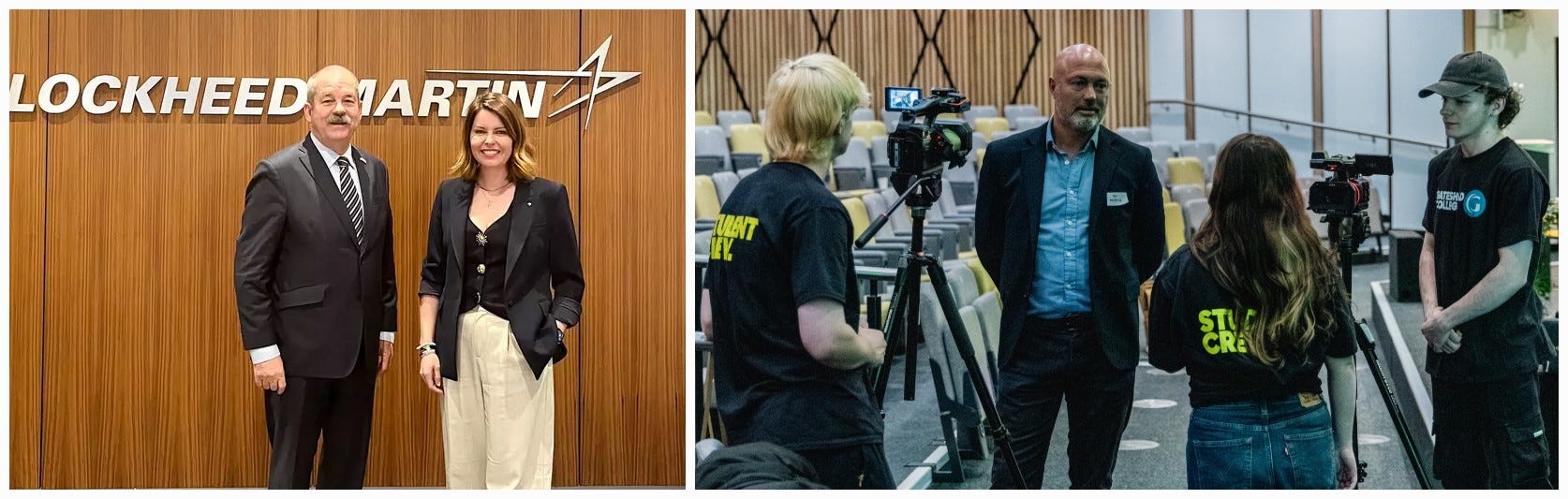
There’s a two-horse race to decide who will build the UK’s next generation of military satellites. US giant Lockheed Martin was the favourite, meaning 500 jobs would be created in the North East.
The finishing line is fast approaching and Prime Minister Andy Burnham is coming under increasing pressure to back against the favourite.
The Government’s Local News Fund has just handed out £6m to 50 organisations to preserve high-quality local journalism - not that it will have much of an impact here in the North East.
Thankfully Tier One Capital boss Ian McElroy is on hand to champion The Source and issue a rallying cry to the region’s businesses to get behind us.
The British-born “godfather of AI” is warning that the technology is “hurtling out of control”. We also have a recommended (long) read on a multi-millionare whose life began in the coalfields of County Durham and who is still creating controversy at the age of 92.
On the offensive

The headline above is from The Telegraph on Friday. The ‘American bid’ would potentially see 500 quality jobs created in the North East, at NETPark in County Durham to be more specific.
The Ministry of Defence launched a competition in 2019 to develop a new generation of satellites, known as Skynet 6, to serve the Armed Forces into the 2040s. The deal matters because Skynet is the lynchpin of British military communications, The Telegraph reports. Two companies are in the running in a process which has ignited a storm of controversy.
In one corner is Anglo-European company Airbus UK which manufactures the current Skynet satellites in Stevenage and employs 600 people. It has the backing of Unite the union with general secretary Sharon Graham saying: “We should not be handing Britain’s satellites to an American contractor in exchange for promises of a few jobs down the line and putting existing jobs at risk.”
In the other corner is Lockheed Martin which insists its satellites would be designed and built in the UK and fully sovereign. The company argues its proposed factory in Sedgefield will bring much-needed jobs and investment to a region that is a rising star in advanced manufacturing but receives a paltry share of defence spending compared with the wealthier South East.
Lockheed has also helped to establish the North East Space Skills and Technology Centre in partnership with Northumbria University and the UK Space Agency, contributing £15m of a £50m investment during a 10-year period.
North East Mayor Kim McGuinness and regional Labour politicians are supportive of the Lockheed bid and Defence Digital, the MoD arm that manages Skynet, is understood to have recommended it.
But Downing Street is now said to be reconsidering that decision, amid warnings that ditching Airbus UK will jeopardise both British sovereignty and jobs in a sector vital to modern warfare.
The quality question
Fifty organisations are benefitting from the Government’s £6 million Local News Fund, helping to “ensure people can continue to benefit from trusted, high-quality local journalism”.
Hmm. Remember the words ‘high-quality local journalism’.
I’ve already said that The Source was unsuccesful in its bid for a modest amount of money to fund the hiring of a reporter who would specialise in public benefit journalism. Before I go on, I want to make clear that no grapes were soured in the writing of this article.
What is clear is that the North East did not do very well in this funding round. Eight of the awards went to London. Only one purely North East project received any money. So, congratulations to Sarah Hartley and the Northern Eco.
“It’s a real game-changer for our small independent news organisation which started three years ago to showcase environmental issues across the North East and North Yorkshire,” she said. “We’ll be using the funding to develop a new technology called ParishPot to help local campaigns raise funds whenever they are featured on our website or newsletter. Once developed, the technology can then also be used by other local news publishers and so give a wider boost to the local news ecosystem - we want to keep local giving, local.”
A worthy project which will undercut the likes of Just Giving - but, with the best will in the world, nothing to do with ‘high-quality local journalism’.
Firefly New Media received the maximum award of £125,000. This is a company that has 172 free online local magazines in the UK, Poland and Ireland. Founder and CEO Barrington Kirkham launched Consett Magazine 14 years ago and the company operates from a base in Derwentside Business Centre at Consett Business Park.
“We work with clients across the UK and internationally, helping them with websites, branding, marketing, consultancy and digital publishing,” he says on his LinkedIn. “Our aim is to help residents, charities, community groups, businesses and PR teams share meaningful stories, while giving local editors better tools to discover, verify and publish them.”
A worthy project - but, with the best will in the world, nothing to do with ‘high-quality local journalism’.
The Spectator yesterday questioned the two awards totalling more than £260,000 to Bylines Networks, an organisation which runs 10 citizen journalism sites in the UK, including North East Bylines. That criticism was obviously politically motivated, given Bylines Networks association with the Byline Times, but it highlighted the reward for an organisation that, for obvious reasons, is not structured to provide ‘high-quality local journalism’.
There were three other awards that had a local connection:
Newcastle-based Living North, which also publishes magazines in Yorkshire and the North West, received funding to recruit a Head of Digital Growth, Digital Sales Lead and an Audience and Newsletter Manager, as well as funding core technology to improve digital services and subscription rates.
The Lead Newspapers, whose online titles include the Teesside Lead, can build their audience and subscriber base by hiring a distribution editor, running live events, producing pop up print editions and hiring a visual storytelling editor.
Local TV Ltd can fund a video journalism training programme for working journalists, journalism graduates and young people not in education, employment or training and several centres including Sunderland University.
The five grand challenge
We failed to attract the support of the Local News Fund judges, but maybe we should have entrusted our application to Ian McElroy chief executive of Tier One Capital.
He took part in the Q&A at the end of our launch event for The Source a few weeks ago, hosted by my good self, Steph McGovern and Simon Rushworth.
“I think you guys are fantastic,” he said (completely unprompted!). “If we really cared about making a difference, most people in this room would be subscribers already, and they’re not. I think they should be so, there has to be a level of accountability held towards all of us and in particular business owners.
“I think people in business in our region need to do more and I think we need to do that with an angle of not making money but to help you guys drive something that raises awareness of the region and holds our region to account.
“My suggestion, rather than a question, is I think you need to identify 10 businesses who will give you five grand a year. If you are prepared to do that, I’ll be the first one.”
You can hear him in all his glory here…
Accelerating growth
Four North East production companies have each been awarded £100,000 to develop new digital entertainment projects as part of an initiative designed to help the region’s screen industry reach new audiences.
The £400,000 investment from the BBC and North East Screen will support ideas ranging from globe-trotting adventures and competitive arm-wrestling to practical DIY advice, health information and a new YouTube entertainment channel.
County Durham-based Adventure Alliance Films, Gateshead’s FilmNova, Newcastle’s Northern Child and Middlesbrough’s Wander Films have been selected for the next stage of the Digital Accelerator programme following a competitive process, which began a year ago at a packed out event at ARC Stockton.
The initiative is responding to a shift in how audiences, particularly younger viewers, discover and consume entertainment, with platforms such as YouTube and TikTok creating opportunities for production companies beyond traditional television commissioning. Cultured. North East has more here.
Recommended reads

Geoffrey Hinton, the British-born “godfather of AI”, warns that the technology is “hurtling out of control”. In comments published by The i Paper, the Nobel laureate says the global race for AI dominance has put the “future of humanity on the line”. He says letting five US companies dominate is “particularly dangerous because of the characters of some of the people, like Altman and Musk and Zuckerberg”, adding: “I wouldn’t buy a used car from any of them.”
Hinton, 78, quit a role at Google in 2023 in order to speak freely about the dangers of AI. He invented the concept of the neural network – the system underpinning AI models. He was in London to deliver one of his starkest warnings yet, at the premiere of a new documentary, AI: Probably Nothing To Worry About. The film airs on Channel 4 tomorrow at 10pm.
You can read his candid, startling views on the future of AI here – both the dangers and opportunities.
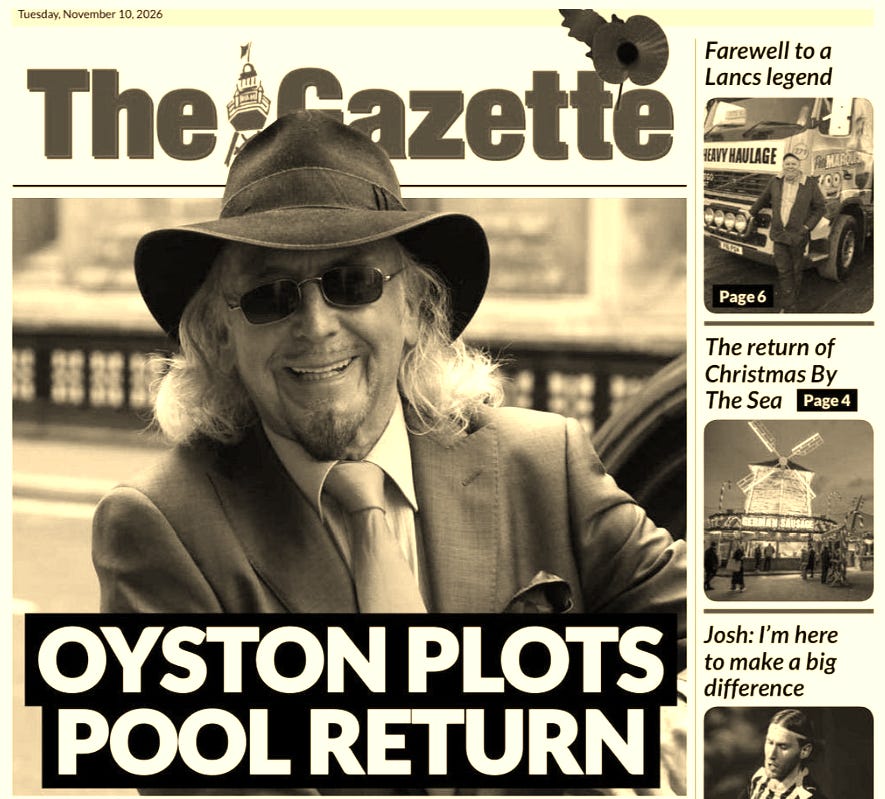
Every so often I come across a story that makes me go ‘wow’. This is one such story - a mesmering piece of writing and reporting from The Fence. It begins in the fields and coalpits of County Durham but is very much centred in Lancashire.
Ten decades have afforded the controversial Owen Oyston a remarkable CV: a miner’s son turned actor turned multi-millionaire; a property baron whose family landholdings march alongside the King’s and the Duke of Westminster’s; a grandfather and a great-grandfather; an avowed socialist and the largest private funder of Neil Kinnock’s Labour Party; a media maverick who invested in a left-wing national newspaper and tried to buy Manchester United; a boyhood fan of Blackpool FC who eventually bought the club and turned its fans against him and his family; a serial and successful litigant who took a six-figure sum from the Sunday Times; the victim of a decades-long conspiracy by members of the local Conservative Party; a convicted rapist who spent three and a half years in prison on charges he still vehemently denies.
Oyston owned Blackpool FC for 32 years before being ousted by the club’s fans. At the age of 92 he’s looking to take it back - and hand over control to the fans. It’s a long read - but worth it.