


It’s not healthy
There’s ‘life expectancy’ and then there’s ‘healthy life expectancy’. The second gives a more comprehensive picture of the nation’s health than life expectancy, which only measures how long people live for.
The healthy life expectancy (HLE) metric involves quality, not just length, of life. The longer someone enjoys a life free of pain, surgery, medical attention and regular medication, the better their life.
The Health Foundation this week released their analysis of data from the Office of National Statistics (ONS) on this. As a country, our figures are not good - and they are shockingly bad in the North East where we have had the lowest healthy life expectancy at birth in every period since the ONS began capturing the stats.
The average woman in Richmond-upon-Thames can expect to live in good health for 70 years - in Hartlepool the figure is only 51. A difference of 19 years. That’s not right.
The UK’s healthy life expectancy has fallen, yes fallen, by two years in the past decade. Men are now expected to have 60.7 years in good health, while women are expected to have 60.9 - and in more than 90% of areas the HLE was below the state pension age.
Labour last year unveiled a 10-year health plan to both fix the NHS and improve the population’s health, especially through a “big shift” from treatment to prevention. It better get a shift on then.
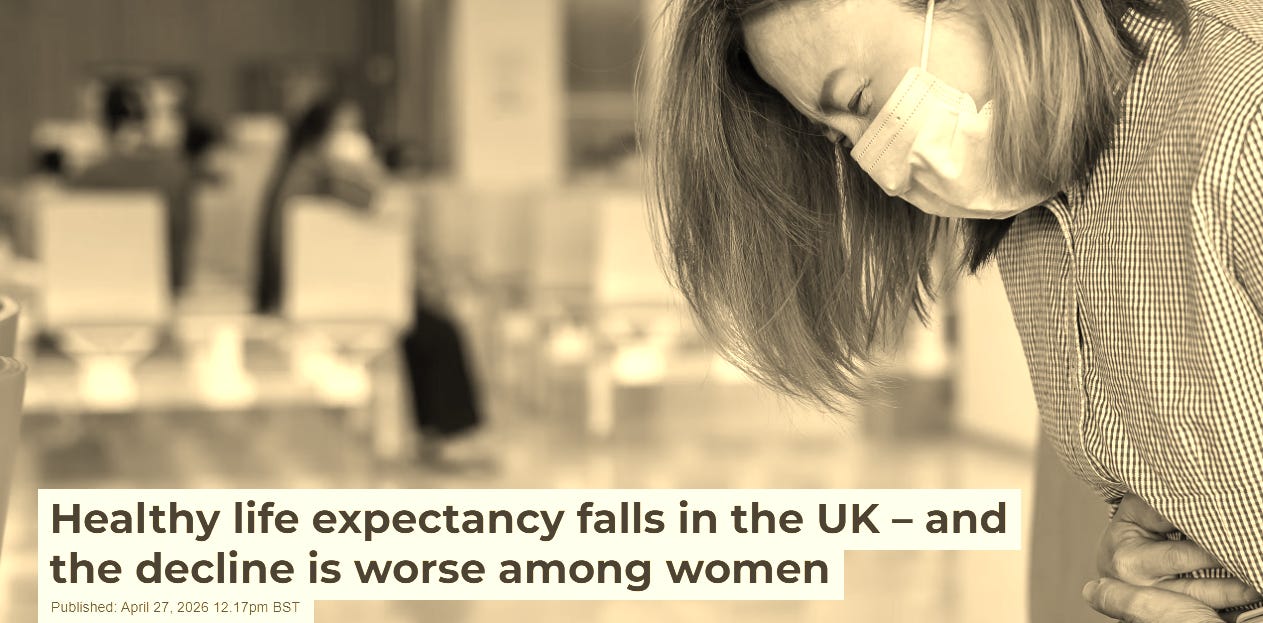
The Conversation has been taking a look at the healthy life expectancy figures, and why the decline is worse among women.
“Healthy life expectancy is not a measure of behaviour or individual lifestyle choices,” says author Philip Broadbent of Glasgow University. “It is the measurable end product of the cumulative conditions in which women grow up, work, give birth and grow old.
“The decline since 2012 maps, with depressing predictability, onto a decade of austerity, rising child poverty and stagnant real wages – pressures that fall hardest on the women already doing most of the unpaid work to hold their households together.”
Small, but big, change
One of the longest parliamentary sessions in modern history came to an end this week - 21 months during which time the Government has passed 60 laws. Not all of them got big headlines and we feature five that may have escaped your attention in The Wider View section at the end. Football, flights and pub extensions get a mention.
On Tuesday night, an amendment was made to the Pension Schemes Bill which means pension schemes can use investment companies to meet any requirement to invest in private assets such as infrastructure and private equity.
“I imagine most people have missed this story,” said Ian McElroy, chief executive of Tier One Capital, on his LinkedIn. “It could turn out to be one of the biggest generational decisions to benefit the UK’s regions in a long time.”
In case you missed his interview with Simon Rushworth in Eyes & Ears last month, where he argued that North East investments and pension contributions should be used to benefit the region, here it is again.

Public safety fears
Concerns about public safety have been raised following an inspection of Northumberland Fire and Rescue Service. It is another blow for the service which saw the chief and deputy leave their posts last year after a damning report identified a “culture of fear” at the organisation.
Urgent action has been ordered. New chief Keith Carruthers, who has only been in post a few weeks, said: “I want to take this opportunity to reassure residents and businesses that we are taking these findings seriously and that their safety is at the forefront of all we do.”
Talking of fire chiefs…
Cleveland’s chief fire officer Peter Rickard has been on parental leave but his absence is being continued pending the outcome of a third party investigation - into what we are not being told.
If this sounds familiar it’s because this is the second independent investigation into an allegation or allegations made against him. In November last year it was announced that there was no evidence to support the allegation(s) and that the matter was closed.
Who cares?
Providing adult social care took up 45% of Newcastle City Council’s budget in 2024-25. Six years earlier the percentage figure was 36%, meaning the council has suffered the second highest proportional increase in the country, according to BBC analysis of data from the Ministry of Housing, Communities and Local Government.
You can see how this compares with other councils by using the BBC’s pulldown menu. It’s not pleasant reading for any of them.
If you add the cost of child social care to Newcastle then it meant that 69% of its total budget in 2024-25 was spent on the statutory provision of social care before it got round to emptying our bins, trying to keep our libraries and community centres open, maintaining our parks and all the other things we expect councils to do.
National Care Service anyone?

Rebel six
Half a dozen North East Labour MPs were among the 15 who defied the Government on a vote on whether to refer Prime Minister Keir Starmer to the Privileges Committee over his handling of the appointment of Lord Peter Mandelson as US ambassador.
The six were: Mary Kelly Foy (City of Durham), Emma Lewell (South Shields), Andy McDonald (Middlesbrough and Thornaby East), Grahame Morris (Easington), Luke Myer (Middlesbrough South and East Cleveland), and Kate Osborne (Jarrow and Gateshead East). The motion, tabled by Conservative leader Kemi Badenoch, was defeated by 335 votes to 223.
South Shields MP Emma Lewell took part in the debate. She said: “Prior to this scandal, people criticised the Government’s policies and, at times, lack of political narrative, but they are now questioning the Government’s moral compass.”
‘Cloughie deserves better’
Cricketing legend Sir Geoff Boycott has called for the statue of his friend Brian Clough to be restored to its former glory. The seven-foot bronze statue in Middlesbrough’s Albert Park has suffered structural damage and been surrounded by steel fencing for four years.
The story prompted Tees Valley Mayor Ben Houchen to say: “Brian Clough is a Teesside legend. He deserves far better - and so do the people of Middlesbrough who pass it every week.
”Responsibility sits with Middlesbrough Council, but if there’s anything we can do to help get it sorted and properly restored, we’ll have those conversations. Cloughie should be celebrated with pride - not left behind barriers.”
Asterisks alert
Councillor Chris Jones has been censured by Redcar and Cleveland Council after various code of conduct breaches were upheld as a result of his role in an incident which happened when he was delayed by a bin lorry on his way to work.
Cameras on the truck showed the councillor swerving on to a grass verge to get past and hitting a wheelie bin which one of the refuse workers was pulling.
A TeessideLive report on the hearing had to use a lot of asterisks because of the colourful language involved.
One of the disputed facts was over when Councillor Jones let it be known that he was a councillor. In his defence, he said it was only after he was told to f*** off, and he had replied with words to the effect of ‘It’s f*** off councillor to you’.
The panel considered that, in either scenario, Councillor Jones’ reference to his official capacity would be perceived as an indication of seniority over the complainant, made with an intention to influence their actions.
From Sunderland to New York
Last April Public Record was staged at The Fire Station in Sunderland. It was a National Theatre Public Arts production with Sunderland Culture and the Sunderland Empire - 100 people coming together to put on a celebratory show about Sunderland’s people, music and identity, told through a live album recording.
Now directors Dan Canham and Emily Lim are taking their community-driven production to The Public Theater in New York this summer
Theatre director Marie Nixon said on her LinkedIn: “Inordinately proud of this project and the amazing work of the Sunderland Empire and Sunderland Culture teams who worked with such diligence, passion and joy originating this project with the brilliant National Theatre team.
“This is the quality, reach and significance of performing arts work originating in Sunderland.”
A quick word
The cost of using the Tyne Tunnel has gone up by between 10p and 20p from today - cars and vans will pay £2.60 instead of £2.50 - with operator TT2 saying the increase is needed to cover increased costs. A primary school assistant head from Teesside has been banned from the profession for life after she hid her relationship with a convicted child sex offender. Manchester-based social research consultancy RISE Associates is opening a North East office which is being headed up by director Chris McHugh. Sunderland-born civil engineer Professor Tony Ridley, the man hailed as the mastermind of the Tyne and Wear Metro, has died aged 92. He later became the first MD of the Hong Kong Metro and then managed the London Underground. A derelict council house in Middlesbrough that was sold for £2,000 has been turned into affordable apartments for artists by the not-for-profit Creative Factory. Dominic Simpson, Assistant Professor of Nursing at Northumbria’s School of Healthcare and Nursing Sciences, has been named Nurse Educator of the Year at the prestigious British Journal of Nursing Awards 2026.
‘Save the bridge’
The Victorian Society is calling for a co-ordinated national response to secure the future of the Transporter Bridge over the Tees after naming it one of their top ten endangered buildings of 2026.
Actor and comedian Griff Rhys Jones, who is president of the Victorian Society, said: “Got to be saved. Got to be operational again. If we can find money for new bridges, we can find money for this great survivor and all that it means.”
Business bites
More than 130 jobs have been saved and another 70 will be created after the sale of the former Venator titanium dioxide pigment plant at Greatham, along with a technical centre at Wynyard, were sold to Chinese company LB Group. Northumbrian Water has become the first water company in the world to be globally certified with a BSI Kitemark for innovation management. Head of innovation Angela MacOscar said: “The Kitemark accreditation recognises that innovation here isn’t ad-hoc, it’s actually built into how we operate as a business. It gives our customers, partners and regulators confidence that we have a consistent, mature approach to developing and delivering innovation that makes a real difference.” Steel Benders UK is relocating from Middlesbrough to a new 40,000 sq ft Hartlepool plant, doubling capacity and adding at least 15 jobs. The project is funded jointly by the Teesside Flexible Investment Fund and the company’s own capital investment. The competition watchdog has now cleared the acquisitions by Hays Travel of Polka Dot Travel and Millington Travel that were announced in February. Hellens Group has secured permission for a huge employment development at Queens Meadow Business Park in Hartlepool. Cramlington air filter maker AAF has reported a dip in turnover and profit as a result of the global economy and the rise of alternative energy sources. Durham-based EMG Solicitors and Kent firm JE Bennett Law are to join clinical negligence and personal injury law specialist Fletchers Group in a move which will create one of the largest court of protection practices in the UK. The combined practice will operate under the EMG brand. Tech firm Mobile Rocket, which develops digital recruitment platforms, is set to take off from its Newton Aycliffe base by investing a five-figure sum to establish a presence in the US and Netherlands.

Tyneside-based gambling machine and pool tables specialist Bob Rudd has joined forces with South East-based counterpart SX Leisure for a large contract to supply 1,000 pubs across the country - and create 40 jobs. Sales have dipped at Stokesley-headquartered Quorn Foods but bosses say their turnaround plan is on track. A 17-strong business board, chaired by Matthew Ord, has been approved by the Tees Valley Combined Authority. You can see them all here. Sunderland-based domestic appliance repair company Pacifica has bought the Repaircare business from Screwfix Spares, and will take on all its client contracts and operational activities. Construction firm Glencar has completed a large £20.5m development in Chester-le-Street which will become Bidfood’s North East distribution centre. Newcastle-based iamproperty, the UK's largest residential property auctioneer, has launched a recruitment drive for 25 auction specialist to expand staff numbers to 200 by 2027 amid surging demand.
1995 ad break
I did a double take when I heard the words ‘Diet Coke break’ coming from my TV this week. Turns out that there has been a reboot of the iconic ad from the 90s, this time featuring Meryl Streep and Emily Blunt from The Devil Wears Prada 2.
This gives me the perfect excuse to bring you the original from 1995 - a groundbreaking ad because it was one of the first to flip gender roles and show women gathering at the office window at 11.30 to have a good ogle at a shirtless worker who was having a wee refreshment.
I am open to requests when it comes to these old ads and I can now cross this one off the list supplied to me by a lady I know.
THE WIDER VIEW

You may have missed…
A 21-month legislative marathon ended this week after one of the longest parliamentary sessions in modern history.
Around 60 laws were passed. Most of the headlines went to the big-ticket items: the end of no-fault evictions, rail renationalisation, and the scrapping of the two-child benefit limit. But buried in that pile of legislation are laws that could affect how safe you are at a concert, whether your football club survives, and how much your flights cost.
Eleanor Langford, political reporter at The i Paper, selected five laws that received far less coverage - but could still have an impact on your daily life:
Terrorism (Protection of Premises) Act 2025: This is also known as Martyn’s Law, named after Martyn Hett, a victim of the 2017 Manchester Arena bombing. It requires every large venue and event in the UK - stadiums, arenas, festivals - to have a formal terrorism security plan in place, with trained staff.
Football Governance Act 2025: A new Independent Football Regulator now exists. It has the power to license professional clubs in England and oversee their financial sustainability - meaning clubs can no longer run up unsustainable debts without scrutiny. For fans who have watched clubs come close to collapse in recent years, it is a significant shift in how the game is governed.
Sustainable Aviation Fuel Act 2026: Airlines operating at UK airports must now blend an increasing proportion of sustainable aviation fuel - made from waste materials rather than fossil fuels - into their supply. The share will rise over time. The Government says it will cut aviation emissions, but airlines and industry groups have warned it could add to the cost of flights in the short term.
House of Lords (Hereditary Peers) Act 2026: The last 92 hereditary peers - Lords who sat in Parliament purely because of the family they were born into - have been removed from the House of Lords. The Lords now consists entirely of appointed life peers, bishops, and senior judges.
Licensing Hours Extensions Act 2026: Ministers can now extend pub and bar opening hours for specific national occasions such as major sporting events or royal occasions, without needing new legislation each time. The power already existed in a limited form but has been broadened. If England were to reach the World Cup final this summer, for instance, expect late-night extensions to follow automatically.
Thought for the day

Let them eat venison
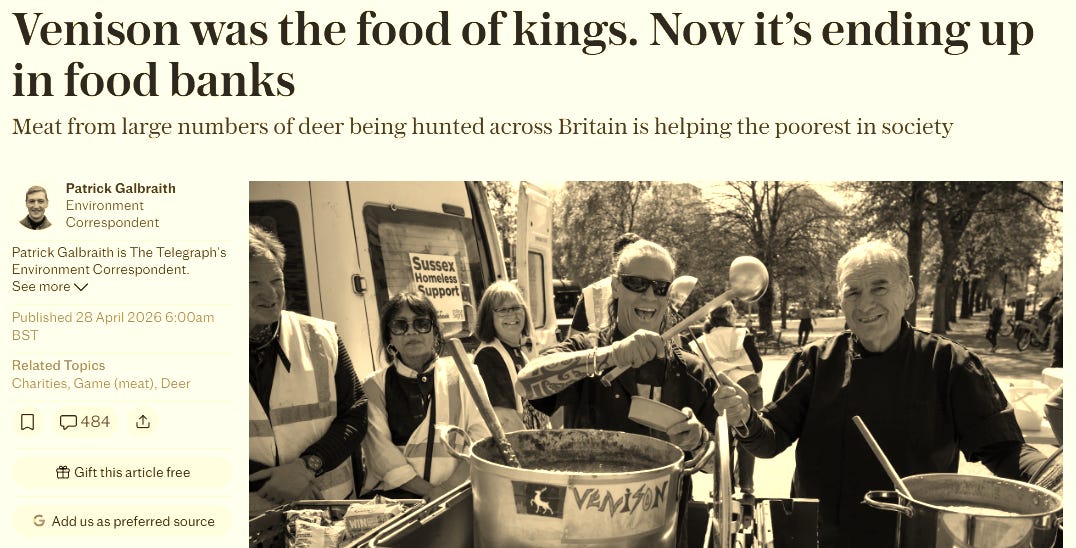
Interesting, if scarcely believable, story in the Telegraph about the growing deer population and the damage they are doing to our woodlands. Farmers are not too happy with them either, apparently.
Culling is one solution. That means Britain must now decide what to do with all the meat. The Country Food Trust, which was founded in 2015, believes it has a solution. It is working with estates, gamekeepers and farmers to funnel venison into food banks.
Earlier this year, the Trust partnered with land managers in Sussex who culled 884 fallow deer. This resulted in 170,000 individual venison meals – in the form of pre-made bolognese – being sent to 69 food banks and community kitchens.