


Bank on £6 billion
The world’s largest wind farm is just 80 miles off the North East coast and will pump more than £6 billion into the UK economy over the next three decades, according to an independent report published yesterday.
Spending in the North East, North Yorkshire and East Riding alone is expected to top £3 billion and by next year Dogger Bank is forecast to support 3,600 full-time jobs across the UK, including 1,500 in the North East and Yorkshire.
The economic impact study by BVG Associates was commissioned by lead operator Equinor, SSE Renewables and Vårgrønn. It says the wind farm will have 277 turbines and will deliver massive economic value through investment in British companies, skills and supply chains.
Dogger Bank, operated from a state-of-the-art facility at Port of Tyne as well as bases at Redcar and Beverley, has pledged £26m for local community investment — funding STEM education and grassroots projects. So far, 123 scholarships have been awarded to students across South Tyneside, East Riding, and Redcar and Cleveland.
Generation game

Eyes & Ears began life as a column in the weekly online news magazine The QT. The very first issue, on February 7, 2024, featured a fascinating article on Dogger Bank, including an interview with operations director Mark Halliday from Peterlee.
His father Billy was a miner at Easington Colliery in County Durham and dreamed of a future where his son would not have to follow him down the pits. He needn’t have worried.
“I spent six years in manufacturing before realising that the renewable energy industry was growing, and I wanted to be part of it,” Mark told QT contributor Graeme Anderson
“There’s no doubt it’s the future and hopefully a large part of the future of the North East. My father worked in the mining industry, and I work in the renewables industry, so you could say there’s that transition in just one generation of my family, but it is similar to what the country as a whole has been going on for some time now.”
The QT article contained some stunning stats.
When fully operational, Dogger Bank will technically be able to keep the lights on in every single home in Scotland and Wales AND still have the power to light up the North East.
The turbines themselves stand 260 metres tall, or 13 times the height of the Angel of the North. And there will be 277 of them, spread out across 600 square km of the North Sea, or, for the sake of a final comparison, roughly the area of Greater London.

You can read The QT article ‘Winds of change’ by clicking here.
Joined up thinking
Improving and joining up existing transport networks in the six largest English cities outside London could unlock £17 billion in annual economic output, according to the think tank Centre for Cities.
Their report ‘Integrated transport: The size of the prize for mayors’ estimates that plans to make buses more frequent and line up better with rail or Metro timetables could add £1.8bn a year to the North East economy.
The research recommends that the Government gives mayors extra powers, including control over commuter railway lines and the ability to levy taxes to top-up transport funding.
Not surprisingly, North East mayor Kim McGuinness likes the report. “I made bringing buses back into public control a priority on my first day in office because I know that we need to provide an affordable, integrated transport network that works for local people,” she said.
“Doing so will transform public transport in the North East and help us connect more people to more opportunities. This important report from Centre for Cities shows just how big a difference that will make for local people and the public transport they rely on.”
Deprivation failure
More than nine years after Tees Valley voted for the supposed benefits of Brexit, more than eight after Lord Ben Houchen was elected Mayor of Tees Valley and over six since Boris Johnson promised to level up left-behind areas, Middlesbrough remains the local authority with the highest proportion of most deprived neighbourhoods in England.
Quite an opening paragraph from experienced journalist Peter Morris in his column for North East Bylines.
He goes on to say: “The relative position of Hartlepool, also part of Houchen’s domain, has actually worsened. It now has the third highest proportion of most deprived neighbourhoods compared with ninth most previously.
“Houchen’s abysmal failure to raise the relative prosperity of these two poverty-stricken boroughs after so many years in unchallenged control of Tees Valley Combined Authority (TVCA) and its three mayoral development corporations, is an indictment of his scandal-laden period in office,” he says.
Tees Valley is not the only part of the region to suffer high levels of deprivation, though overall it is the worst affected. The wider North East has 21.5% of its neighbourhoods among the most deprived, followed by 20.2% in the North West. In the East of England it is only 3.9%.
The regional picture is mixed. Northumberland, North Tyneside and South Tyneside improved their relative positions while County Durham, Newcastle, Sunderland and Gateshead moved in the wrong direction.
Peter points out that rural areas are under-represented among the most deprived neighbourhoods, with only 71 (1.3%) of the 5,554 rural neighbourhoods included in this category, compared with 11.7% of urban neighbourhoods.
“But County Durham is an exception,” he says. “Of the top 20 most deprived rural areas nationally, no fewer than eight are in County Durham, including the top three, which are around Peterlee, Horden and Shotton Colliery. There is also one most deprived rural neighbourhood each in Northumberland and Redcar & Cleveland.”
It’s not compensation
Battling Betty Brown, the oldest surviving victim of the Post Office Horizon scandal, has reached a settlement of around 95% of her original claim.
“I can settle up my affairs. I can turn the heating up full blast, and that will be wonderful,” the 92-year-old, who ran the Post Office in Annfield Plain in County Durham during the 90s and early 2000s, told the BBC’s Emma Simpson, who has been following Betty’s case.
Her settlement comes after it was confirmed that leading campaigner Sir Alan Bates had agreed to a multi-million pound settlement figure. “At last, after 26 years, they’ve recognised justice,” said Betty. “Pity they took so long.”
I’ve been careful not to call Betty’s pay-out ‘compensation’.
“This is a redress scheme,” she says. “They’ve only given us back what they took from us. We haven’t had a penny in compensation.”
Lower salaries = higher fees
Newcastle City’s Council’s legal department is expected to overrun its £1.7m budget by £800k thanks in no small part to a huge increase in claims over the state of its houses - rising from 50 a year to up to 80 a month.
The problem is made worse by an inability to retain and recruit lawyers - five of the six other North East councils are said to pay more than Newcastle - resulting in a reliance of more expensive locum solicitors and legal officers.
The council took back control of around 25,000 properties from Your Homes Newcastle last year and has since been ordered by regulators to sort out serious failings in the state of the properties.
Bridge ‘at risk’
Middlesbrough’s Transporter Bridge, which has been closed since 2019 over safety concerns, has been added to Historic England’s Heritage at Risk register.
The organisation said the addition of the bridge could help to “unlock funding from public bodies and private funders”, as was the case when Heighington, the world’s oldest railway station was added to the list last year.
Eleven sites have been taken off the list after Historic England awarded £744,514 in grants for repairs. These include Headland and Seaton Carew conservation areas, St Cuthbert’s Church in Darlington, and sections of the Stockton and Darlington railway.
Too much information
Newcastle City Council has refused an FOI request from independent councillor Jane Byrne asking for details of emails between the political leadership or directors and Newcastle United about Leazes Park since 2018.
It was denied on the grounds that it would take too long to go through the correspondence, she said.
The reply to Councillor Byrne said there were 31,680 potentially relevant emails which appeared in an initial search of its email system containing the terms ‘Newcastle United Football Club’ and ‘Leazes Park’ – and either the words “legal agreement”, “leasehold”, or “sale”.
The football club want to be able to increase the number of fans who can attend matches - and Leazes Park is next door to St James’ Park.
Air ambulance appeal
The Great North Air Ambulance Service (GNAAS) is looking to raise £2.5m for a deposit on a third helicopter as its current fleet comes to the end of its “economically viable life”.
Joe Garcia, CEO of the charity which has bases at Eaglescliffe in County Durham and Penrith in Cumbria, said having a third aircraft could mean “the difference between life and death” for patients.
Banks in firing line
The UK’s big banks are “drowning in cash” but have been allowed to close branches “with impunity”, said Blyth and Ashington MP Ian Lavery.
Speaking during Prime Minister’s Questions, he welcomed Labour’s manifesto commitment to open 350 new banking hubs by 2029, but called for urgent revision of the “quirky, almost bizarre” qualifying criteria.
Good call

Joanna Lewis has grown Newcastle-based Safecall into a company that provides confidential whistleblowing hotlines, reporting software, independent investigations, and training across the globe - supporting over 1,200 organisations in 130 countries.
Her achievements were recognised at an awards ceremony in London where she was crowned overall winner in the National Business Women’s Awards 2025 - she had earlier won the corporate leader and the Northern England categories.
“Being from the North East and having worked here for the majority of my career, the core values of resilience, ambition and creativity which are typical of so many people from the region, have definitely shaped my career,” she said. “I’m proud to lead a business that is so firmly rooted in the North East and makes an important and significant impact both nationally and internationally.”
On the right road
A machine that repairs potholes four times faster than normal methods - and at half the cost - has arrived in Gateshead. The Pothole Pro is a 3-in-1 machine which cuts, crops and cleans potholes in just eight minutes.
Councillor John McElroy, cabinet member for environment and transport, said: “This is a really exciting investment for us as we know it will make a huge difference to the condition of our roads and the speed that we can respond to any issues reported.”
In the fast lane
Nova Marketing, the company behind the Great North Run, posted a strong set of results for 2024 which saw turnover rise to £22.6m, pre-tax profit more than double to £3.61m and the Great Run events all sell out.
In addition, the directors said: “Our adventure division successfully delivered the 13 Valleys Ultra, which again saw increased demand in its second year, the Beyond Series of trail events was launched with events in Newcastle and London, and we also negotiated a deal to acquire and deliver the long-established Windermere Marathon.”
Film Nova also enjoyed a successful year and The Great Run Company formed a joint venture with UK Athletics and London Marathon Events to create Athletic Ventures, a vehicle to deliver elite athletics events - it has already secured the rights to deliver the European Athletics Championships in Birmingham next year.
‘Cutting-edge’ training
A North East education trust has launched its own training body with ambitions to create a national centre of excellence.
The Advance Learning Partnership, based in Spennymoor, has created the ALP Institute of Teaching, Leadership and Research in a strategic partnership with Evidence Based Education (EBE).
The institute has been welcomed as a “cutting-edge investment with the potential to lead the way across the country” by Professor Rob Coe, director of research and development at EBE.
Founded in 2015, EBE employs 22 people from its Sunderland base, and offers innovative teacher professional development and school improvement tools through its Great Teaching Toolkit, which has become an international training resource.
A quick word
Stockton Arc hosted the launch of Digital Accelerator, a pioneering nine-month initiative from the BBC and North East Screen designed to supercharge the digital ambitions of production companies and help them create youth-focussed content. Newton Aycliffe and Spennymoor MP Alan Strickland has made a Commons call for the Stockton and Darlington Railway to be recognised as a UNESCO World Heritage site. Teesside University has begun the search for a vice-chancellor and chief executive to replace Professor Paul Croney who is to retire in August next year. Deputy leader Richard Wearmouth says Northumberland County Council is opposed to reintroducing lynx to the county despite the success of a scheme in Kent. Plans for the first phase of enabling works at a building earmarked for a new glassmaking hub in Sunderland have been officially submitted by the city council to its own planning department. The only hand-built, full-size reproduction Spitfire MK IX will feature on the route of Durham City’s annual Remembrance Parade on Sunday to mark the 80th anniversary of the end of World War Two and the 85th anniversary of the Battle of Britain. Jo Agger has stepped down from her role as director of Stockton Globe with head of operations Peter Savage stepping up as acting general manager. Northumberland councillors have made renewed calls to dual the AI after hearing it was being closed on “almost a weekly basis” due to accidents.
A window in time
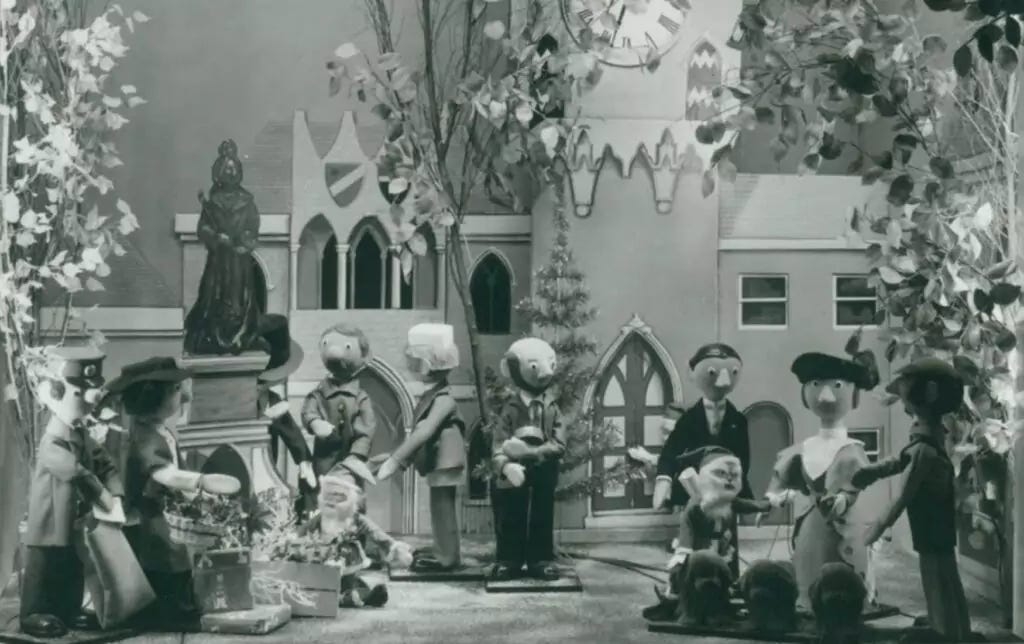
A Christmas Carol is the subject of this year’s window display at Fenwick, featuring traditional scenes from the Charles Dickens novel.
It was 54 years ago that Fenwick first devoted their entire window display in Newcastle’s Northumberland Street to a themed Christmas display - a festive animation featuring Windy Miller and the gang from Camberwick Green.
A tradition was born, and online magazine High Life North has been taking a look at the Christmas window displays through the ages, including a full listing of every theme since Camberwick Green in 1971.
I moved to the North East in 2003 when the display was Santa’s Workshop.
Business briefs
Sam Clark was the only employee when he founded Test Driven Solutions during lockdown. Now his tech consultancy has160 staff across offices in Newcastle, Poland and Canada and has announced plans to launch bases in South America and Edinburgh. Billions Europe, the UK subsidiary of Chinese company LB Group, has agreed a deal to buy Venator Materials UK’s site at Greatham near Hartlepool. The 3,000 staff at defence firm Leonardo, which has a site in Newcastle, have called off strike action after receiving a new pay offer. Newcastle-based Kinewell has announced that Evolv Energies has chosen its inter-array cable layout optimisation software for a major European offshore wind project. Darlington Borough Council is set to transform land near the Faverdale Industrial Estate into a biodiversity net gain habitat bank, while keeping other parts available for potential business use.
THE WIDER VIEW

Pasta master
Some authors go to extraordinary lengths to research their stories for The Conversation. Andrea Scotti from Lund University visited circular particle accelerator and neutron facilities in the UK and France to study… spaghetti, and work out the perfect levels of water and salt to use when you cook it.
Seven grams of salt per litre is optimal, according to physics.
Grey hair and cancer
Grey hair is an inevitable hallmark of ageing. It’s a visual reminder of the passing years and all the bodily changes that accompany it. But emerging scientific research is challenging this simple narrative with a new study suggesting there’s a connection between greying hair and our body’s mechanisms that keep cancers at bay.
No trouble at Mill
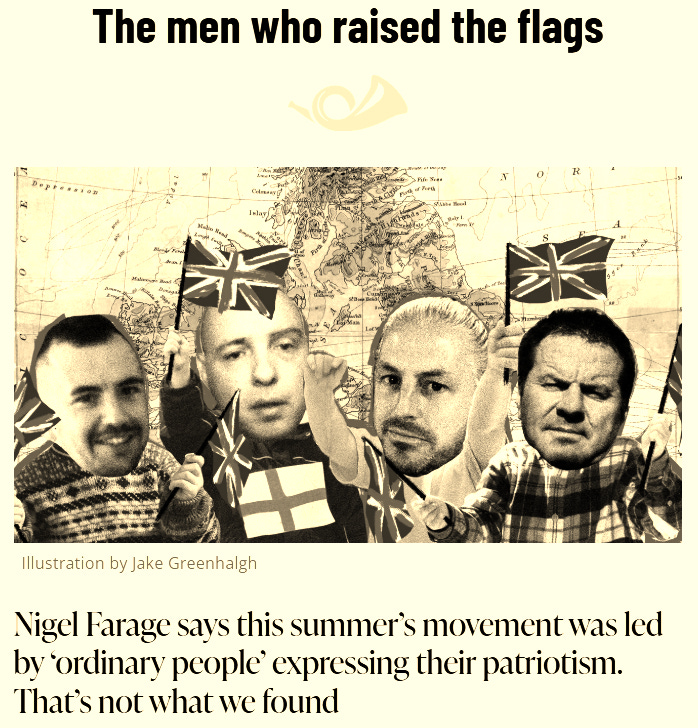
Here’s a fantastic piece of collaborative investigative reporting by the small (but growing) teams at the Mill Media titles in Manchester, Liverpool, Sheffield, Birmingham and Glasgow.
It pulls together the reporting they have done over the past few months on the ‘ordinary people’ who have been putting up flags in neighbourhoods up and down the country.
“Wherever we looked for the prominent flaggers and leaders of this movement, we found people smugglers and sex doll salesmen, people with dubious criminal pasts and people willing to put in a good word for Adolf Hitler.
“Farage told us the flag-raisers were just ordinary folk sticking it to the system. A few months worth of local journalism later, that now looks like a shaky claim.”
It’s a great piece of journalism - but if you don’t like swear words then you may have to give the first paragraph a miss! It’s anything but gratuitous though.
Mill Media was started as a one-man enterprise in Manchester in lockdown by Joshi Herrmann who believed that people would pay to read quality writing. He was right. Thanks to an ever increasing number of paid subscribers and investment from some high-profile individuals, his company now has six regional titles - The Londoner being the most recent.