

Where did we get the idea that data centres use up so much water? It’s a question that is posed and answered in today’s edition - with some thought-provoking stats provided by the people behind the giant data centre being built in Northumberland.
It’s difficult to keep North East Mayor Kim McGuinness out of our headlines given the importance of her role and the budget she has at her disposal.
She will be part of a Northern delegation heading off on a trade mission to India in the autumn. She has also announced a £7 million support package for businesses and £2.2 million for grassroots venues and emerging performers.
There’s also the small matter of a £100 million discrepancy in the region’s bus franchising plans.
Teesside MPs are toasting the Government’s decision to bring the steel industry under state control, John Cleese, of all people, has annoyed the organisers of the Durham Miners’ Gala and a council is backing the free school meals issue we highlighted last week.
Brian Aitken
Editor
Data centres and water
The headline grabbed my attention: ‘Data centres don’t use that much water’. Well, that’s not right, was my immediate thought. Everyone knows they do.
We’ve got soaring temperatures thanks to global warming, a record number of wildfires, hosepipe bans and increasing warnings that we need to conserve water supplies. AI data centres would be an attractive proposition - if they didn’t guzzle so much of our increasingly precious water supplies.
Wrong, says Sky News technology correspondent Rowland Manthorpe.
His investigation shows that our misconceptions are based on US statistics and that UK data centres use roughly the same amount of water as the postal sector and far less than food manufacturing or sports facilities.
“Did you know that hospitals use a TON of water,” he says. “Hand-washing, toilets, kitchens, cleaning, sterilisation, surgical scrubbing, laundry, cooling, dialysis – it all adds up. One of those big data centres uses as much water as a medium-to-large specialist hospital; or, if you must, the daily household water use of a town of about 1,200 people.”
So why do people think data centres consume so much water? Because the reporting often uses numbers that sound big but aren’t, he says. The BBC ran a story saying Scottish data centres used enough water to fill 27 million bottles a year. Further down the article it became clear that this huge number of bottles was 0.005% of Scotland’s supply.
A case in point

A massive data centre is planned at Cambois in Northumberland where Britishvolt were planning a gigafactory.
QTS, owned by Blackstone, one of the world’s biggest investment companies, is redeveloping the site of the former Blyth Power Station to build one of Europe’s largest AI and cloud data centre campuses.
The company uses what is called a closed-loop cooling system which means that, once operational, it will only use mains water for standard building needs such as toilets, kitchens, cleaning and humidification.
The graphic above is obviously American because we have centres and not centers and I’m not aware we have any almond farms in this country. But the chart compares annual water consumption on 8.6 acres of land across various industries.
A QTS spokesperson told me: “In 2025 alone, the QTS closed-loop cooling system saved an estimated 28 billion litres of water worldwide when compared to evaporative cooling. We are proud to be leading the way in developing solutions that conserve water while enabling the digital future.”
India trade mission
A group of Northern political and business leaders are to go on a five-day trade mission to India in the autumn.
Travelling under The Great North brand, the delegation will promote the North’s economic strengths in advanced manufacturing, life sciences, and clean energy. The visit, on October 12-16, will also focus on fostering collaboration in digital technology, financial services, creative industries and tourism.
The trade mission comes as the historic UK-India Free Trade Agreement comes into force, projected to boost annual bilateral trade by £25.5 billion by 2040.
North East Mayor Kim McGuinness, who is also chair of The Great North, said: “The Great North was created to do something the North of England has rarely had the opportunity to do before: come together with a single voice and tell our story to the world. This mission to India is a powerful example of that vision in action.”
The delegation will include civic and business leaders, academics, and regional partners from Liverpool City Region, West Yorkshire, South Yorkshire, York and North Yorkshire, the North East, and Cheshire and Warrington. It will be supported by the Department for Business and Trade and the Foreign, Commonwealth and Development Office.
Steely determination
Teesside MPs have welcomed the Government’s announcement that British Steel has been brought under public ownership.
Redcar MP Anna Turley said: “Having witnessed the loss of steelmaking in Redcar, no community understands the consequences of governments standing back and letting strategic industries disappear better than ours. I hope this gives workers at the Lackenby and Skinningrove sites greater confidence about the future and helps unlock further investment here on Teesside. I’ll continue working with ministers to ensure our area is at the heart of Britain’s industrial revival.”
Andy McDonald, MP for Middlesbrough & Thornaby East, praised the Government’s decision that he said “will bring security and protection for thousands of jobs in the industry” across the UK. “This is deeply personal for us on Teesside where steel built towns, livelihoods and identities from the early 19th Century onwards.”
More please
Durham County Council is to write to Education Secretary Bridget Phillipson calling on the Government to widen eligibility for the Holiday Activities and Food Programme (HAF). This was the issue raised by Professor Greta Defeyter in last week’s edition (Eyes & Ears 10.07.26).
The Northumbria University professor, who is also Chair of Feeding Britain, highlighted the contradiction of 500,000 youngsters who are deemed poor enough to receive free school meals during term time but not during the holidays.

Democracy and hypocrisy
Durham’s decision on calling for the HAF scheme to be widened was contentious in more ways than one.
Lib Dem councillor Alex Neil supported the motion but accused the Reform administration of hypocrisy over previous decisions on council tax support. Then the Lib Dems accused Reform of “blocking and shutting down democratic debate” at what was the council’s final meeting in County Hall.
“Of five motions on notice, only Reform’s own motion, first on the agenda, was heard. The other four were kicked into the long grass until October,” said Lib Dem leader Amanda Hopgood. “This isn’t how local democracy is supposed to work. Residents deserve their elected representatives to have their voices heard, not silenced by a majority unwilling to sit and debate the issues that matter.”
£105m short
Auditors have said that the North East’s bus franchising plan did not take account of staffing costs over 30 years and would cost nearly £105 million more than expected. However accountants Grant Thornton said the additional expenditure did not change their conclusion that the scheme is affordable.
A spokesperson for the mayoral strategic authority described the extra staffing costs as a “small fraction” of the sums involved in the franchising calculations.
£7m business support
North East Mayor Kim McGuinness has announced a £7.1 million support package to help businesses manage rising costs, protect jobs and support future growth.
“When firms are facing rising costs, it has a direct impact on jobs, and it makes it harder to make ends meet,” the mayor said. “With government also setting out new support to improve access to finance for small businesses, we want to make sure North East firms are in the strongest possible position to benefit.”
The investment marks the start of a wider programme to reshape business support, with the North East Mayoral Strategic Authority (North East MSA) working alongside the region’s seven local authorities to provide tailored, locally-delivered services that are easier for businesses to access and better connected to national funding opportunities.
Strife of Brian
John Cleese has angered organisers of the Durham Miners’ Gala. The comedian reposted footage on Twitter of a pro-Palestine delegation and said: “If this scene had been in Monty Python, nobody would have thought it out of place.”
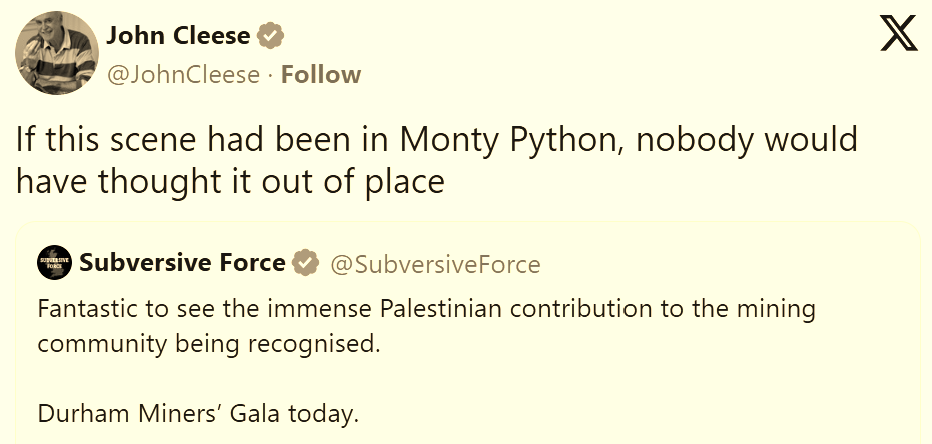
Alan Mardghum, secretary of the Durham Miners’ Association, said: “He has a lot of fame and influence over people and comments like that are totally out of order. The Durham Miners’ Gala has a very long history of international solidarity. They need to read their history and talk to people who have been involved for many, many years before they make comments like that.”
For the record
I’m not going to name names and I really don’t know how widespread this is, but I received an email this week which said: “I just wanted to check in on the below release and see if there is any additional information I can provide for this release to be of interest? If possible, it would also be good to know if there are any fees associated with news placements and how much it would be to appear online and socials please.”
For the record, the only payments I want to receive are from satisfied readers who think that the quality content I am providing twice a week is value for a £6.99 a month subscription.
A quick word
Durham, Newcastle and Northumbria are among the 35 universities who have joined the new Defence Universities Alliance, which aims to bring together defence and academia to strengthen research, develop critical skills and build the skilled workforce needed to support the UK’s future defence capability. Newcastle councillor Amy Hunter has resigned. Reform UK said that her health, personal and work commitments had “changed abruptly”. The Lib Dems are running a minority administration with 25 of the 78 seats. Reform and the Greens now have 23 each. Complaints about councillors in County Durham increased by 336% to 288 in the past year. However, a new report says only 30% engaged the council’s code of conduct, meaning the majority did not meet the threshold for further action. Nearly 100 sculptures of Peter Rabbit have appeared in Newcastle and North Tyneside – the fourth interactive public art trail run as a fundraising initiative by St Oswald’s Hospice since their successful Great North Snowdogs in 2016. Northumberland National Park has secured £20,000 from the National Lottery Community Fund to recruit and train more volunteers. The former Debenhams store in Sunderland could be turned into an entertainment centre with go-kart tracks, bowling lanes, an arcade and restaurant areas. Plans to stop paying volunteer coastguards have been dropped by the government over fears officers would quit or reduce their hours. The volunteers can claim about £11 an hour for callouts. Cleveland Police said the number of people injured by “dangerous dogs” has more than doubled in the last five years with 533 in the past year when 137 dogs were seized. Durham Police has received the highest grade possible in a new performance system. Being rated Level One means Durham is among those encouraged to share their experiences of good practice with other forces nationally.
Small - but thinking big

A new £2.2 million fund has been launched to help grassroots venues and emerging performers weather rising costs and continue nurturing regional talent.
The mayor’s Small Venues Fund was launched at an event in Sunderland last night and will offer grants ranging from £3,000 to £100,000 over a three-year period, supporting venues with a capacity of up to 300 seated or around 500 standing.
Generator CEO Mick Ross said: “Every headline artist, every award-winning comedian, every producer, technician and promoter starts somewhere. Grassroots venues are the R&D department of our creative industries. This fund is a landmark moment.”
Side dish
The treasure trove of North East documentary photographs and films known as the AmberSide Collection is to be given over to the custodianship of Newcastle University. It is part of a project called Relocating Amber, for which charity The AmberSide Trust has received £242,508 from the National Lottery Heritage Fund. David Whetstone has more in Cultured. North East.
Adventures start tomorrow
Life as an evacuee in the 1940s and discovering post-war Britain through the eyes of a teenager in the 1950s are just two of the six themed adventures families can experience during Beamish Museum’s Summer of Fun programme which begins tomorrow and runs until the end of August.
Business bites

The expansion of wealth management group Fairstone continues with the acquisition of two independent financial advice firms - Sunderland-based Grainger Financial Planning and Riverstone Wealth Management in Morpeth. Distribution and storage firm AV Dawson is adding a £5 million dry bulk rail terminal to its Port of Middlesbrough site. MD Charlie Nettle said: “Our fifth rail terminal expands our presence in the dry bulk market and reinforces our commitment to delivering solutions across rail, land and sea.” Peterlee-based utilities firm Everflow has secured investment of £44 million to expand across the UK and move into new sectors through mergers and acquisitions. The 200th anniversary celebrations of the Stockton and Darlington Railway and the Tour of Britain Women helped deliver record visitor numbers in Tees Valley. New figures show the visitor economy generated more than £1.5 billion in 2025, following a 4% increase in visitor numbers to 21.3 million. Mike Ashley has entered the auction for Harvey Nichols despite a backlash from the store’s luxury suppliers over his involvement. The former Newcastle United owner’s Frasers Group has been approved to participate in the sale after convincing the department store to drop its initial opposition to a possible bid. Durham County Council bought the Newgate Shopping Centre in Bishop Auckland four years ago for £3.1 million in the hope of regenerating the town centre but has now told traders it intends to sell. The large De La Rue site at Team Valley where passports and banknotes were once printed has been put up for sale with vacant possession. It comes with parking for around 250 vehicles.
1971 ad break
The UK is increasingly at risk of experiencing wildfires, with last year seeing the most blazes on record. And it will get worse. The National Fire Chiefs Council (NFCC) reported that there were 342 wildfires in the week beginning July 6 - the figure was nearly 1,000 for the whole of 2025, according to The Lead.
The impacts of climate change increase the risk and severity of wildfires but, according to the NFCC, most wildfires are caused by human activity, including leisure activities or deliberate acts.
So, this may be a good time to let you see this public information film from 55 years ago about following the Country Code. Warning: this does include a courting couple where the young man carelessly throws away a match - after lighting his pipe.
THE WIDER VIEW

PPE shame
Two-thirds of the personal protective equipment bought by Boris Johnson’s government during the pandemic was defective, wasting £10 billion of taxpayer money and putting the lives of healthcare workers at risk.
It’s a figure worth repeating. TEN BILLION POUNDS.
Wasted.
This conclusion comes from the Covid inquiry’s latest report. Its chair, Baroness Hallett, also criticised Johnson’s decision to create a VIP lane that prioritised PPE providers with political connections, although she stopped short of calling the system corrupt, reports The Observer’s Daily Sensemaker newsletter.
“Her report paints an excruciating picture of a state that was ill-prepared for a pandemic and responded chaotically. Only one third of the masks in England were within their expiry dates, and aprons were at 22% of their target volume. Scotland had no high-grade respirator masks at all. This failure to plan forced GPs and care homes to source their own equipment.”
Michael Gove, who was the lead minister in the cabinet for much of the pandemic, was questioned by Channel 4 on this waste of money. He said it was an honest mistake and refused to apologise.
Hallett said her inquiry had found “no evidence of cronyism or corruption on the part of ministers or officials in the final decision of whether to award or reject a contract”, but noted the system was “inherently biased towards those with connections to the UK government”.
She said: “This heightened the risk of abuse. It damaged the reputation of those involved in procurement during the pandemic and undermined public trust in the UK government’s emergency procurement system, in the UK government itself and in its response to the pandemic.
“The High Priority Lane should not be repeated.”
You may have missed…

SEND staff under threat
Major reforms to the special educational needs and disabilities (SEND) system face being “derailed” by NHS staff redundancies, according to The i Paper.
Wide-scale NHS reorganisation, which is set to see the loss of 18,000 admin and managerial jobs, has fallen “disproportionately on SEND teams”, according to a new report by the Institute for Government (IfG).
The report, shared with The i Paper, reveals that uncertainty over plans to fold NHS England into the Department of Health and Social Care (DHSC) has led to SEND redundancies at a time when services are already stretched.
It argues that a “joined-up” approach is needed across the Government for the SEND reforms to be a success.