

I know it’s only Saturday and the last edition only landed in your inboxes yesterday morning (Eyes & Ears 16.10.26), but The Source is dedicated to bringing you quality stories told by quality storytellers - and today’s main article couldn’t really wait.
You know that Jeff Brown? Him off the telly? Well, he’s only gone and sent us a missive from Portugal where Sunderland played their first competitive match in a European competition for more than 50 years on Thursday night.
Along the way the former BBC Look North journalist and presenter met loads of people including his old bank manager, an ex-colleague, and his cousin’s son. It’s a lovely insight into a trip that meant so much to so many people.
We’re talking supporters here, and today’s extra edition also includes a story on the Newcastle United-supporting brothers who are about to launch a self-financed platform which will measure the loyalty of football fans.
“Football has always celebrated clubs and players,” said Craig Archer. “We want to celebrate the supporters. Clubs can point to trophies. Players have statistics and medals to measure their success. But despite being the heartbeat of the game for more than 150 years, supporters have never had a lasting way to record or celebrate their loyalty.”
That’s two football stories in one day - but you don’t have to like football, or even know anything about the sport, to appreciate either of them.
We can all understand Jeff’s dilemma when he was looking to book tickets to Portugal and, as the prices on the screen go up before his very eyes, he paid to fly to an airport some 230 miles from where the match was played!
The return journey gave him plenty of time to send us his words and pictures from a trip he feared he would never see.

Have you ever seen a Mackem in the Algarve?
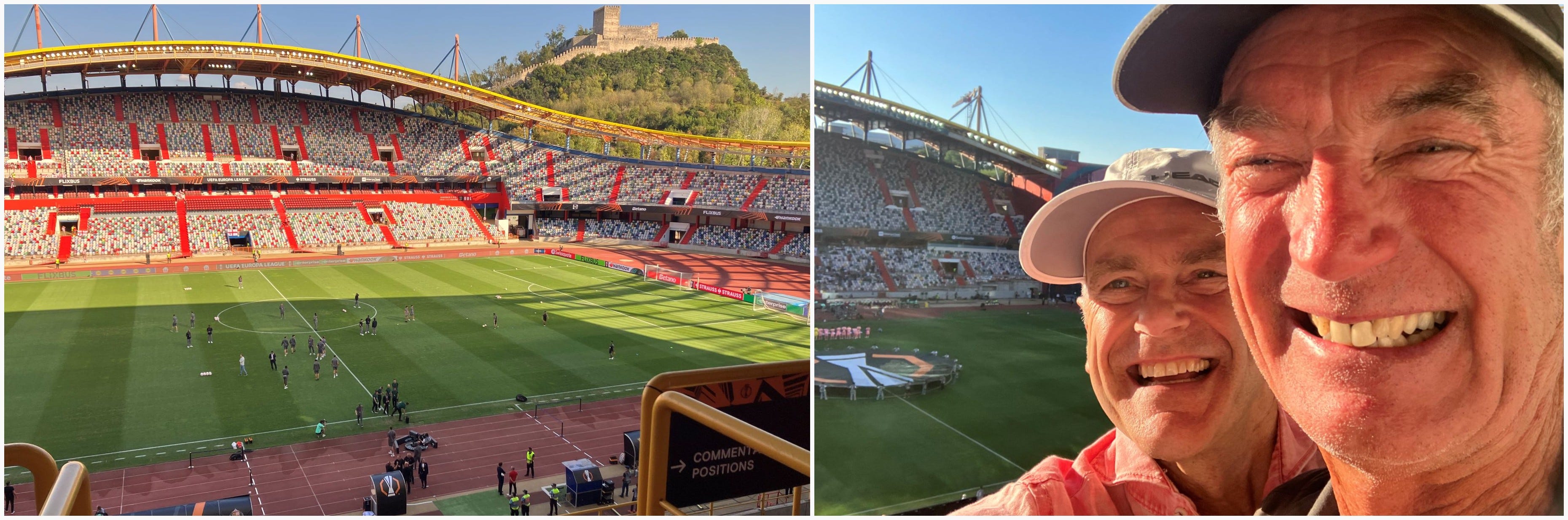
By Jeff Brown
When you’ve had more than half a century to plan a party, not even the finest details should really pose too much of a problem.
This, however, was a football match with three possible venues, hosted by a team unknown to all but the most dedicated followers of the world game. And when they did finally choose where to do battle, it was in a town some 70 miles from the nearest airport.
The problem for around 5,000 Sunderland fans was just how to make the pilgrimage to Leiria, an historic city in the Central Region of Portugal, for the club’s first game in a top European competition since 1973.
They flew from Newcastle, of course. But also from Edinburgh, Manchester, Leeds and London, arriving in Lisbon, in Porto or – like me and my old schoolmate Sean and friends Helen, Steve and Janet – 230 miles away in Faro, the capital of the Algarve.
Confession time: as a journalist I should really have checked the facts before pushing the Jet2 “confirmation” button, but the on-screen price was rising in front of my eyes. It’s how they get you.
Sunderland’s opponents for this historic Europa League tie were Portuguese Second Division side SCU Torreense, surprise winners of last season’s Taca da Portugal (the country’s equivalent of the FA Cup) which was the first domestic trophy in the club’s 109-year history.
Home games are usually played at the Stadio Manuel Marques, a ground which holds barely 2,500 spectators. Clearly a non-starter with European football’s governing body, UEFA.
Torreense had sought, and been granted, permission to switch the game to Estadio Algarve, just a few miles north of Faro. Only… they’d had a late change of heart, as their fans complained the ground was too far to travel - and opted instead for Leiria, some 60 miles north of base.
Fortunately, I wasn’t alone. Even greater fortune followed in the shape of exiled Black Cats’ fan Mark Chapman, a veteran of previous pre-season trips to Portugal. Via a fans’ website, he offered to single-handedly organise two coaches and a handful of mini vans to transport around 150 strays on a four-hour trip to the game and back. What a lifesaver.
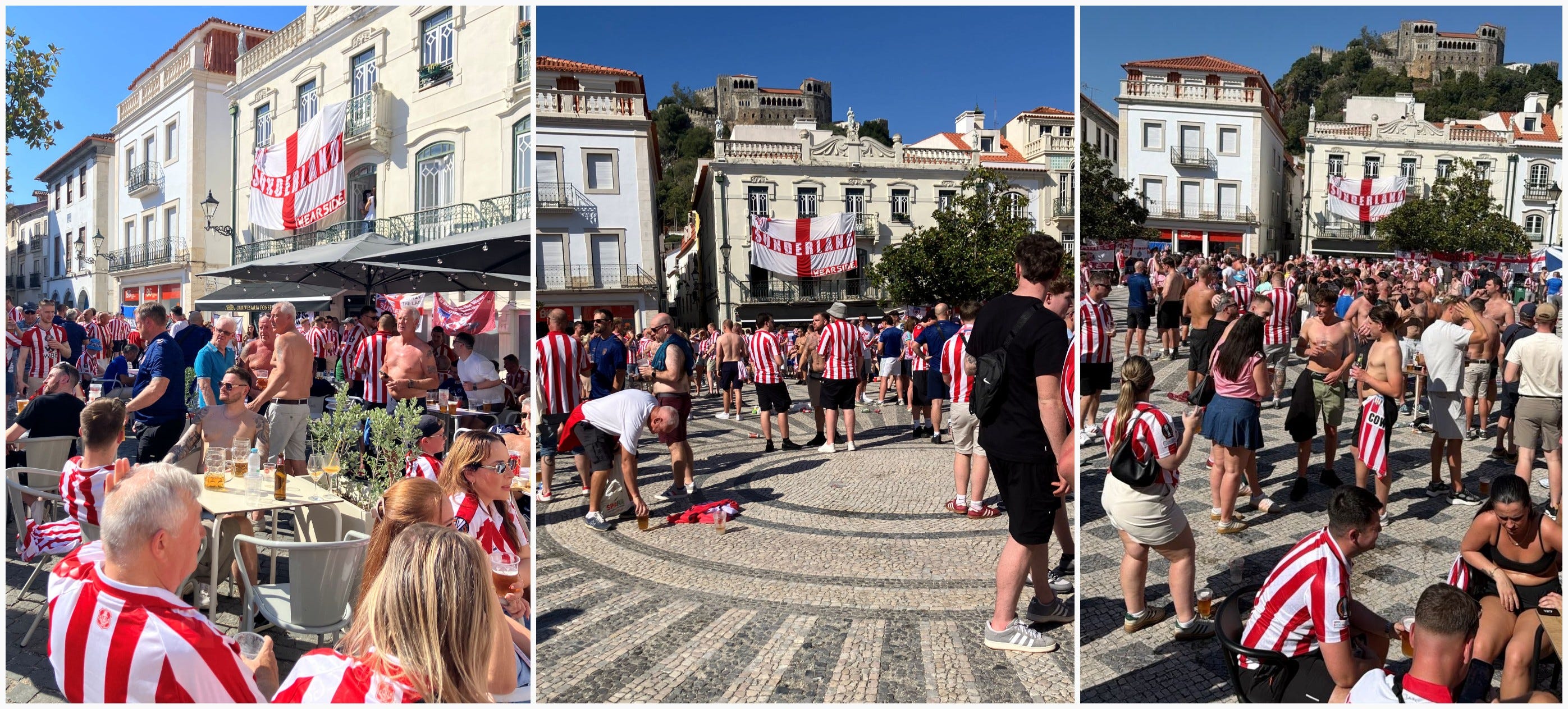
Come match day, Leiria’s town square was a sea of red and white, mostly fuelled by an ocean of Super Bock beer which heated up as rapidly as the topless lads in the sweltering 26 degree heat.
For those of us of a certain vintage, who had only been bairns when Sunderland’s FA Cup winners of ’73 had briefly trod the European trail, the misty-eyed refrain was a recurring theme: “Never thought I’d see this again in my lifetime…” Certainly not when League One awaydays of only a few short years ago featured trips to towns no more exotic than Morecambe, Rochdale and Accrington Stanley.
As a sports reporter for The Journal, ITV Tyne Tees and BBC Look North over a period of almost 40 years, I’d been privileged to follow Newcastle United and - for two brief, unforgettable seasons – Middlesbrough to Belgrade, to Sofia, to Athens, Rotterdam, Rome and beyond.
For years I’d bored my mates with tales of those magical trips: the thrill of hearing familiar accents and coming across neighbours far away from home, sharing a common bond of being there for the game. It was something I dearly wanted them to experience, but assumed they never would.
As a 12 year-old fan I saw Sunderland’s two home games in their short-lived 1973-74 European Cup Winners’ Cup campaign. Not even the scandalous hike in admission prices from 30p to £2 - more than a week’s pocket money - could keep me from being at their first home game, against the Hungarian side Vasas of Budapest.
The club, incidentally, justified the rise by claiming it was to pay for new floodlights which could accommodate midweek television transmission in colour, rather than bog-standard black and white.
In the decades since, pre and post-match pub talk has occasionally featured the brave boast that: “If we ever get back into Europe – I’ll be there”, never really expecting there’d be a need to keep that promise. Finally, unbelievably, it was time to deliver.
Flights booked, then, transport sorted. How to get into the game itself? Enter an unlikely hero in Torreense vice president Nuno Carvalho.
With Sunderland requesting an allocation of 4,000, word quickly spread on the internet grapevine that a simple email to Nuno would allow you access to as many tickets as you required.
Torreense’s average home gate is around 1,500. Playing in Leiria’s 24,000-capacity stadium, they weren’t about to let this money-making opportunity slip by. UEFA, it’s understood, is investigating…
And so they came, and unfurled their flags. From Boldon, from Bishop Auckland, from all points across the North East and beyond. One guy’s banner proudly proclaimed: “I quit my job to be here!”
Who did I bump into? So many folk, from so many areas of my life: Andy, a former colleague at Look North; Adam, my cousin’s lad; Barry, for years my bank manager at Lloyd’s in Jarrow and Mez, from Roker Methodist Church Boys’ Brigade. That took me back…
As for the game itself? Like so many Sunderland matches down the years – and you can substitute that for your own team’s name - for much of the night it seemed the fun would end with the first blast of the referee’s whistle.
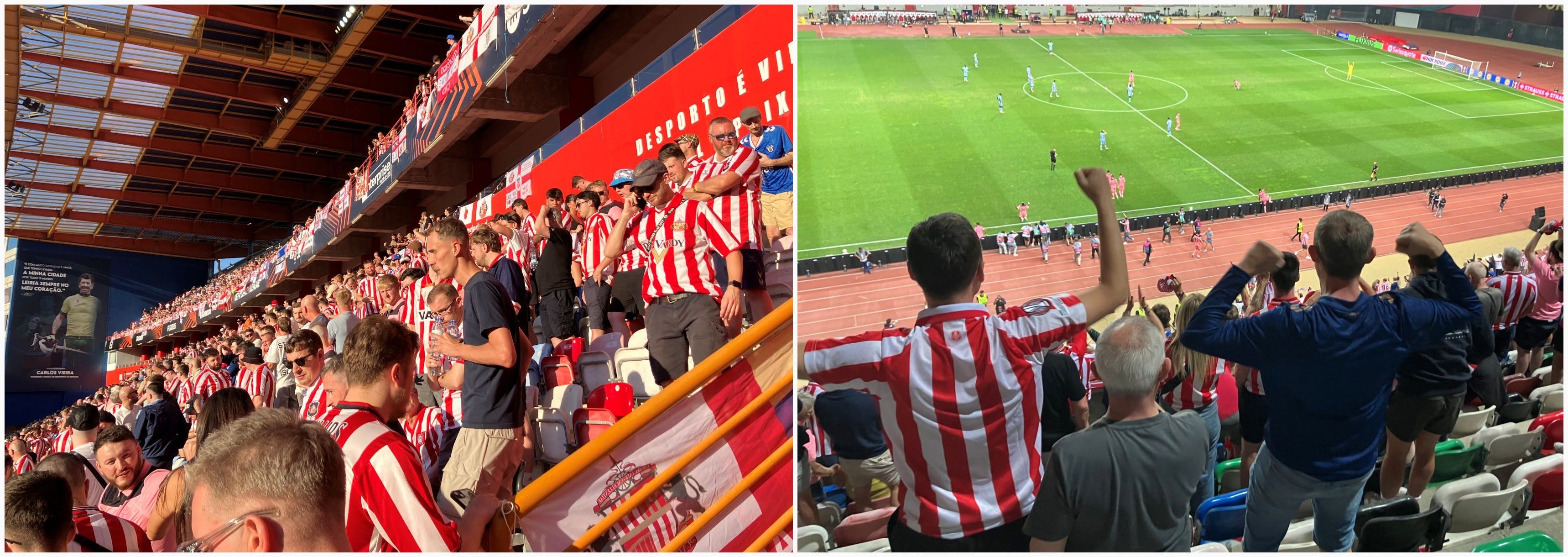
In a ground resembling an upmarket Gateshead Stadium – albeit with a stunning view of the city’s 12th Century castle – a much-altered Sunderland side plodded their way painfully through a sluggish first half, enlivened only by an early disallowed goal for the visitors and a wonderful 20-yard strike from Torreense’s Brazilian centre-back Volnei Feltes.
A second half rally saw the Wearsiders’ summer signing Jules Ahoka sneak a header inside the near post for the equaliser, and a host of regulars – Mukiele, Reinildo, Le Fee and skipper Granit Xhaka – left the subs’ bench to lead a late charge.
It seemed they would have to settle for a disappointing draw, when Albanian referee Enea Jorgji overturned a late penalty award after an eternity studying the pitchside VAR screen.
But with only three of the added six minutes remaining, Congolese midfielder Noah Sadiki volleyed home his first goal for the club, with what may well have been his first shot on target in his 15-month Sunderland career.
Cue mayhem, as Sadiki and his team-mates vaulted the advertising hoardings to celebrate with the travelling fans. And pity the handful of harassed stewards, trying to break-up the massed love-in. Ask any football fan - there really is nothing like a late, unexpected winner to transform a tedious game into one which lives long in the memory.
For the red and white diehards, the next stop is Bournemouth tomorrow for a Premier League battle of two stuttering sides. Then it’s on to Poland and Poznan for the latest leg of this European adventure.
That’s not for me. I’m otherwise engaged. But come December you’ll certainly find this Mackem in Milan. Along with, I’m guessing, many thousands more…
Headline news

The Source was launched by Steph McGovern, Simon Rushworth and me at the Helix in Newcastle four weeks ago. Independent, politically neutral but North East biased, it’s a growing media platform that will provide quality stories told by quality storytellers - as today’s edition demonstrates.
There’s more next week. Arlen Pettitt draws on personal experience to write about why it’s time for action on ADHD and autism, Bob Hudson asks what is going on with Local Healthwatch, and Harry Pearson… well, Harry Pearson takes a look at the tupping season in his own inimitable way. It’s highly recommended.
If you value what we do then please consider becoming a paid subscriber or contributing to our Crowdfunder - set up with specific purpose of hiring a reporter dedicated to public-benefit journalism.

www.crowdfunder.co.uk/p/the source
Tables turned on fans
By Simon Rushworth
Two brothers with a shared love of Newcastle United have launched the world’s first platform dedicated to measuring, celebrating and documenting the loyalty of football supporters across the globe.
Craig Archer and Ryan Archer-Robinson have self-financed the Football Supporters Index (FSI) — a unique online space that brings together the beating heart of the beautiful game.
And the Magpies-mad siblings insist fans deserve their chance to shine in an era when success and failure in football is increasingly measured in purely financial terms.
“Football has always celebrated clubs and players,” explains Craig, who’s worked in construction all his life and ploughed personal savings into developing FSI. “We want to celebrate the supporters.
“Clubs can point to trophies. Players have statistics and medals to measure their success. But despite being the heartbeat of the game for more than 150 years, supporters have never had a lasting way to record or celebrate their loyalty.
“Unlike traditional social media platforms or football forums, FSI has a single purpose: recognising the people who make football what it is.”
Newcastle United season ticket holders Craig, 45, and Ryan, 27, had talked about ranking supporters for years before joining forces to create FSI.
“Our family weekends are dominated by football and one thing we always come back to is which club has the most loyal supporters,” explained Craig. “There’s nothing to measure that, so we decided to create FSI.”
Ryan added: “I used to travel to loads of the away games during the Rafa Benitez era and the one thing that always used to crop up was who were the best supporters. It’s a conversation football fans have been having for as long as the game’s existed.”
The brothers’ self-financed project started to take shape in April and has the capacity to fully index more than 4,000 clubs from 200-plus countries. Fans are asked to pay a one-off fee of £2.99 to secure a lifetime ‘supporter number’ — the first step towards boosting their chosen club’s ranking.
Additional loyalty points will be awarded to supporters who: submit unique stories linked to their favourite clubs; encourage fellow fans to sign up; and attend fixtures.

Ryan added: “Going to games will guarantee the greatest number of loyalty points. That’s a given. Fans who follow their team home and away can help to propel their club up the global league table. It means a supporter of a lower league club who goes to all of the games can quickly outscore a casual fan of a bigger club.
“FSI isn’t about replacing football traditions — it’s about recognising the supporters who have kept those traditions alive for generations. Players become legends. Clubs make history. We believe supporters deserve a legacy too.”
Craig said: “We’re a very small team — me, my brother and a friend of mine who has developed the website. We’re doing this without any external support and, while that poses its own challenges, we’re very proud that this independent project has its roots in the North East and always will have.
“We want FSI to be the best it can possibly be. We understand football supporters and that is reflected in the website. Every supporter believes their club has the most loyal fans in the world, but until now there has never been a way to prove it!”
Craig and Ryan built FSI with legendary former Newcastle and England manager Sir Bobby Robson in mind. “We designed the site around the exact philosophy Sir Bobby famously championed,” added Ryan. “He always said that a club is defined by its passion and its people, not its corporate balance sheets.”
FSI — featuring the world’s first Global Football Supporters League table — encourages fans to connect with like-minded football communities worldwide. During phase two of FSI’s development, an interactive Global Fan Map will reveal the extent of clubs’ support far beyond their traditional heartlands.
“We want FSI to be more than a website,” added Craig. “The platform also aims to become one of the world’s richest sources of insight into football supporter culture by helping fans build detailed supporter profiles. We’ll be documenting everything from favourite football shirts and matchday traditions to supporter journeys and lifelong football memories.”