

For every one of us who thinks ‘I can’t believe it’s October already, where has the time gone’, I have another question: When was the first time you heard of AI?
Artificial Intelligence has actually been around since 1955 but only became an everyday word when OpenAI released ChatGPT to the public in November 2022.
That’s less than four years ago - five years after Taylor Swift’s first UK No 1 single, if that means anything to you.
The Entrepreneurs’ Forum has been asking members about how they are using AI and the benefits they are seeing. The answers are illuminating - and we have asked two founders to tell us more. You may find it helpful.
Also today, there are worrying signs about anti-social behaviour. Parents in one part of Newcastle are afraid to take their children to football practice while police in Hartlepool have issued their third dispersal order after a weekend of chaos and disorder.
A museum director has called on Sunderland University to halt the demolition of the National Glass Centre, the former councillor who failed to show up for any meetings for six months got just 11 votes in his re-election bid, and we pose a grave question - can you go ‘over the top’ with headstones?
Brian Aitken
Editor
Foul behaviour

Parents are too scared to take their children to football practice because of the anti-social behaviour of youths. This is in the part of Newcastle that bus services avoid in the evenings (Eyes & Ears 18.09.26).
Blakelaw FC has nearly 400 youngsters on its books, supported by 70 volunteers. Chair Gavin Campbell said fireworks had been aimed at players over the fences, and a fire had recently been set in the car park. “Parents are scared to bring the kids to football now because the cars are getting hit with stones and eggs where they’re travelling to and from the venue.”
A Northumbria Police spokesperson said the force held meetings to listen to the local community about their concerns and answer any questions. “To date, we have identified 20 young people, some of whom have been arrested and are on police bail pending further enquiries.”

And there’s more
Police issued three dispersal orders in Hartlepool after a weekend of chaos and unruly behaviour in the town’s parks involving an estimated 100 young people.
Fireworks launched at homes, eggs hurled at police and a huge gathering for a pre-arranged fight are just some of the incidents reported in parks across the town since Friday. Officers dealt with several incidents involving large groups of young people in Ward Jackson Park on Saturday night.
Hartlepool Neighbourhoods Inspector Adrian Dack said: “Sadly we’re having to bring in another dispersal order for a park in our town but we’ve had no option since the behaviour of these large groups of young people is leaving the law abiding public - who just want to enjoy their local green space - feeling intimidated and unsafe.
“Last night we also saw direct hostility towards officers who were simply doing their job; we cannot and will not let this go unchallenged.”
‘Stop the demolition’
A museum director has called on Sunderland University to reconsider plans to demolish the National Glass Centre and donate it to the community instead.
Alexander Goodger, director of the Stourbridge Glass Museum, described the £2m demolition as unnecessary and said the university should hand the building over to the Save the National Glass Centre campaign, which has relentlessly pledged to repair and operate the facility as a community asset.
Drawing on his own experience, Mr Goodger pointed to the success of the Stourbridge Glass Museum, which was once a derelict factory but is now an award-winning, self-sustaining attraction. The museum operates without government funding and is powered by a net-zero system using solar panels, Tesla batteries, and LED lighting.
“The National Glass Centre is nothing like the state the Stourbridge site was in,” he said. “It is barely 30 years old. The building still looks brand new. We can implement a similar plan here and save it.”
A quick word
Former councillor John Allen, who lost his Northumberland seat after failing to attend any meetings for six months and then decided to contest the by-election he caused, received just 11 votes. He was expelled from Reform after allegedly making online threats to then Prime Minister Keir Starmer. There were two by-elections on Thursday with Labour regaining both the seats that they lost to Reform in 2025. The operators of Freight Island have secured £3m backing from the Whiterock-managed Investment Fund for Northern Ireland to open a live music and events space at its Newcastle base and expand into Leeds. The official groundbreaking of the £25m Energy Central Institute in Blyth town centre has taken place. MP Ian Lavery, Northumberland council leader Glen Sanderson and Port of Blyth CEO Martin Lawlor, who chairs Energy Central Campus, joined students from Bede Academy and Energy Central Learning Hub for the ceremony. The new building at St Leonard’s Catholic School in Durham has been officially opened three years after buildings were deemed structurally unsafe and at risk of collapse. Some of the 1,400 pupils were forced to take lessons remotely, in temporary buildings or commute several miles away to Ushaw College. It was built in the 1700s to support the local salmon fishing industry, now the Ice House, which is under the Custom House in Berwick, is to become an underground live music venue after two successful trial events took place during the Berwick Fringe. The planting of 600,000 trees is to begin at Greencroft Forest Park in County Durham, making it “England’s largest new productive and mixed woodland in over 40 years,” according to investment firm True North. The project was put on hold after a legal challenge. Chief executive Harry Humble said: “This has been a complex, costly and time–consuming development, and we are excited to finally get trees into the ground and create a forest that local people can enjoy for decades to come.” It’s not the first. It’s unlikely to be the last. But it is the biggest - NETPark-based Filtronic has secured a follow-on order worth £51.3m with Elon Musk’s company SpaceX.
AI’s working for us
Should we be surprised by the latest figures on the use of Artificial Intelligence in North East businesses? Not only are 97% using it in some form but nearly 90% say it is delivering measurable benefits, according to the research from the Entrepreneurs’ Forum.
Other headlines from their Pulse Survey of 113 business owners:
34% claim to be saving up to five hours per week
32% are seeing productivity or operational efficiencies equivalent to five to 20 hours.
23% report significant operational or financial benefits equivalent to more than 50 hours saved each week.
You might find it useful to know that ChatGPT and Claude came joint top with 38% when people were asked which AI tool had proved most useful.
“These results don’t mean every business has suddenly transformed because it bought an AI subscription,” said Elaine Stroud, CEO of the Entrepreneurs’ Forum. “There is still a lot of experimentation going on, but when almost nine in ten users can identify a measurable benefit, it is becoming much harder to dismiss AI’s impact in the workplace.”
Research is the most common application, used by 74%, followed by marketing content and meeting notes or transcripts, both at 65%. More than half use AI for writing proposals, bids, and tenders or summarising lengthy documents, and almost half use it to analyse data or as a thinking partner to stress-test decisions and plans.
“One of the really interesting findings is that AI is also beginning to affect recruitment decisions,” said Elaine. “While 59% say it has made no difference to their hiring plans, 19% of our members expect to recruit people with different skills as a result of AI, and 12% expect to hire fewer people.”
How we use AI
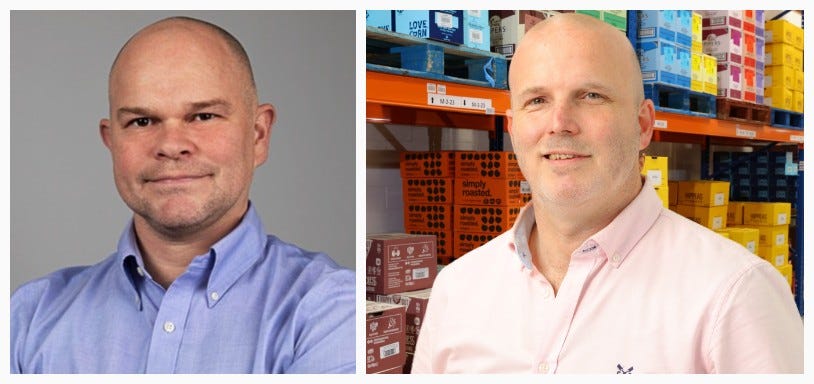
Richard Coates, co-founder and MD of Newcastle serious games studio Lumanorth, and Ben McKechnie, founder and MD of Epicurium, the Consett-based healthy snacks wholesaler, shared their AI journeys with The Source.
When did you start using AI seriously in the business, and what prompted you to explore it?
BEN: About a year and a half ago. Just at senior level, and prompted mainly by the need for advance SQL report coding to allow us to mine our data at the click of a button and avoid awkward pivot tables and misreporting. It cuts report development time to hours and avoids £000’s of development spend, whilst enabling things at the touch of a button we’d never dreamt possible without huge expense.
RICHARD: We started experimenting with AI early, but became serious when we saw the opportunity to make our people faster and more effective, rather than treating AI as another piece of technology. We also saw huge potential in helping clients embed AI into how their people actually work and learn.
Within the business, what are you using AI for today?
BEN: Alongside ongoing SQL data extraction and reporting, we’ve applied AI in drafting product collateral for the sales team - making it quick and most importantly consistent when we’re launching a high number of new products. More recently, we’ve developed an excellent onboarding programme for our internal sales executives, which gets them fully productive within 2 weeks and working at a very high level within 12. I also use it as a strategic sounding board and for ongoing competitor strategy analysis - and this is a game changer. It gives me potential for scanning competitor activity across a vast range of sources.
RICHARD: We use AI for research, analysis, proposals, content, meeting preparation and administration. With clients including McDonalds, Dr Martens and Dogs Trust, we’re particularly interested in applying AI to real workflows, improving access to knowledge, supporting decision-making and training simulators.
Can you give one or two examples of something you now do differently because of AI?
BEN: Onboarding staff – developing an accelerated training programme that can be self-taught rather than requiring time from the incumbent team. Plus a significant amount of management data reporting in ways we couldn’t achieve prior to the use of AI, certainly without the significant cost of time spent doing so.
RICHARD: Research and preparation can be done significantly faster. AI allows us to get through large amounts of information quickly and spend more time on the thinking and judgement that adds real value. For clients, the opportunity is often about creating capacity rather than simply reducing costs.
Has AI changed the jobs people do, the skills you value, or the people you expect to recruit?
BEN: Not so much yet, but it will through upskilling them and affording time spent on productive tasks rather than admin and manual data processing.
RICHARD: Yes. We increasingly value curiosity, judgement, creativity and the ability to work effectively with technology. AI can produce an output, but people still need to ask the right questions, challenge it and apply it intelligently.
Where do you think AI will make the biggest difference to your business over the next 12–24 months?
BEN: Analysing customer buying patterns and creating predictive sales tools and demand forecasting
RICHARD: I expect the biggest shift to be from AI as an assistant to AI embedded in everyday trusted workflows. The opportunity is to create an AI-enabled workforce that gives people more capacity to focus on customers, creativity, relationships and higher-value decisions.
It’s the future - I’ve tasted it
“There is no long-term viable solution to the problems in local journalism that doesn’t come from getting people to pay for local news again. Our business isn’t super risky. It’s sustainable.”
The quote above is from Joshi Herrmann, founder of the Manchester Mill, a company that started just six years ago and now has online newspapers in seven cities. You can read more about Mill Media in Friday’s edition (Eyes & Ears 02.10.26).
The Source is on the same course as the Mill and, with your help, we can provide the North East with a growing media platform that serves up informed opinion and engaging columnists, and produces quality stories on the people and places that make the North East such a great place to live.
Independent, politically neutral - but North East biased.
Becoming a paid subscriber is the most sustainable way to help us achieve that. Are we worth £6.99 a month? You can click on this button if you think we are:
You could also consider helping our Crowdfunder which has been launched with the express purpose of hiring a reporter who will specialise in public-benefit journalism. We’ve had contributions ranging from £5 to £2,000 so far. You can add to that total by clicking here.

www.crowdfunder.co.uk/p/thesource
The two stories below are from the Mill Media stable - The Bell in Glasgow and The Tribune in Sheffield. Great examples of what you can get when you invest in quality journalism.

Players and prayers
I spent five years working on the sportsdesk of the Daily Record in Glasgow. I know all about the religious divide. Celtic and Rangers fans would ring in equal numbers to complain about our supposed bias - so we knew we were getting something right.
The Bell, however, has brought a new perspective to the issue of religion and football in Glasgow - with a spotlight on the club which runs bible study sessions, has its own branded Gideons New Testament & Psalms, and where a growing number of players have pre-match prayers on the pitch.

Grave matters
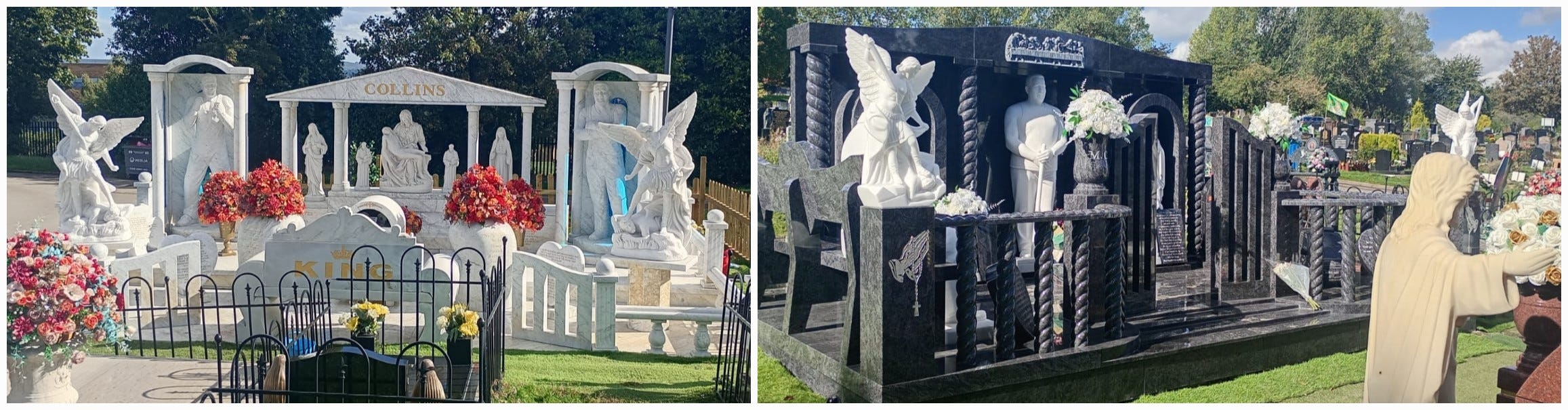
There are gravestones. And then there are gravestones. These are some gravestones.
One has been causing controversy for more than four years and is said to have cost £200,000. The other has been in place for a month.
They are in memory of brothers, members of the travelling community, as The Tribune in Sheffield reports. The final resting place of 49-year-old Willy Collins has been the subject of 34 articles in the local newspaper alone as well as significant mentions in national publications such as The Telegraph, the Daily Mail, the Independent and The Guardian. The headstone for brother Michael has brought the issue back into the limelight.
Both have operational jukeboxes, I might add.
It raises the issue of what is acceptable in a place renowned for respect and quiet contemplation. Some people are not happy with what the Collins family has done. Two CCTV cameras are clearly visible on a large pole just behind Willy’s grave and several local residents allege that relatives sometimes show up in a white van to keep an eye on any strangers seen sniffing around.
AI is reshaping not just how news is produced but the entire business model behind it.