


Today’s feature article is from the former Guardian columnist Harry Pearson, a regular contributor to the magazine When Saturday Comes and author of the cult classic The Far Corner: A Mazy Dribble through North East Football.
Harry, who now lives in Hexham, is one of those people who sees and hears things then puts words together and makes them a joy to read. A rare skill.
He has already written for us about how dementia has affected his family (If you didn’t laugh, you’d cry), the weighty funeral instructions he received from his Dad (Ashes to ashes), the missing item that came to dominate his Dad’s mind in his last few months (Poignant mystery of the hunting horn), and his observations from the dementia ward (The York Fruits). Click on any of the links to read them.
Today, as he prepares to become a grandfather for the first time, he brings us some childbirth stories that bear some relation to the Monty Python Four Yorkshiremen “we were so poor” sketch.
After Harry, I have left you with a few articles I thought you might like. Sunday is supposed to be the day for leisurely reads after all, but you can come back to them another time if you want.
But first, a few Eyes & Ears Extras
Green can now mean ‘go’
The Treasury’s Green Book has been rewritten and that is brilliant news for the North East - in fact for everywhere outside London, the South East and the Oxford-Cambridge Arc.
The Green Book is not just a book it’s more of a bible, used by Whitehall to decide on what major infrastructure projects get approved - and where. The rewrite is the most favourable shift (to us) in public spending rules in a generation and should stop it being a barrier to growth and development opportunities in areas like ours.
Investment decisions will no longer be based on single metrics such as cost-benefit ratios. The Treasury themselves said “overlooked regions and communities” would now be given a “fair hearing in public spending decisions”.
Chancellor Rachel Reeves said: “These groundbreaking reforms are part of a new approach from the Treasury that truly makes a long-lasting difference for all areas across the country – ensuring they get the fair hearing they deserve and can have confidence in how Government invests into where they live.”
I must admit that I thought the Green Book changes were already in place. The Chancellor was asked about investment in the Leamside Line, a key priority of North East Mayor Kim McGuinness, when she was in Darlington earlier this month.
She told the Local Democracy Reporting Service then: “We have changed the way that the Treasury looks at the value of investments because of the reforms to the Green Book. The onus is on us now to work with Kim and get a business case that can stack up. But I really want to do that, I can see the benefits it will bring.”
About time.
Shaping an AI future
An MP with a strong mining background gathered representatives from government, industry, academia, skills organisations and local communities to discuss how the region can capture the benefits of AI.
Blyth and Ashington MP Ian Lavery, who organised the conference at the Blyth Energy Central Learning Hub, said: “AI is already affecting how we work, live and access services, and it’s right that these conversations happen here in Blyth. This conference has brought together national decision-makers and local voices to ensure the North East is not just part of the AI future, but helping to shape it in a way that is fair and inclusive.”
Research and Innovation Minister Lord Patrick Vallance said that “if we are to lead on AI, we need to lead on an energy system capable of supporting that ambition”. This included building the Advanced Modular Nuclear Reactors which are planned for Hartlepool.
RIP John
Former Sedgefield Borough councillor John Burton, who was Tony Blair’s constituency agent for 24 years, has died aged 85. Former Prime Minister Blair said: “He was smart. But he was also caring, enormous fun with a brilliant sense of humour.”
In case you missed it

Once you see it…

I saw this image on social media this week. It was said to be something that would break our brains - and that once you’ve seen it, you can’t unsee it. It certainly took a while for me to see the full picture, so to speak. How about you? If you don’t get it then the answer is at the bottom of this edition.
Hell and Hot Water
By Harry Pearson
In the final few years of his short life F. Scott Fitzgerald wrote a series of funny short stories featuring Pat Hobby, an archetypal booze-soaked Hollywood hack. Hobby’s proud boast is that he invented the line: “Boil some water - lots of it!” This was a command uttered by doctors in all movie childbirth scenes for decades. Nobody knew why.
Pat Hobby’s line has been on my mind lately because my daughter is expecting a baby (or, as the screenwriters of every period drama ever made would phrase it, ‘she is with child’). The due date is the first anniversary of her grandfather’s death. If you have read that sentence without subconsciously humming Circle of Life from The Lion King then my market research indicates that you are in a minority of one.
This is indeed good news and I already picture myself performing the sacred duties of a grandfather such as teaching the youngster how to make a bow and arrow out of garden canes and then saying ‘but you must never aim it at any living thing’ in full knowledge that at some point my daughter’s postman will take one in the buttock.
My daughter came to visit at Christmas. She was soon surrounded by older women eager to share their childbirth stories with her. When it comes to childbirth stories, it seems there is always somebody worse off than yourself. And that person is usually the next woman to tell her childbirth story.
The scene begins when the first-time mother tentatively asks just how painful it is. After a good deal of laughter, yelping and general hullabaloo, mother number one says: “I was in labour for 10 hour and the agony was so intense I squeezed my husband’s wrist until his fingers turned blue”.
After a short pause, mother number two takes a deep breath and commences: “My labour went on for 18 hours and the pain… I yelled so loud I gave my partner tinnitus”.
The third mother rises in her chair: “24 hours. Crushed the wife’s hand so badly she had to borrow my morphine drip.”
And then all the mothers sit back, smile and say: “Eee, it’s the most wonderful gift nature can bestow, I envy you pet, I really do”.
In the past men wouldn’t have been expected to sit through the childbirth stories, they would have been shooed out into the scullery to boil some water (and lots of it), while pacing up and down and smoking furiously. These days, however, men have to sit through the childbirth stories offering comfort and encouragement and being told to shut their bloody mouths because they haven’t the faintest clue what it’s like.
My daughter’s partner is a sensitive soul and I could tell the childbirth stories were making him a bit queasy. Later, when we were on our own he said sheepishly: “You were at the birth, weren’t you? What was it like?”
My mind went back to when I was in the same situation. It was no use asking my father. When I was born he was at work at Teesside Bridge. “I asked my boss if I could phone the hospital to see how things were going with the labour,” my Dad recalled. “And he said: “Yes, but make sure you do it in your tea break and use the payphone in reception”. Ah, those were the days. So instead, I asked male peers for their experiences.
The response was almost universal. “It’s the most transcendent experience of your life,” they said. Or: “It’s like every moment of joy you’ve ever experienced hitting you in the heart all at once.” Or: “It’s an utterly overwhelming feeling of pure love. And then they reached for their hankies.
I found these stories far more unsettling than those of the women. Growing up in the North East in the 1970s prepared a man to deal with pain, blood and horror, raw and transformational happiness not so much. As the day of my daughter’s birth approached I grew more and more nervous of the uplifting emotional tsunami that was about to engulf me.
Then, two weeks before she was due, I went to a Northern League game and met a bloke there I regularly sat with. He was big-faced, ten years my senior with a voice that rumbled like gravel in a cement mixer.
I had known him for years but had little knowledge of his life outside of watching grassroots football. We didn’t speak of such matters at matches, we escaped into a trivial world of match official mockery and anecdotes about Alan Shoulder.
Now, transgressing the unwritten code, I asked if he had children. “Aye”, he said, “I’ve got a son”. “Were you there at the birth?” I asked. He said he was. Fearfully I asked him what it was like. He sat back and wrinkled his nose. “Well, Harry,” he said. “Have you seen Reservoir Dogs?” It cheered me up no end.
I looked at my daughter’s partner as he awaited my response with a half-hearted grin of expectation. He grew up in the Home Counties in the 2000s.
“Absolutely euphoric,” I told him. “A shower of pure glee falling from the heavens”. As Pat Hobby says, a writer’s got to know his audience.
Recommended reads

Carole Cadwalladr is an investigative journalist who has spent a decade reporting on the collision of technology and democracy including exposing the Facebook/Cambridge Analytica scandal for the Guardian and New York Times. Here is an extract from her rivetting Substack column. You can read it in full by clicking here.
This is not the piece on Jeffrey Epstein that I was going to write. I’ve struggled with that article all week. On Monday, I plunged into the three million-plus files which the Department of Justice dumped onto the internet a week ago and immediately surfaced a dozen or so gobsmacking emails that hadn’t then been made public.
By Tuesday, I had a scoopy piece almost ready to publish… but I’ve been unable to finish it. I have, to be perfectly honest, been overwhelmed.
Some of the key stories it reveals are areas that have been my specialist interest for years. The Kremlin. Silicon Valley. MAGA and the European far right. Israeli intelligence. And there, slap bang in the middle of it is a man who I’d never wanted to pay any attention to, Jeffrey Epstein. Not only are they all connected. Epstein connects them.
There’s been something else that’s been holding me back. It’s the geopolitics that’s fascinated me, the files are like a door you didn’t even know existed suddenly swinging open. But there’s another subject in there that’s manifestly Epstein’s core interest, a subject I’ve covered, that underlies so much of my reporting, that I’ve both tried to expose and found myself hard up against: power.
And yesterday, I realised the first piece on Epstein I write has to tackle what I believe is the overwhelming revelation of the files. It speaks, I think, to our inability to even see the edges of this story, let alone process it. It’s not just the rampant misogyny that oozes from the pages of these documents. Women as chattel. Women as objects. Women as objects of both hate and desire.
It’s darker than that. Because it’s something that we do not want to see, that we cannot comprehend, that’s as sickening as it’s pervasive.
What Epstein shows us is that we live in a paedophiliac culture.

He was an architect with monumental plans for Newcastle and who designed a sweep of prominent buildings and structures on Tyneside.
Robert Burns Dick, who has just been honoured with a plaque, certainly left his mark with creations ranging from the Spanish City at Whitley Bay and Berwick police station to the Laing Art Gallery in Newcastle.
But his legacy could have been even greater if two of his most ambitious schemes had come to fruition. Read Tony Henderson’s article by clicking here.

I said a few weeks ago (Eyes & Ears 16.01.26) that student loans could be the next thing to bite the Government on the bum. This week’s BBC Question Time reinforced that.
New Statesman executive editor Oli Dugmore was impressive generally - more so when it came to the topic of interest charges and repayments of student loans where he pointed out that the combined tuition fees of the entire panel wouldn’t cover one year of his university costs.
Money-saving expert Martin Lewis is also on the case saying that a private lender would not be allowed to change repayment terms in the way that the student loans company has done.
LBC presenter Ben Kentish has written an opinion column for The i Paper on why Rachel Reeves’ decision to defend the system she inherited from the last government could prove a costly error. You can read that here.

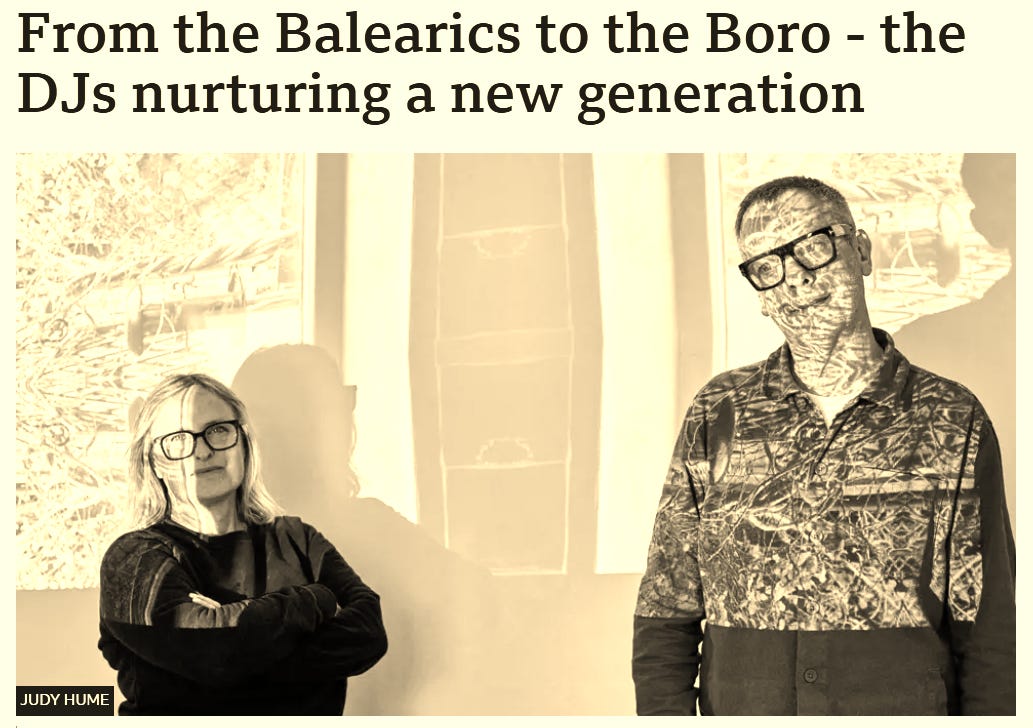
Fatboy Slim, Daft Punk, Happy Mondays and Grace Jones. Just some of the big names Sally Rodgers has rubbed shoulders with while performing on the dancefloors of Ibiza in the 80s and 90s.
But Sally has returned to her Teesside roots and is now working with organisations such as the Middlesbrough Institute of Modern Art and Teesside University to put the area on the creative and cultural map. A great read from the BBC’s Anna Murray.
Once you see it
It’s a close-up picture of four forks with the tops of the forks chopped off. Imagine the purple as the background.