

Regular readers will have noticed that football does not figure large in Eyes & Ears. That’s not quite the case today, although there are several good reasons for this, as you will soon see.
BBC legend Jeff Brown has waited almost 44 years to tell us what he considers to be his most important story. It concerns Sunderland’s first black player and the racism and ridicule he faced – inside the dressing room as well as outside.
There’s also the story of the remarkable Ewan Bowlby, a Newcastle fan who never lived to see his club win the Carabao Cup - but whose legacy lives on thanks to football, his dad and a book he has written.
“Whenever I hear an exasperated football supporter claiming his team’s performance is ‘doing his head in’ I sometimes think of Ewan joking about Newcastle United while holes were drilled in his skull.”
Also today, there’s good news about jobs and training with aerospace giant Lockheed Martin, concerns about the North East tech scene, the importance (or otherwise) of flags and the Durham University professor who helped the Pope explain what it means to be human in a time of artificial intelligence.
Space for growth
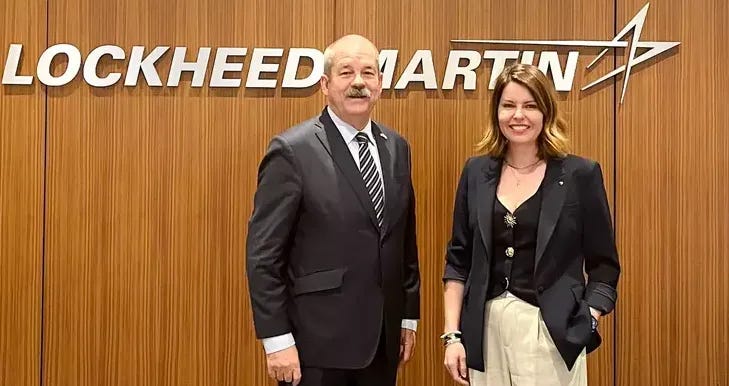
Aerospace and defence giant Lockheed Martin has strengthened its commitment to the region by agreeing a new Memorandum of Understanding with North East Mayor Kim McGuinness.
The agreement supports delivery of the mayor’s Local Growth Plan and builds on Lockheed Martin UK’s role as a major partner in Northumbria University’s North East Space Skills and Technology Centre (NESST) and proposals for a major new facility at NETPark in County Durham.
At the heart of the partnership is Lockheed Martin’s commitment to building a long-term skills pipeline in the region.
Rod Drury, vice president of Global Space at Lockheed Martin, said: “By working closely with the Mayor and North East MSA, we can help grow the industrial base, create new opportunities across the supply chain, and support high-value jobs in the North East.”
Scary story
Jamie Hardesty, esteemed author of the weekly Newcastle Tech Digest, knew he was going to annoy some people with his latest edition.
“I think there are two North East tech stories unfolding at the same time,” he wrote. “The first is the story of a region that has built significant technology capability. The second is the story of a startup ecosystem that has yet to convert enough of that capability into a critical mass of high-growth companies. As someone passionate about local tech startups, this scares me.
“The challenge facing us has never really been whether smart people exist here. They do. Nor whether good companies exist here. They do. Nor whether important infrastructure exists here. It does.
“The challenge is conversion. I’m talking… turning more talent into founders. Turning more founders into scale-ups. Turning more scale-ups into the next generation of founders, operators and investors.”
Priorities? Toast?
I have always been ready to accept and impart advice when needed. Having edited a few newspapers in my time, I have been sounded out by a couple of people who were about to step up to the editorial hotseat for the first time.
My response was consistent: don’t rush into things, and make sure your first decision is widely recognised as a good one - no one will ever remember your second decision.
I don’t know what new editor No.1 did to have the union pass a motion of no confidence in him within a couple of weeks, but new editor No.2 is a regular Eyes & Ears reader (hi, Darren) and we have since shared a laugh over his first decision which was to get rid of the office toaster (the wiring was a bit dodgy, as I seem to recall).
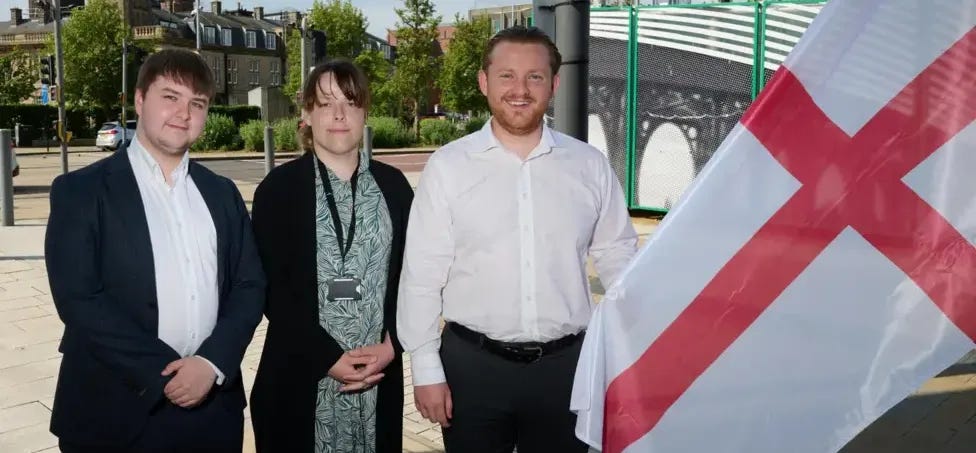
All of this came to mind when I read that the new Reform-led administration at Sunderland City Council had made an early decision - over what flags could and could not fly outside city hall.
What about the bill?
Hospitality is having a tough time of it these days but one South Shields establishment is being frequented by a couple of regulars who visit several times a day. Mind you, it’s not all that great for business - they never pay the bill.
I got to hear about Donald and Daisy’s visits to Sinia’s on Matt Chorley’s Radio 5Live show. Landlady Sinia Jawzi said the charming pair even peck on the glass to get the staff's attention if they find the door closed. They are ducks, by the way, did I not mention that before. Daisy is apparently ‘with child’ I heard on the radio, although there is no mention of that in this BBC story.
Home truths
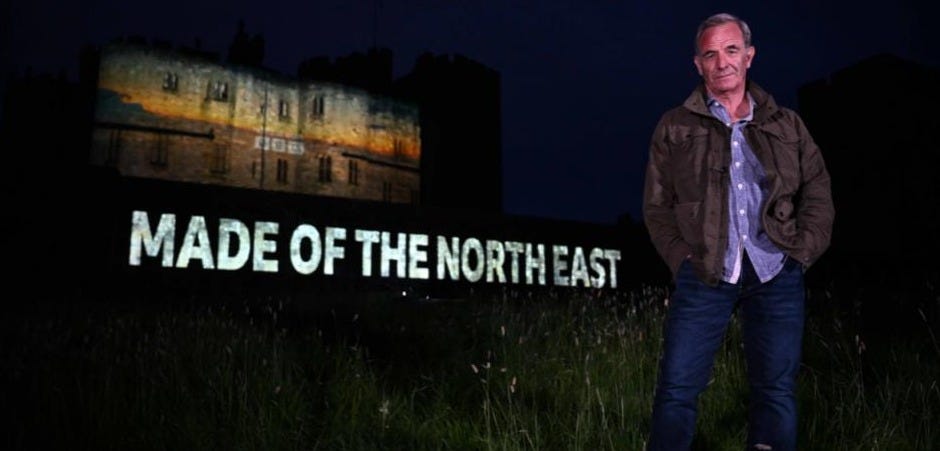
TV star Robson Green is to open up the garden of his 350-year-old cottage on the banks of the River Tyne and invite viewers into a personal project, Growing Home, that celebrates gardening, the outdoors and life in the North East.
“Filming this series at my home, in the garden I care deeply about, has been incredibly special. It reflects the character, voice and spirit of the North East, a place of straight talkers, hard grafters and beautiful landscapes,” he said.
Robson has also voiced a new BBC short film projected onto Alnwick Castle as part of the Made of Here campaign and a renewed push to showcase and grow the North East’s screen industry.
A quick word
A countryside summit will take place at Raby Castle tomorrow. The event will discuss food production, housing rural enterprise, land management and skills with speakers including Kirstie Allsopp, Sir Simon Jenkins and Viscount Matt Ridley. Matt Tebbutt, the host of the BBC’s Saturday Kitchen is to headline this year’s Seaham Food Festival which will be on the first two days of August. AG Barr, the new owners of Fentimans, has confirmed that there will be a phased closure of the Hexham base over the summer and that 37 roles will be made redundant. Goodbye ‘Destination North East England’ - hello ‘Experience North East England’. The pilot scheme for the country’s first destination development partnership has come to an end but the new body, supported by £7m from the North East Mayoral Strategic Authority, is ready to go. South Shields FC, which just lost out on promotion to the National League, has been taken over by ORY Investment Holding. Ian Watson will continue as manager while Geoff Thompson will remain as chairman and a “significant shareholder”.
Show time
It’s not a concert as such, but it is a show... An Evening With The Futureheads is taking place at The Fire Station in Sunderland on June 20, an event which forms part of the closing weekend of Sunderland Year of Music. It comes as Sunderland prepares to welcome music leaders from across the world for the Music Cities Network Summer Summit from June 18-20.
What a story
North East broadcaster and journalist Jeff Brown is a man who loves to tell stories. He didn’t expect to have to wait almost 44 years to tell what he considers to be his most important one though.
In February 1980, Sunderland AFC cancelled the contract of 21 year-old Roland ‘Roly’ Gregoire, the first black player to wear the red and white stripes in the football club’s long history.
Jeff, a Sunderland fan before he became a journalist, wanted to know more. He has now interviewed the reluctant Roly and tells the story of the racism and ridicule he faced – inside the dressing room as well as outside.
Unbelievably good
Jeff is a BBC legend. In May 2024, The QT’s Associate Editor Simon Rushworth caught up with him the day before his final Look North shift. It was a memorable interview about blueberry muffins, fire alarms, Brian Clough, dropped trousers and so much more. You can catch up with that here:

Life, death, football and the cathedral on the hill
Football, whatever a famous manager said, isn’t more important than life and death but it can stir deep emotions. Author Chris Bowlby tells DAVID WHETSTONE how it keeps memories of his son alive
Another football season ends amid heightened drama, multiple hands in air (jubilation) or clasped to head (despair), clichés clashing as commentators surrender to the heat of the moment. Chris Bowlby has heard them all and been known to flinch.
Careless talk costs lives, they said in the war. Careless commentary can take him back to what he calls “my most troubling football memory”, rendering him “briefly but powerfully paralysed”.
A “game turned on its head” might do it, or even “late drama”. Worst of all – and now I fear my opening paragraph might have been a trigger – a goal scored “right at the death” (as a Newcastle United fan, he’ll have heard that a few times this past season).
All can transport Chris to the moment described in the opening chapter of his new book which is a poignant addition to the canon of football literature (not, in this instance, a contradiction in terms).
It happened on a January day in 2012 when Chris and his son, Ewan, had been kicking a ball around on a meadow near their home in Oxford, as they had done many times since the now 16-year-old was “a tenacious toddler”.
Chris, football fan and self-confessed ambitious dad, hoped the meadow’s uneven surface might foster the skills famous players had attributed to childhood practice in streets or backyards.
Game over and trudging home that winter’s day, Ewan’s head jerked up suddenly and he collapsed. A figure recently “full of vigour” now “lay motionless”.
Writing years after the event but with crystal clarity, Chris remembers the “few seconds that mark the most abrupt rupture of my life, a line forever drawn between its before and its after”.
That ‘before’ and ‘after’ forms the substance of Chris’s book, called No Complacency after one of the phrases that peppered the to-and-fro texting between football daft father and son.
It’s an apt title because the book, as well as an absorbing read, is a reminder to take nothing for granted, either in life or, as far as this narrative’s concerned, its inseparable bedfellow, the so-called ‘beautiful game’.
Ewan recovered to kick a ball again… for a while. But his father relates how a leisure activity became thereafter “the location of constant fear”. There were further collapses. Diagnosis of a brain tumour – eventually, after the right tests – meant surgery.
Ewan earned a place at Cambridge University where he shone academically, although things didn’t always run smoothly. Chris explains how “mental as well as physical scarring” post-surgery necessitated emotional support and encouragement.
“At times,” he reports, his son “remained reclusive in his college room, shunning social life”, although football, a powerful force in both their lives, could draw him out. Just before Ewan’s final exams, another collapse heralded yet more surgery – but this time, so surgeons could monitor cognitive activity, he was kept conscious during the operation.
Chris remembers the long and anxious wait with his wife, Jane. What would their son be saying and thinking?
Later, Ewan told them the surgeon’s eyes “lit up” when he let slip his interest in football and talk of teams and players flowed.

“Whenever I hear an exasperated football supporter claiming his team’s performance is ‘doing his head in’ I sometimes think of Ewan joking about Newcastle United while holes were drilled in his skull,” relates Chris in the book.
His story, in the most fundamental sense, does not end well. A biopsy on the tumour tissue revealed its malignancy and cancer treatment delayed Ewan’s postgraduate studies at St Andrews.
He died in December 2022, aged 27, and was laid to rest in Hexham where his parents now live. Obviously he is much missed by them and siblings Laura and Alfie (Ewan was the middle of the three).
“A lot of people will say, ‘Oh, far too soon… no life at all. That was no age’,” says Chris, echoing my thoughts. “People don’t mean it but it sounds almost dismissive.
“I suppose what’s been nice – well, ‘nice’ is probably the wrong word – about doing this publishing project is a feeling that actually Ewan packed in an amazing amount and particularly during the 10 years after the initial diagnosis.
“This has been about trying to honour that… not deny what’s happened but at the same time back up the idea that a short life can also be productive.”
There’s no denying that. This was a gifted young man, one-time promising footballer (junior player for Oxford City FC) and chorister (sang in the Royal Albert Hall… and, source of more potent pride, won an inter-choir football tournament).
Near the end of his life he got married, completed the Great North Run in aid of the Maggie’s cancer charity and was awarded his doctorate virtually from his hospital bed.
Chris recalls Ewan’s wit, sharp until the end and exemplified after the death of Queen Elizabeth when he heard a top football manager talk on the radio of his “regret at the Queen’s passing”.
“Ewan looked at me with a mischievous grin and instantly quipped: ‘But what about her heading or ball control?’”
Elaborates Chris in the book: “As part of his challenge to our denial of death he had noticed how increasingly unwilling people were to use the word ‘death’ at all, assuming it was somehow kinder if it was carefully avoided by all kinds of euphemism.”
The impression given is of a brave and stoical character. “I was constantly in awe really, that he seemed to have that extraordinary inner steel,” agrees his father. It must have come from somewhere and there are clues in No Complacency which is as much Chris’s story as Ewan’s, the pair linked by pedigree and football passion.
Chris was born on Teesside when his father was a vicar in Billingham, a career that would take the family to Croydon (Chris’s first experience of professional football was at Selhurst Park, Crystal Palace v. Man United) and then, in 1973, back north to Tyneside.
Chris’s father Ronnie, Ewan’s grandfather, had been appointed Bishop of Newcastle and wasted no time, says Chris, in “establishing his episcopal-football credentials”.
To his delight, Chris found a newspaper cutting reporting his pleasure at the postponement of his enthronement because he could now cheer on his new team, Newcastle, against his old one, Crystal Palace.
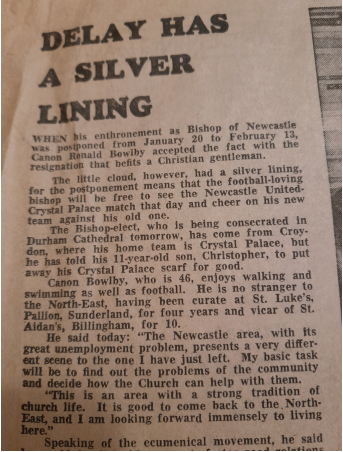
It seems he also told son Christopher, then aged 11, to “put away his Crystal Palace scarf for good”. That’s not how it usually works with father-to-son football allegiance and it took Chris, by now a pupil at the Royal Grammar School, time and soul-searching to comply.
But he did become an ardent Magpies fan… and would meet his future wife, Jane, now an archaeologist (and somewhat bemused by the football obsession, apparently), because she was a pupil at the girls’ school over the road in Jesmond.
She’s the daughter of the late poet Tony Harrison whose televised poem ‘V’, booted into life by the discovery of foul, football-related graffiti on a family gravestone, was the centre of a media storm-in-tea-cup in the 1980s.
“Quite an unusual pairing of grandads,” says Chris. “A poet accused of blasphemy by Mary Whitehouse (self-styled moral guardian) and a bishop. But it was a creative tension. They’d have great conversations at family get-togethers. My dad would talk to anyone and Tony, for all that his public persona was that of an angry atheist at times, wrote mystery plays that my dad loved and Ewan loved too.
“They didn’t require personal religious belief but were a celebration of the culture of religion.”
Chris toyed with an academic career but ended up in journalism, joining the BBC and becoming its correspondent in Prague (his writing today includes obituaries for The Times).

Ewan, says his father, had been, “technically and through his academic work”, a theologian, although he had considered it rather a “narrow” calling, akin to preaching from on high. He had enjoyed when at St Andrews (he did get there eventually) volunteering at the local Maggie’s centre, talking to the different people who passed through.
Based on this, says Chris, he had become interested in how people use culture to face up to a cancer diagnosis, embracing high end literature by the likes of Dante and Dostoyevsky and popular TV series such as Breaking Bad and Cold Feet.
“He’d started on a popular book arising from his PhD studies but ran out of time. He said to me, ‘Could you finish it?’ It was a big thing to take on but I thought it was a good way of ensuring his legacy.”
It’s called Borrowed Stories and you’ll find at the back of Chris’s book a page dedicated to it, along with praise from Rowan Williams, former Archbishop of Canterbury.
His own book, says Chris, arose from a conversation he had when getting Ewan’s into print. Someone asked, after he’d shared a vague idea: “Do you fancy writing about that too?”
Chris was worried at first how it would hang together with its autobiographical, historical and sporting threads.
“But once I started, it fell into place. I was aware I was jumping around a bit in terms of chronology and theme (stadiums, players, rituals, women’s football… there are many football-flavoured digressions) but I wanted to keep Ewan’s voice in there as well.
“The idea of it being a conversation helped. It’s really recording, in a sense, the kind of conversations we always had about football.”
The last Newcastle United match Ewan attended, with brother Alfie, was against Everton when Miguel Almiron scored a peach of a goal at St James’ Park. Chris received a text message from Ewan: “Sublime.” Like “no complacency”, it was another favourite from their shared football lexicon.
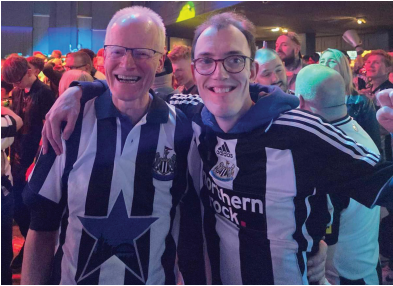
The Carabao Cup victory of 2025 came too late for Ewan. Chris and Alfie, having failed to get tickets, saw it on a big screen, both aware of how much Ewan would have relished the occasion.
Later, attending the first home league match after that famous win, Chris “was speechless with stinging eyes for several minutes” when confronted by the huge Wor Flags banner dedicated to ‘All the Ones Who Didn’t Make the Night’.
Here, he notes, in a summer when flags were becoming associated in many places with tension, hostility and division, was a moving display of “a community’s shared sense of its people and its past”.
Chris says that Ewan, with “characteristic generosity”, had wanted him and Alfie to go on enjoying football without him, but in the spirit they had all shared.
And so the “running conversation” goes on, not in person or in a text message flurry but in the heads of those left behind… and now also on the pages of this book.
No Complacency: Life, Death, Football and the Cathedral on the Hill by Chris Bowlby is published by Herne Books. https://www.hernebooks.com/product-page/no-complacency-a-memoir-of-football-grief-and-belonging
When the Pope calls
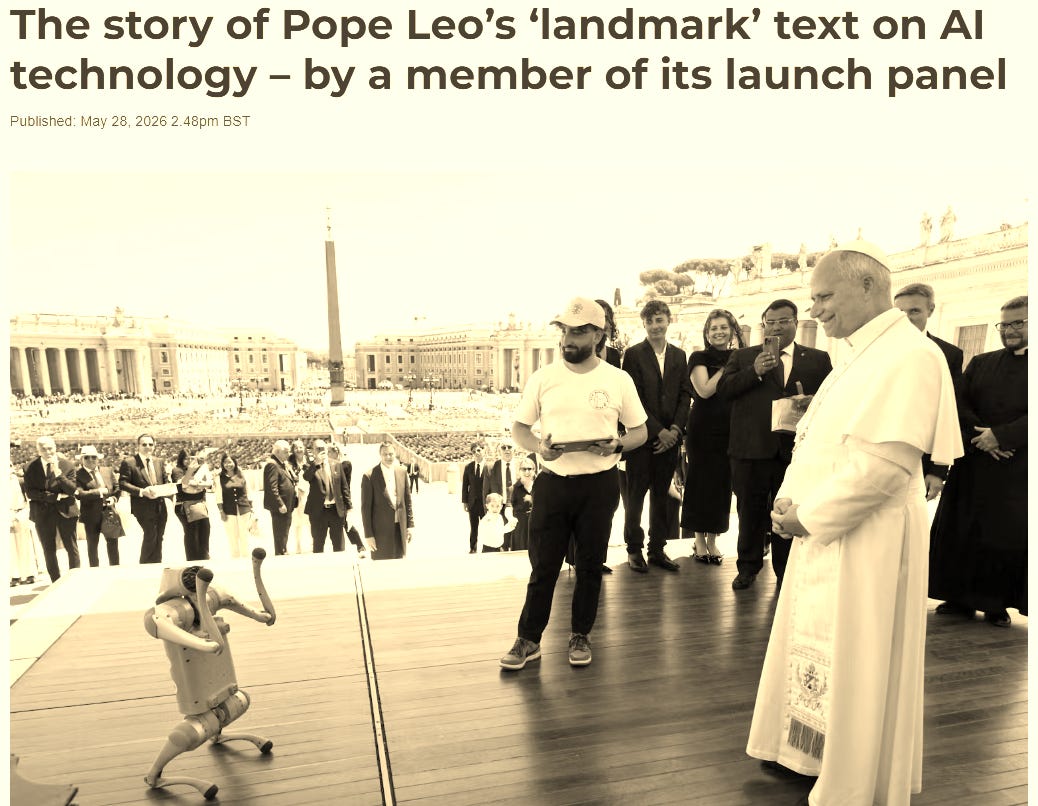
A little while ago, Anna Rowlands, professor of Catholic social thought and practice at Durham University, received a surprising request, says Mike Herd, senior science and technology editor at The Conversation.
Would she be willing to help Pope Leo XIV launch his first social encyclical – a papal pronouncement on one of the biggest social issues facing humanity? The topic, AI technology, was bound to be contentious. The decision to select Chris Olah, co-founder of AI tech firm Anthropic, to sit alongside Anna on the advisory panel made it more so.
She has written an article on how this landmark text came about. “In the run-up to launch,” she writes, “questions over the make-up of the panel and how equipped a pope is to comment on AI showed me this text would be controversial. And that’s OK.” You can read her article by clicking here.
How could you forget the Maserati?
A local authority in London decided to have a crackdown on vehicles abandoned on public roads. In just seven months, Ealing Council confiscated some 1,000 cars - including a Maserati, Rolls Royce, Jaguar and several Audis. A machete and class A drugs were found in one car. The Ealing Times has the full story.
All that glitters…
Publishers in the UK and US have fallen victim to another AI-generated hoax. The New York Post, the Telegraph, GB News, The Sun, Mirror and Express are among titles that ran with the story of five burly Thai cops who donned sequin-encrusted dresses to go undercover as a drag dance troupe to arrest a drug dealer.
The story was made by an image of the cops looking like the least convincing drag queens in history, reports Press Gazette. Sadly the story was too good to be true and the image was an AI-embellished fake.