

Read all about it - or maybe not
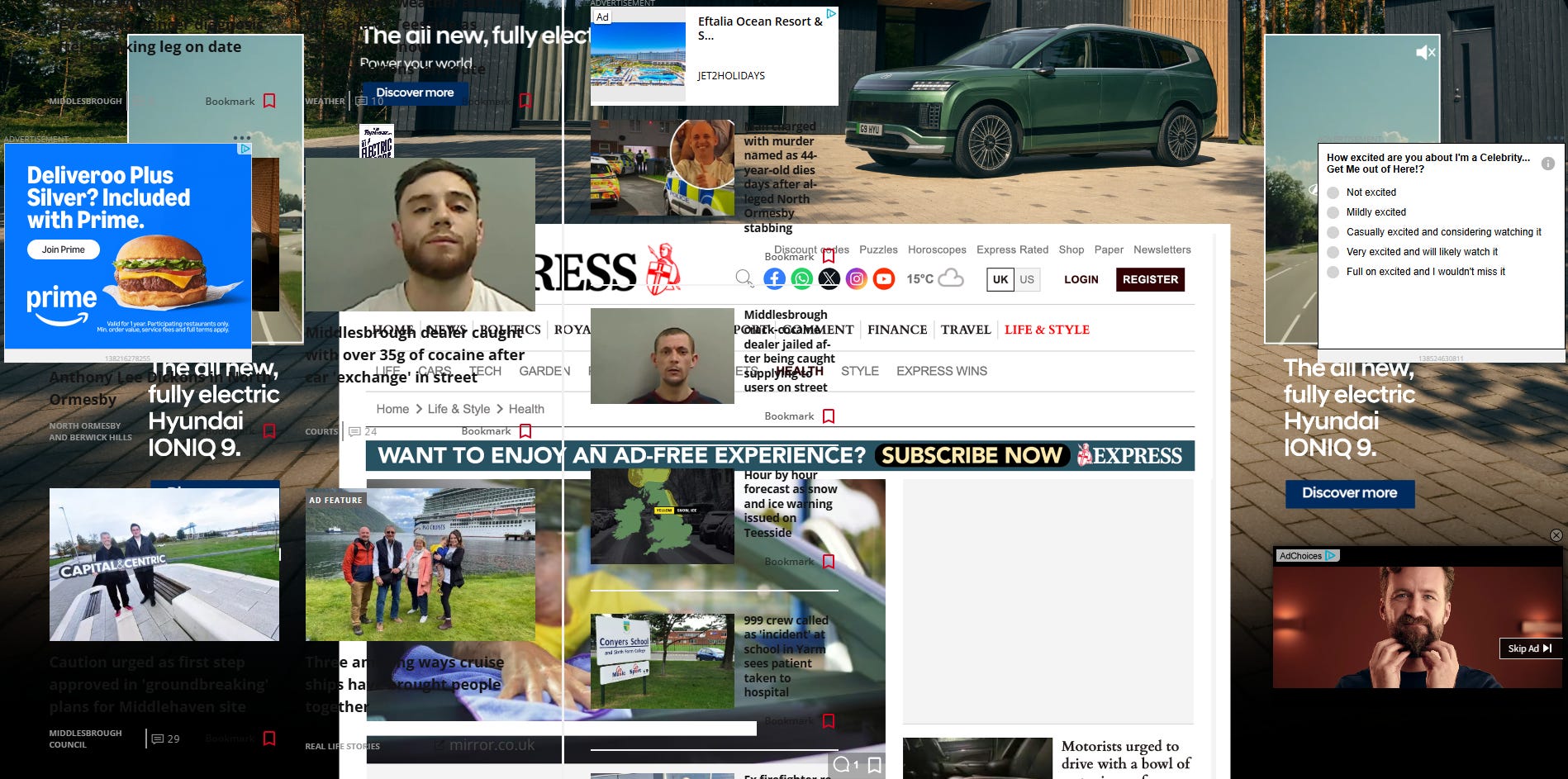
I don’t need to be told how frustrating it can be trying to read a story on a newspaper’s website. This week I encountered the worst I’ve seen.
I clicked on a regional news website and this is what I was presented with. I don’t know why anything from the Daily Express was on screen - although the newspaper in question is from the same organisation. Ad-free experience anyone?
Today’s main article is another Life Through A Lens feature where photographer Christopher Owens selects 10 of his favourite photographs and gives some interesting background stories to them.
Why presenting Sir John Hall with a bunch of roses made a difference, the portrait of a politician that became a regular for satirical artist Cold War Steve and made the caption competition on Have I Got News For You, how Rory Stewart came to be hanging upside down from a tree swing, and the background to the momentous shot of Sam Fender as hears he has won the Mercury Prize.
But first a few Eyes & Ears extras.
Funding getting fairer
The anticipated Fair Funding formula for councils is a bit like the forthcoming Budget - nothing has been announced yet but there is feverish conjecture over what is and isn’t going to happen.
Analysis by the Institute for Fiscal Studies in the summer unexpectedly found some deprived areas such as South Tyneside, Sunderland and Gateshead were set to lose out in the proposals for revising the way local authorities are funded.
But The Guardian reports that tweaks have been made to the formula and the three North East councils are now expected to be among the beneficiaries.
Money is expected to be redirected from affluent rural areas to urban councils hit hardest by austerity - with Durham expected to be among the biggest winners.
That will be a welcome piece of news for the Reform-led council as North East Bylines reported this week that the black hole in its budget has grown by £11m and its cabinet forced to approve a £10m list of proposed cuts and increases in charges.
But the measures will still leave the county council with a deficit of £72mn over the coming four years unless councillors agree more cuts or council tax increases or use of reserves or a combination of the three. Without the £10m cuts now being proposed the four-year deficit would be £82.1mn.
A quick word
Northern has unveiled its ‘30 by 30’ plan – an ambitious, data-driven strategy to grow annual customer journeys by 30 million by the end of the decade. The plan outlines how the operator will achieve long-term growth through a combination of organic demand, better performance and targeted strategic interventions that will make rail travel easier and more reliable. Gateshead council leader Martin Gannon has admitted “we need to do better” after a survey of more than 3,000 residents showed only 21% were happy with how the council runs its services. Nice story about Teesside offshore worker Christian Jones who was just sitting down to enjoy a Thai curry with friends when someone knocked on the door and told him he had won £1m in the Omaze Monthly Millionaire Draw. He won’t be going back to the rigs. Professor Chrisina Jayne, Dean of the School of Computing, Engineering, and Digital Technologies at Teesside University has been included in Computing magazine’s Tech Women Celebration 50 list for 2025. The Spennymoor branch of Hays Travel has been crowned Best Travel Business in England’s Business Awards which celebrate excellence across a wide range of industries. Newcastle Airport is urging drone users to fly responsibly after a massive increase in the number of people using them in its Flight Restriction Zones, which extends for 5km around the airport. The first saplings grown from the Sycamore Gap tree were planted yesterday and the National Trust say more plantings will take place in Hexham, Leeds and Sunderland this week.
Life Through A Lens: Christopher Owens
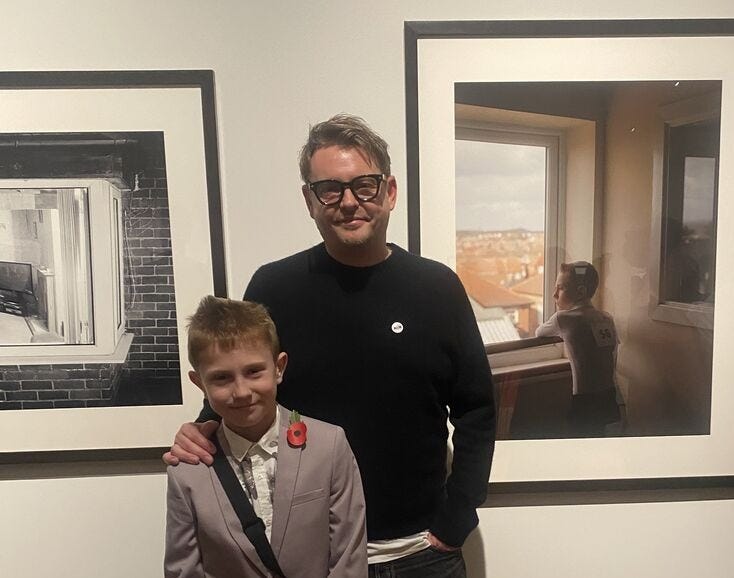
The work of Newcastle-based photographer Christopher Owens is currently on display in the National Portrait Gallery.
His photograph of a young ballroom dancer looking out of the window of his dance studio in the city’s West End was selected for the prestigious Taylor Wessing Portrait Prize at the London gallery.
Dancer Abe travelled to London with his mum Danielle Brough, and the BBC have a video of what the 11-year-old made of seeing himself in the exhibition which runs until February 8.
Christopher, who is known for his bold, character-driven portraits and strong narrative approach, is the latest to take part in our occasional Life Through a Lens series where photographers select their standout pieces of work and explain a bit about them.
You won’t be surprised to learn that Abe features in what you are about to see - and there’s a cracking picture of Sam Fender at the end when he hears he was won the Mercury Prize.
Sir John Hall
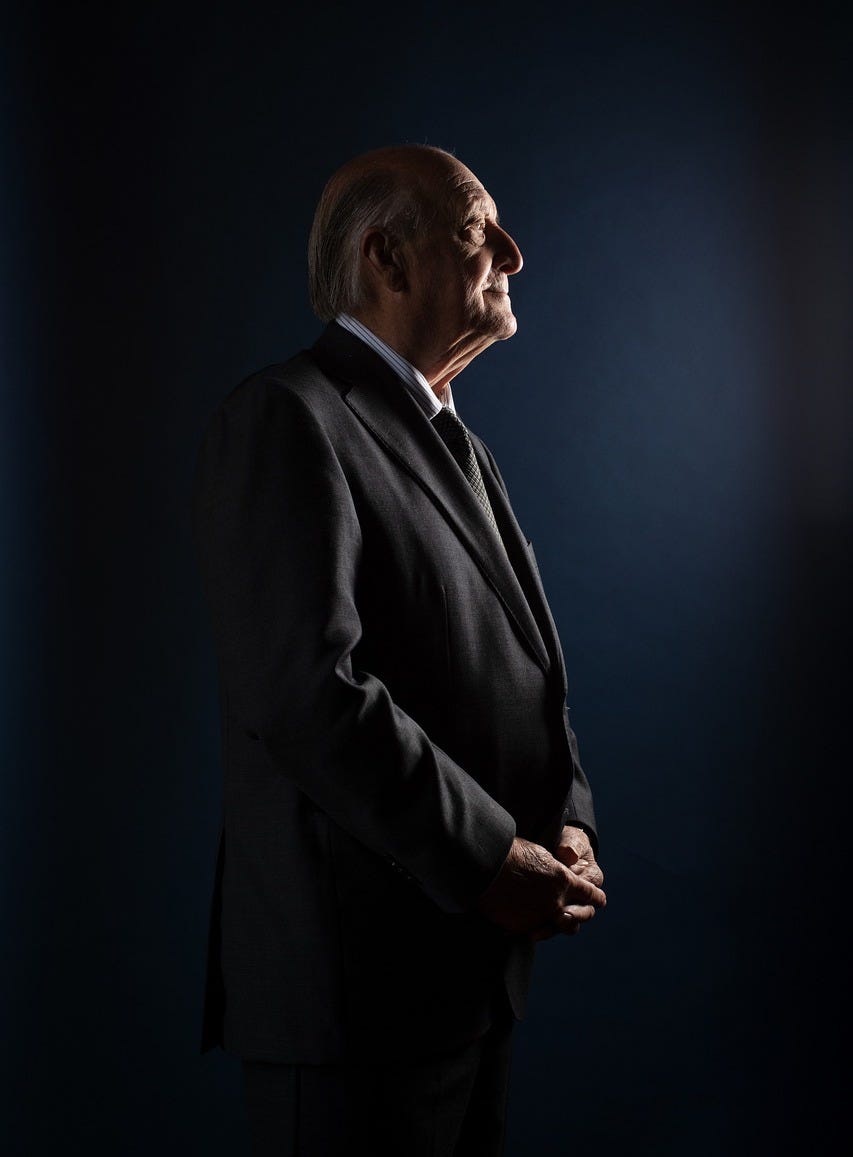
Portrait photography is often defined by constraints — time, location, personality. With Sir John Hall, I had two of those challenges: limited time, and a subject with a reputation for being somewhat prickly and occasionally uninterested in the point of a photoshoot. The assignment, for North East Times, was at Wynyard Hall. We had an hour to complete an interview, a portrait session, and a short film.
I’d photographed Sir John a couple of times before on PR jobs, but I’d never captured anything I was proud of; he typically wanted to do the bare minimum. I knew from previous shoots, however, that he had a deep passion for roses. Hoping to win some goodwill, I brought him a bouquet of white roses. I suspect I may be the only man ever to present Sir John Hall with flowers.
He was genuinely touched. I also mentioned that my maternal family is from Ashington and that I was born there too. Whatever combination of roses and shared geography did it, the shoot suddenly opened up. We made portraits with the roses, tried different set-ups, and he later drove us around the estate in his Range Rover —seatbelt alarm blaring because he refused to put his on.
From the interview, it was clear he was entering a reflective stage of life, thinking about legacy. I think this portrait captures that — classic, timeless, contemplative. A couple of weeks later he phoned to thank me and asked for prints for his family book chronicling his life. For a man I share almost nothing in common with, besides Ashington and an appreciation for roses, it meant a great deal.
Matt Hancock (in the news this week!)
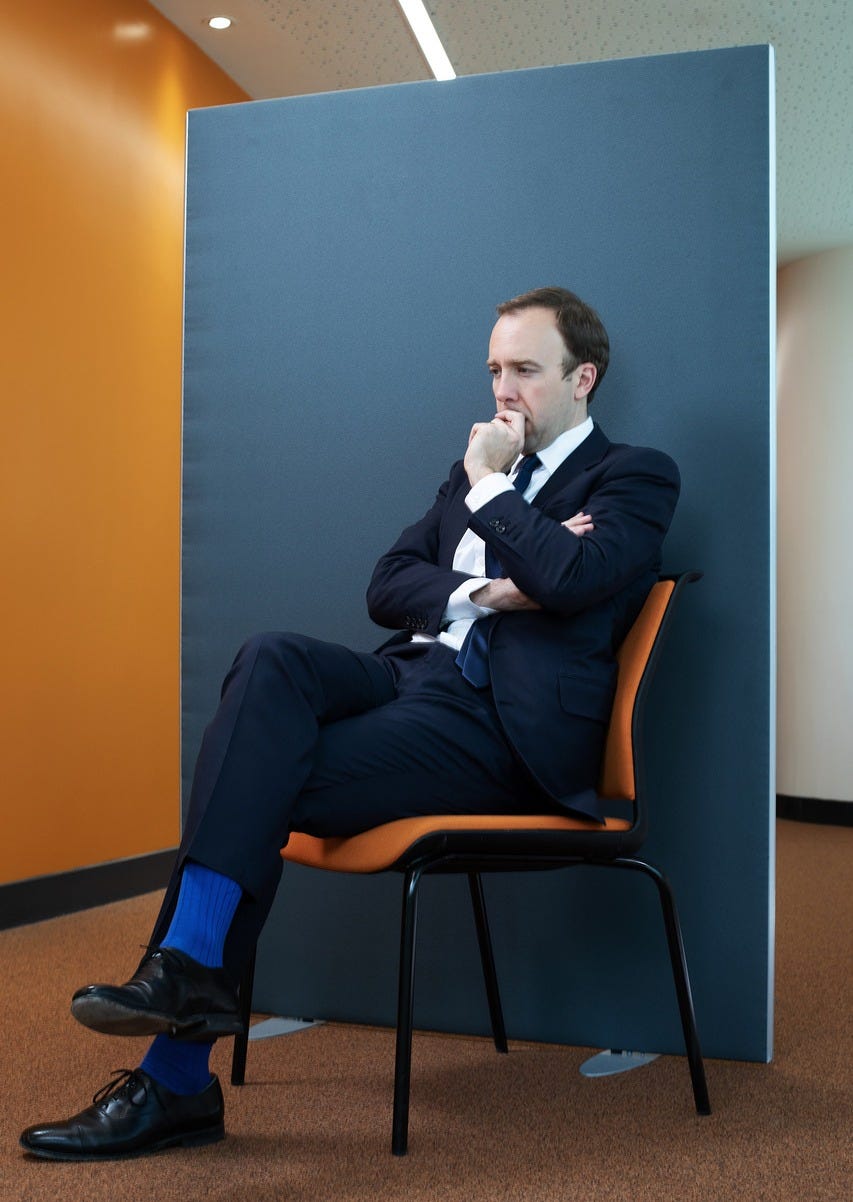
Some photographs acquire new meaning with time. In 2019, I was commissioned to photograph Matt Hancock — then Minister for Digital and Culture — for a tech magazine that ultimately never launched. He was speaking at Newcastle’s Urban Sciences Building, and I was promised five minutes after his speech.
I barricaded a makeshift ‘studio’ near the exit using an office pod divider — half to keep him in, half to keep eager audience members out. His talk had gone badly; he’d mixed up Newcastle and Gateshead. One of his entourage informed me I now had only a single minute.
The session was tense. He gave me nothing but a strained grin. At one point he remarked: “Good practice.” “Good practice for what?” I asked. One of his advisors chimed in smugly: “The Minister is being photographed by David Bailey next week.” They all laughed. Already irritated by their condescension, I shot back: “Are you giving David Bailey more than 60 seconds?”
But then — my moment. Hancock sat down, crossed his legs, and revealed bright Tory-blue socks. That was the picture.
Months later he was Health Secretary in the Covid crisis. The expression that once looked strained suddenly looked haunted. Satirical artist Cold War Steve began using my image almost daily. Then came the affair scandal. Watching Have I Got News For You one night, I saw my photograph as the caption competition image — Hancock being mercilessly roasted. A cheque from Getty arrived shortly afterwards.
Taka Suzuki – Paralympic gold medallist swimmer
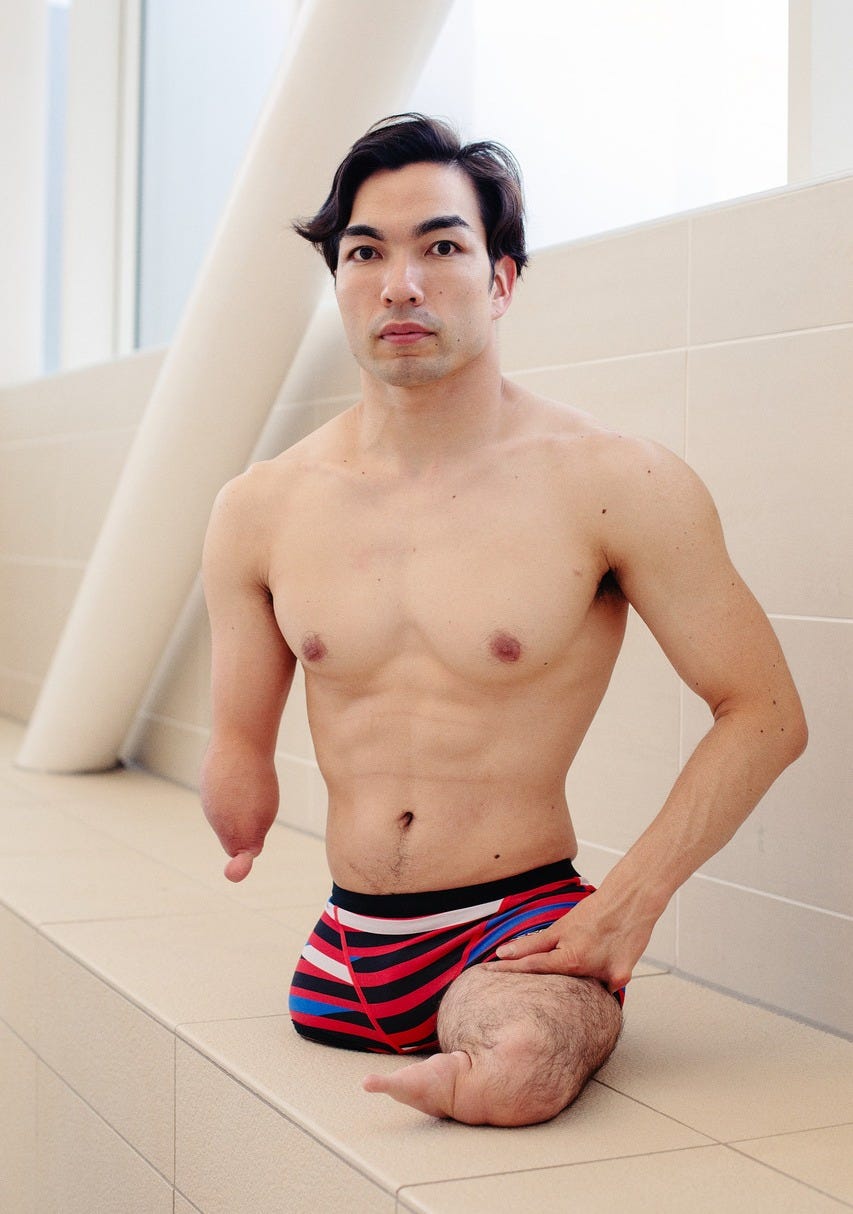
I’m always looking for remarkable stories, and my friend Michael Wood, Assistant Professor in Sports Management at Northumbria University, has often been the one to point me towards them. He told me about Taka Suzuki, a Japanese Paralympian who was studying and training in the North East. His story was extraordinary, and I immediately pitched a photo essay to North East Times.
We shot at Northumbria Sport Central, making use of the pool for action shots, but it was a quiet, powerful portrait that stayed with me. It’s a heroic image that asks viewers to confront their own assumptions about disability. Taka’s physical difference is visible—yet what you really see is an elite athlete whose determination and resilience are written into his body.
The image won the British Journal of Photography’s Portrait of Humanity award. With exhibitions cancelled during Covid, the organisers sent a screen containing the work into space — a surreal twist that I love. Somewhere out beyond the stars, this portrait of human strength was beamed into the void.
Sir Keir Starmer
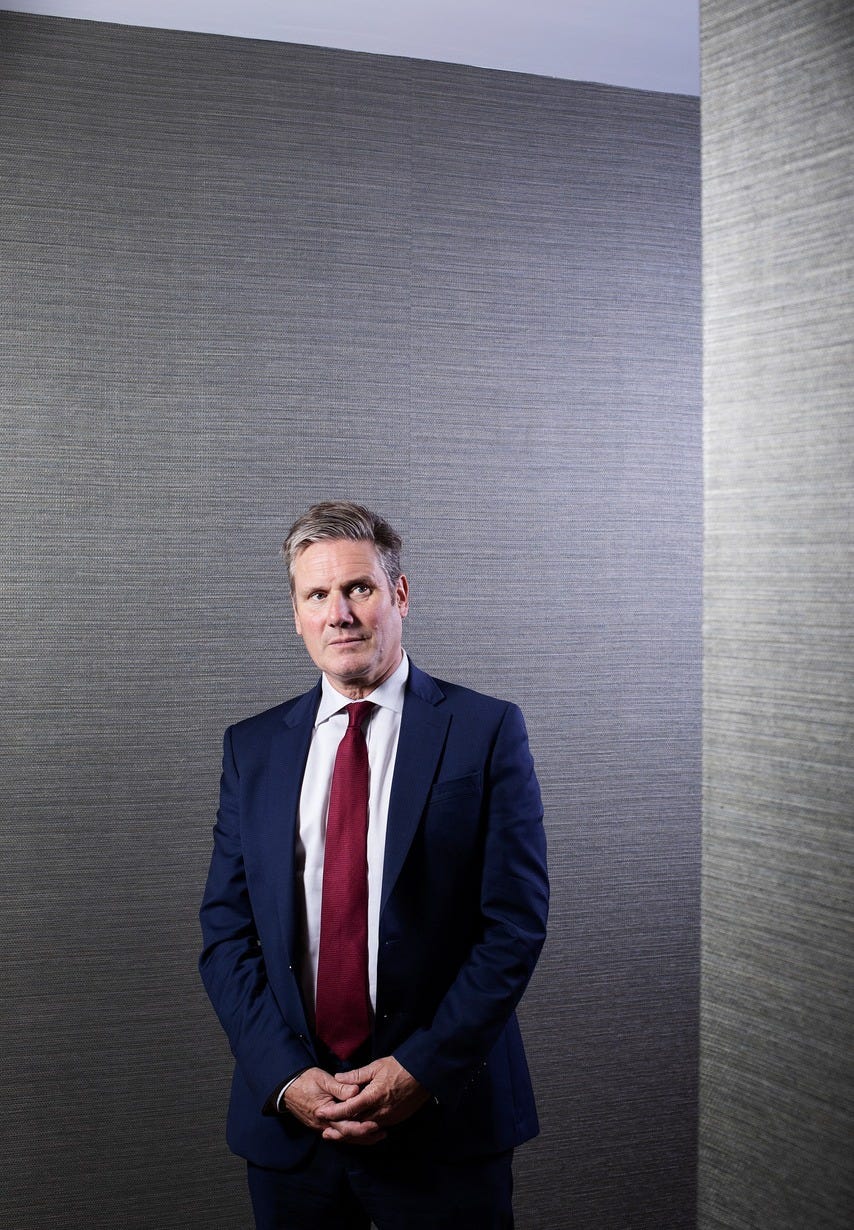
In 2019, I was asked to photograph Keir Starmer while he was in Sunderland speaking at the NECC Presidents’ Lunch for Contact, the Chamber’s magazine. As is typical with politicians, I knew I’d only get a minute or two with him. The landscape then was very different: pre-Covid, a Tory government, and a general election looming. I suspected Labour would face another defeat and would soon be looking for a new leader. Keir, then Shadow Brexit Minister touring traditional Labour territories, seemed to sense the same.
The only snag? The shoot fell on September 13, my wedding anniversary. I had planned a day off and a nice lunch with my wife, Hannah. Fortunately, Han is extremely understanding. When she asked what she was supposed to do while I nipped off to photograph Keir Starmer, the solution was obvious: bring her along as my assistant.
When we arrived, we learned Keir was delayed on a call with the Shadow Cabinet, which meant my already tiny window was shrinking by the second. When he eventually appeared, he was unlike many politicians I’d photographed — no entourage, no fuss. Sensing an opportunity, I introduced myself and, without thinking, added: “And this is my wife, Hannah who you owe an apology.” He looked taken aback. I explained that it was our anniversary and that I had dragged her with me. He laughed, apologised warmly, and the ice was broken. It bought me a few extra minutes— perhaps out of guilt for Hannah or sympathy for the man who’d brought his wife to work on their day off.
Maysa – Skateboarder
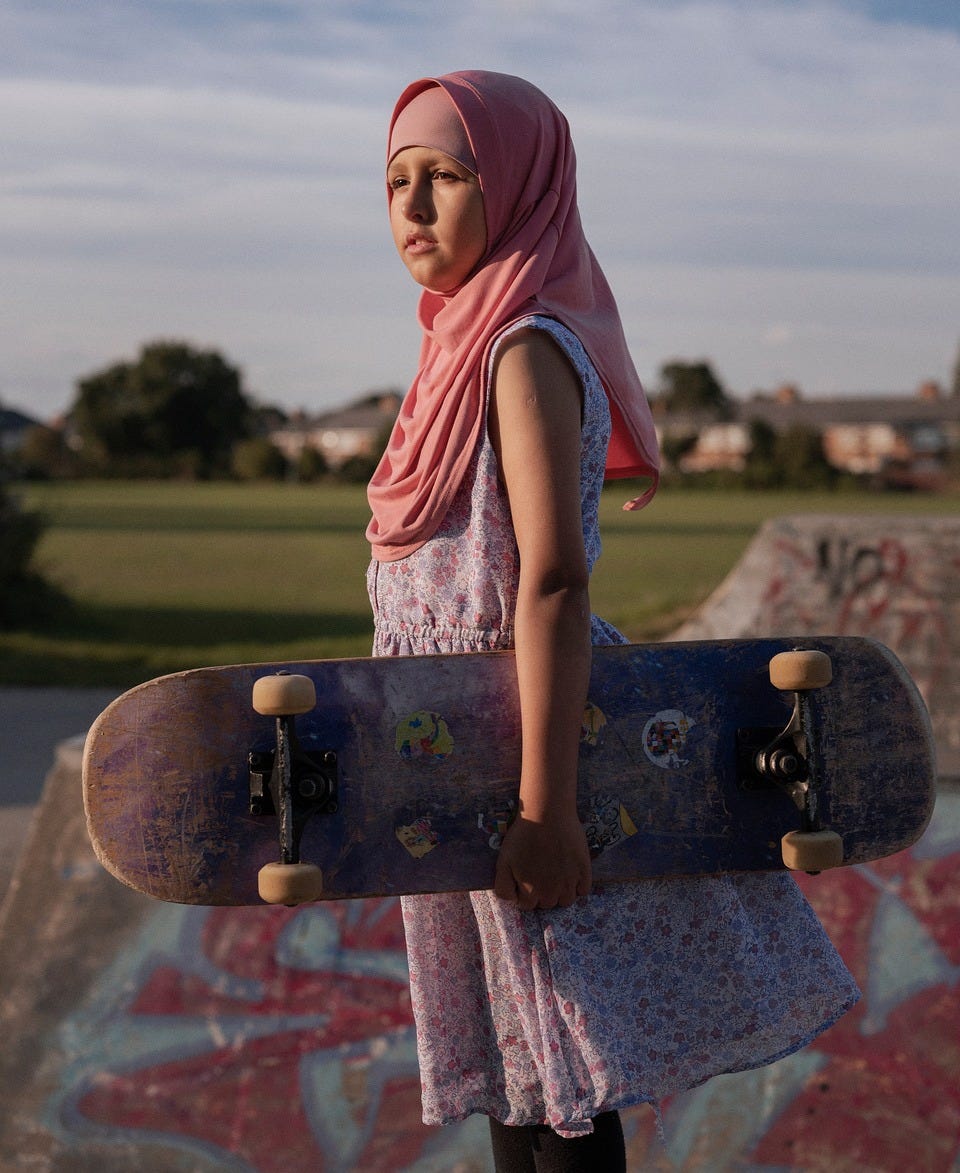
In 2020, I began a personal project on female skateboarders after noticing how much of the sport’s imagery was still defined by a macho, male-centric aesthetic. In exploring the scene, I discovered a trio of sisters in Hull blending their Muslim heritage with skateboarding culture. They lived too far away for an immediate shoot —but, by coincidence, I was booked for a job in Hull that same week.
Their skatepark was two minutes from my hotel. The light that evening was magical. I shot a series of portraits I remain proud of. One was selected for Portrait of Britain, featured in the annual book, and displayed nationwide on digital billboards. The unexpected bonus was the online community that formed among that year’s selected photographers. In an industry where you often work alone, that sense of camaraderie was a prize in itself.
Sharon Armstrong – Menopause educator
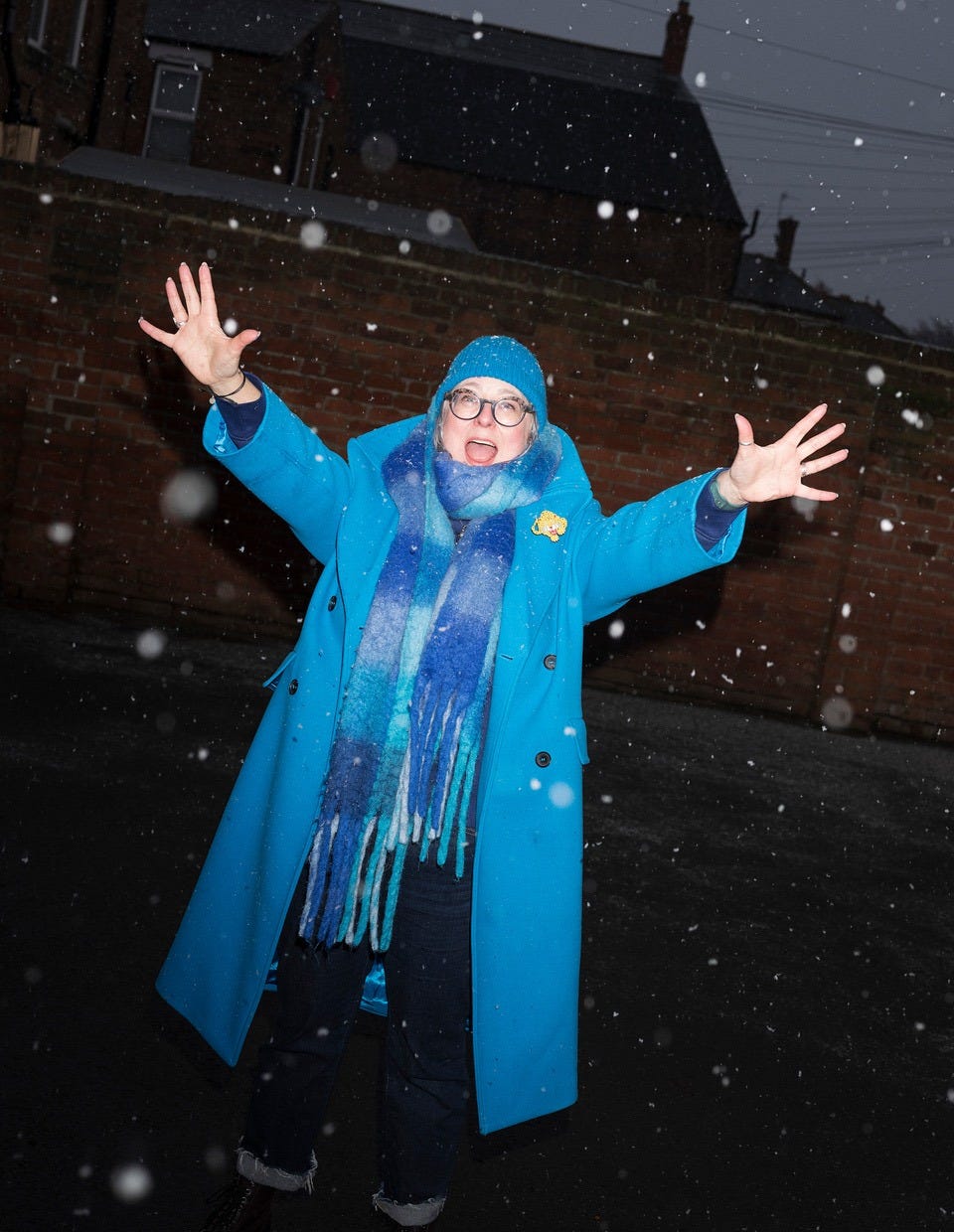
In late 2022, I launched Pattern, an editorial platform dedicated to telling under-reported human stories about working lives in the North East. Having spent nearly two decades in magazines, newspapers, and digital publishing, I’d long felt that many brilliant personal stories were slipping through the cracks of traditional media.
Sharon, known widely as Miss Menopause, was an early subject. Her work educating both women and men about menopause is transformative, and I felt it deserved a wider audience. The portrait itself is simple but bursting with character. Sometimes we overcomplicate things in photography, but this image is just Sharon: direct, joyful, passionate. I shot it with a single flashgun on a snowy day, which made the colours sing.
It went on to win the Shot Up North Award (2023) — a reminder of a mantra I hold strongly: personality always wins.
Rory Stewart – Political commentator and former Cabinet minister
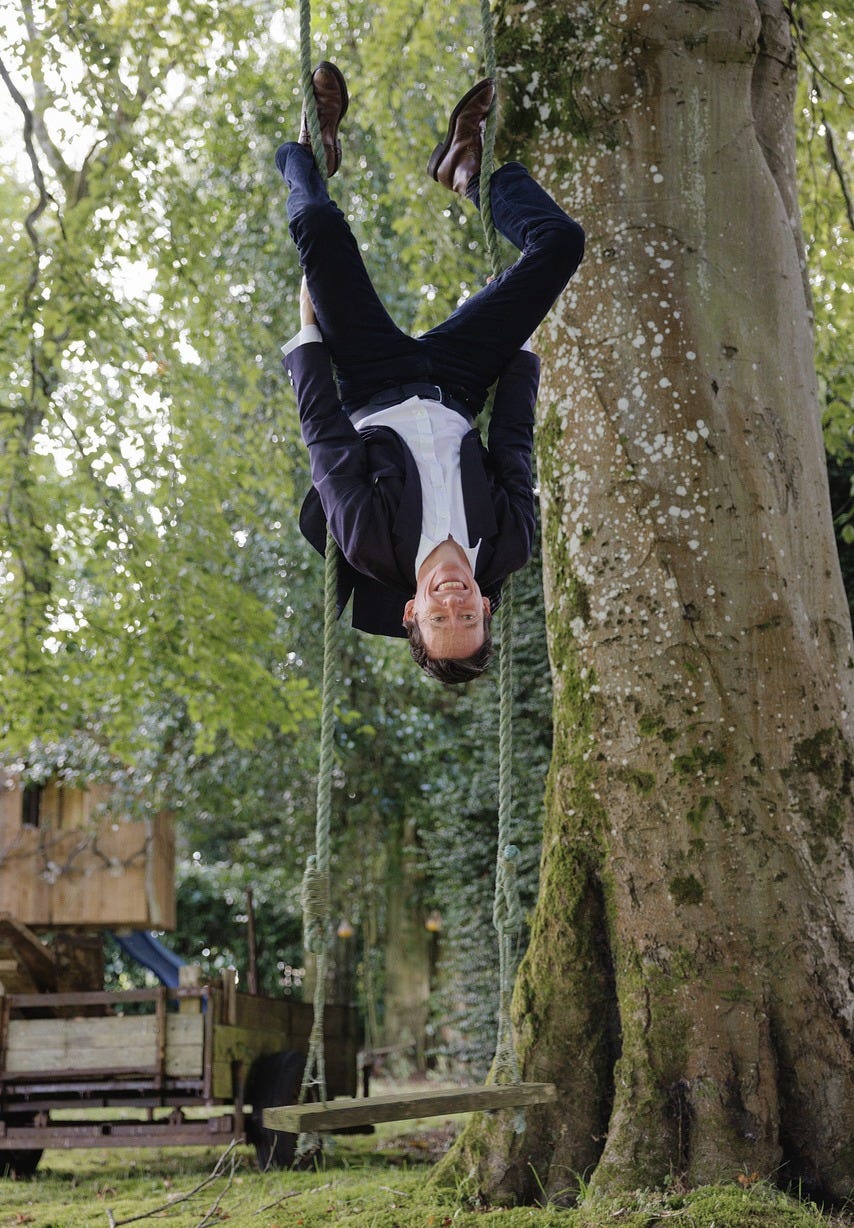
I’m occasionally commissioned by The Guardian and The Observer to photograph people based in the North. One such assignment took me to Crieff, Scotland, to photograph Rory Stewart for The Guardian Saturday Magazine. I’m a fan of his podcast with Alastair Campbell, so I was genuinely excited.
After shooting some potential cover portraits in a makeshift studio I built in his living room, we wandered into the garden with his young son, Sacha, joining us — in part acting as self-appointed art director. A swing hung from a tree outside the house. I suggested it as a possible shot and Rory immediately replied: “I can hang upside down if you’d like?” You never say no when a subject offers physical peril for a portrait.
The final image, though unused in the spread, is one of my favourites: he’s almost unrecognisable, suspended upside down, echoing the topsy-turvy politics he often analyses.
Abe – Dancer
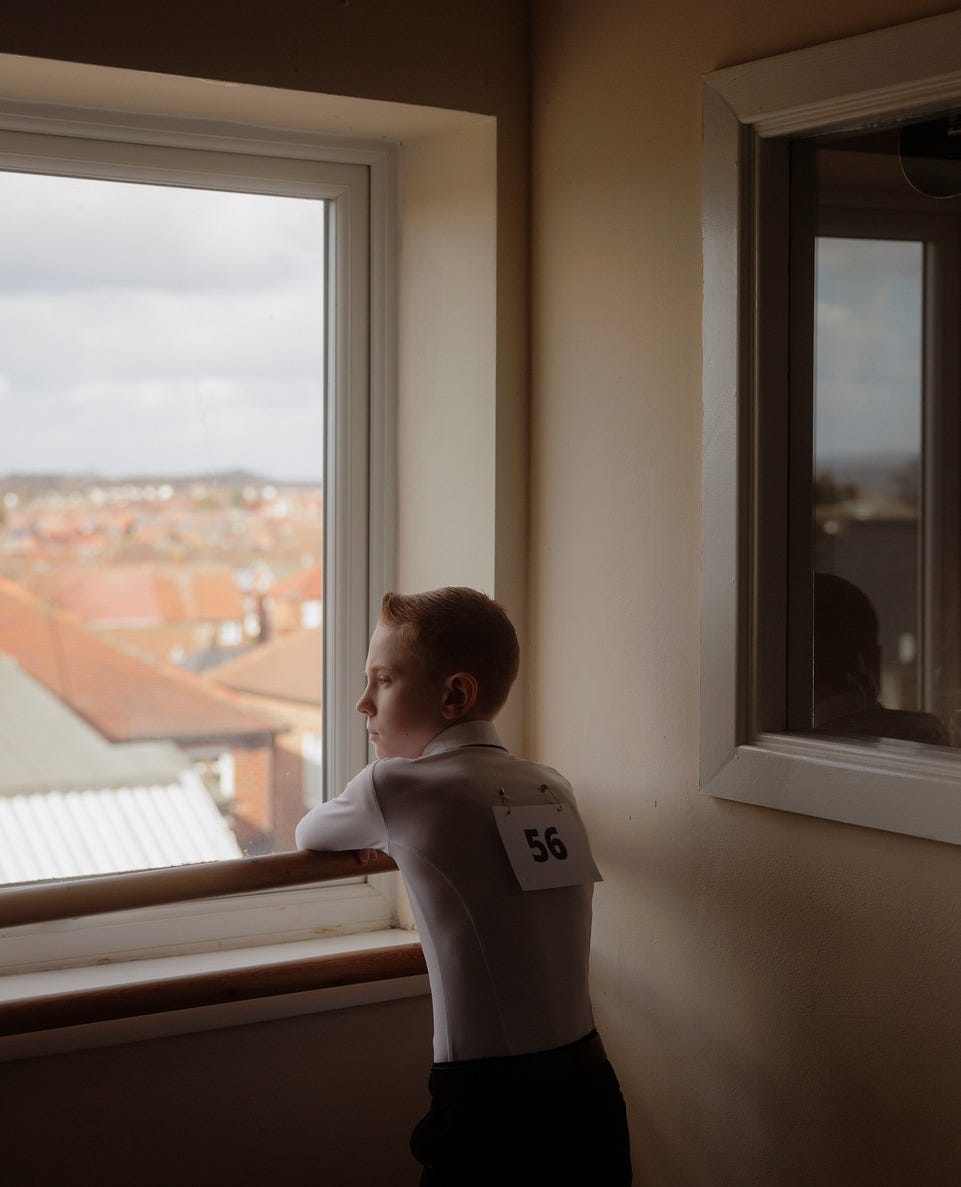
I photographed Sarah Tempest and Dan Brough of Ladies, Wine & Design, a community celebrating and supporting women in the creative industries, for a Pattern feature. After the shoot, Dan and I followed each other on Instagram, where I soon came across videos of her 11-year-old son, Abe, competing in ballroom dancing.
I knew instantly it would make a powerful photo story. We arranged to shoot at his dance studio in the West End of Newcastle. Some shoots fight you. This wasn’t one of them. Everything aligned. One image shows Abe alone, looking out over the rooftops, competition number pinned to his back — a poignant mix of determination, vulnerability, and quiet resilience.
For years my mentor, the portrait photographer Harry Borden, told me to keep entering competitions. This year, Abe’s portrait was selected for the Taylor Wessing Portrait Prize at the National Portrait Gallery — one of the highest honours in portrait photography. It’s also shortlisted for Portrait of Britain, making it a rare double. We attended the opening together — it was made even more special when I saw Harry also had a portrait in the exhibition, of Keir Starmer no less.
Unnamed Boy – Last day of school
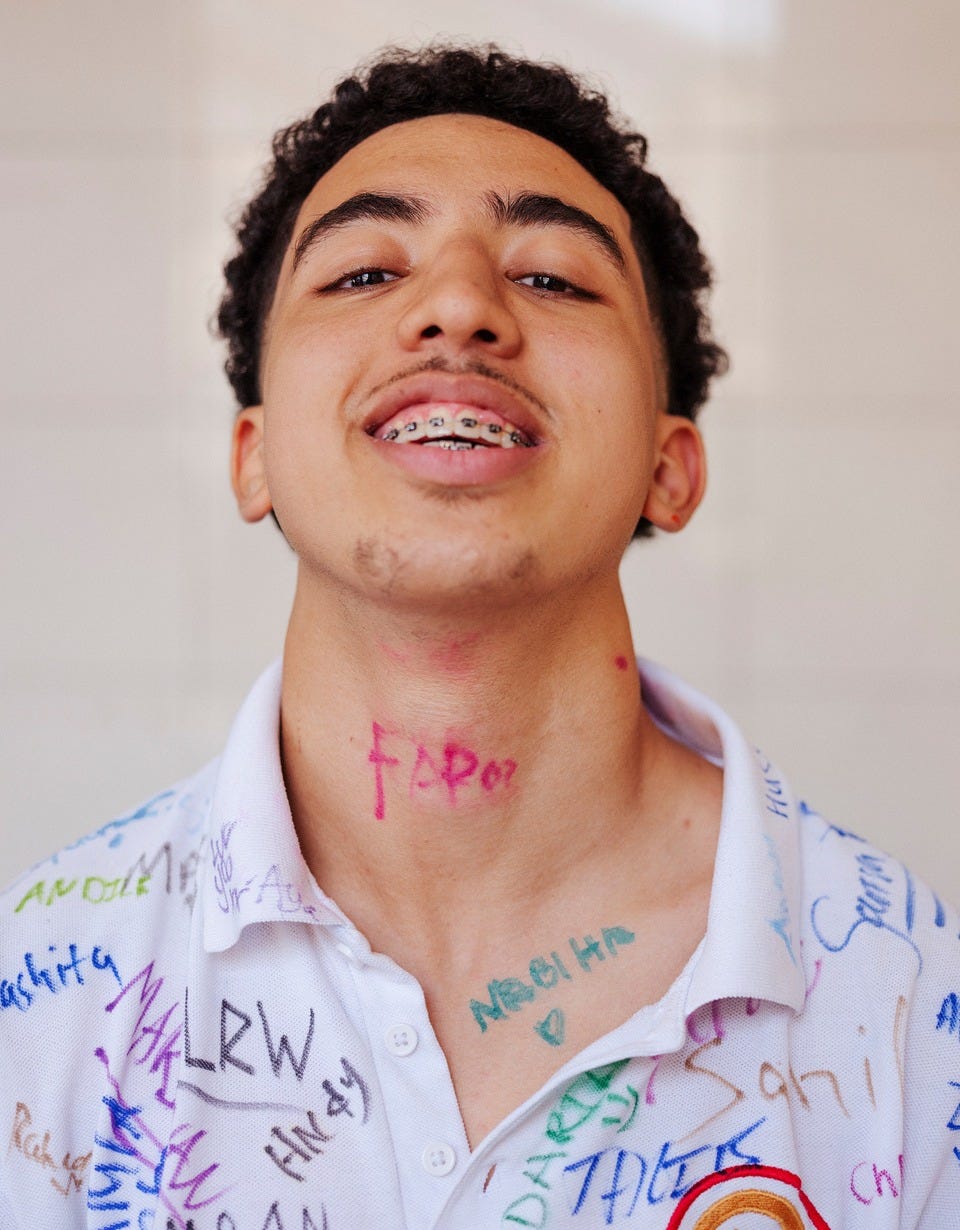
Always carry a camera. Even when you don’t expect to need one. I’d just finished giving a talk on authenticity in portraiture at the brilliant Design Talks series run by Layers Studio and was walking to meet a friend for a quick pint. A group of lads came towards me in polo shirts covered in scribbles and signatures — last day of school tradition.
I asked if I could photograph them and pulled out the Fuji medium format camera I often carry. Within seconds the quiet street turned into a full-blown impromptu shoot on the corner of Gallowgate and New Bridge Street. Once they clocked my Instagram blue tick, they were all lining up.
The picture takes me straight back to that feeling of being 16 — the joy, the invincibility, the sense that adulthood is miles away. The image has since been shortlisted for the Portrait of Britain prize and book.
Sam Fender
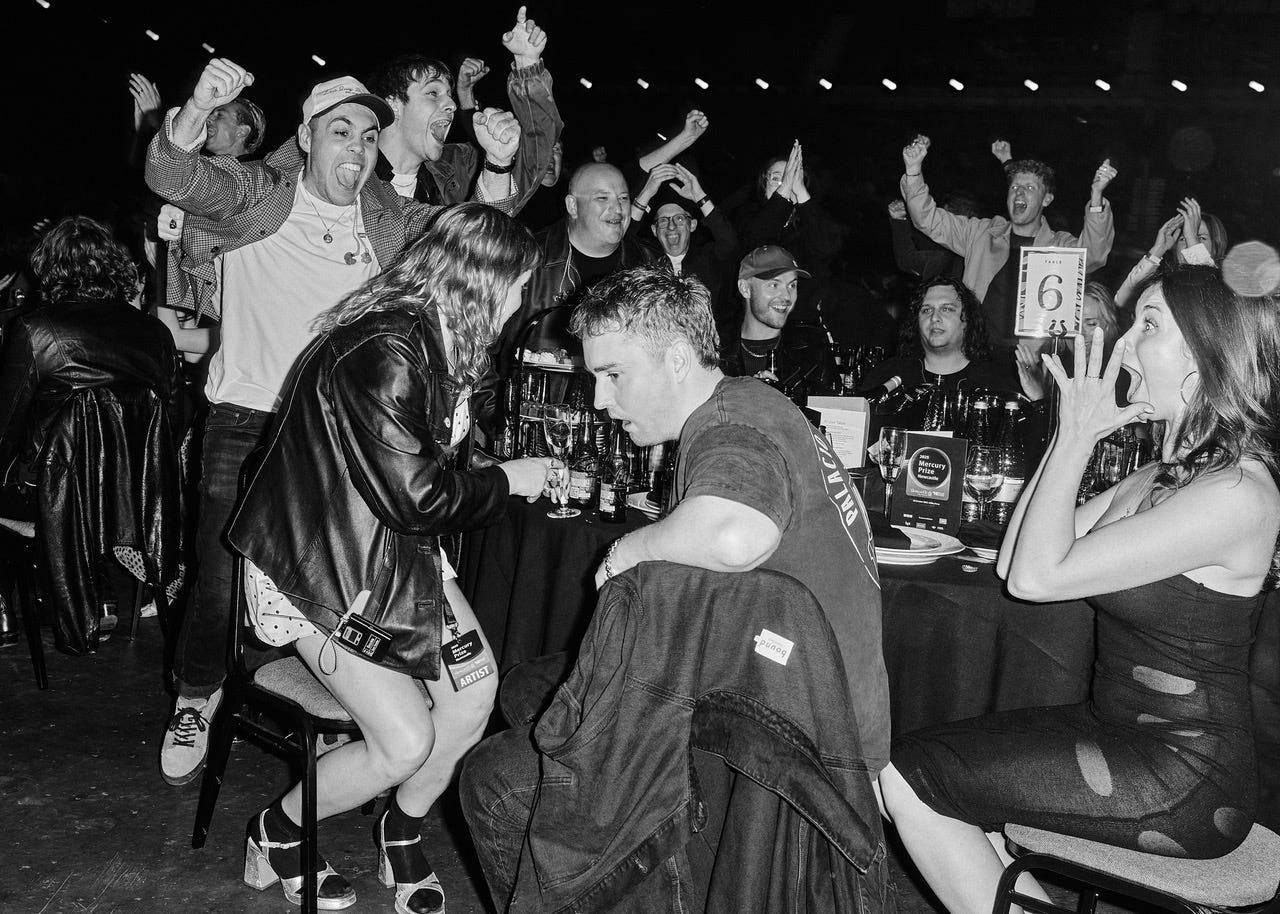
A more recent image, but the old saying is true: you’re only as good as your last shot.
Ahead of the Mercury Prize coming to Newcastle, I was commissioned by the council and Generator to photograph the fringe events and the awards evening. Although I don’t shoot a huge amount of event work these days, I knew how significant it was for the city — and music has always been a love of mine. I started out photographing bands, before shifting focus towards business and editorial storytelling in the North East, so this job felt like the perfect blend of the two worlds.
Access on the night was tricky; everything was heavily controlled by the BBC and the press teams. After some strong encouragement from Jim Mawdsley, Mick Ross and Christian Cerisola, (“You need Chris Owens on that floor”) I eventually got access —though technically only for a short window. Naturally, I stayed longer, drifting between tables hosted by people I knew who could shelter a roaming, unauthorised photographer.
As the evening built towards the big announcement, I decided to take a gamble. I chose the Sam Fender table and put all my chips there. If someone else won, so be it—but if Sam won, the room would erupt.
He did. And it did.
I pushed through the crush, past press photographers, past BBC cameras, and fired off a rapid burst. Sam’s jaw dropped, stunned, vulnerable, overwhelmed, as Newcastle exploded around him. It’s not the most conventionally flattering picture, but it feels true. Honest. Human.
Hey, great read as always. That web jumble is just infuriating, so relatable. Your 'Life Through A Lens' pieces are always a highlight; loved these background stories even more then the last one!