

We promise you quality stories told by quality storytellers. We have another one for you today, this time from former Guardian columnist Harry Pearson, who has posted an article from Northumberland where he now lives.
What’s he writing about? Here are some clues:
“Powerful shoulders and gleaming black eyes that simmer with the kind of surly menace that would send bosoms heaving in a Gothic bodice ripper”, cutting toenails in bed, “memories of a pub gent’s toilet on a Saturday in 1975, albeit without the bass notes of Brut and yesterday’s cabbage”, Catherine the Great, and being “faithfully polygamous”.
You probably have to be a member of The 1% Club to guess that the answer is sheep. Yes, sheep. You’ll have to read it to believe me - but you won’t regret it.
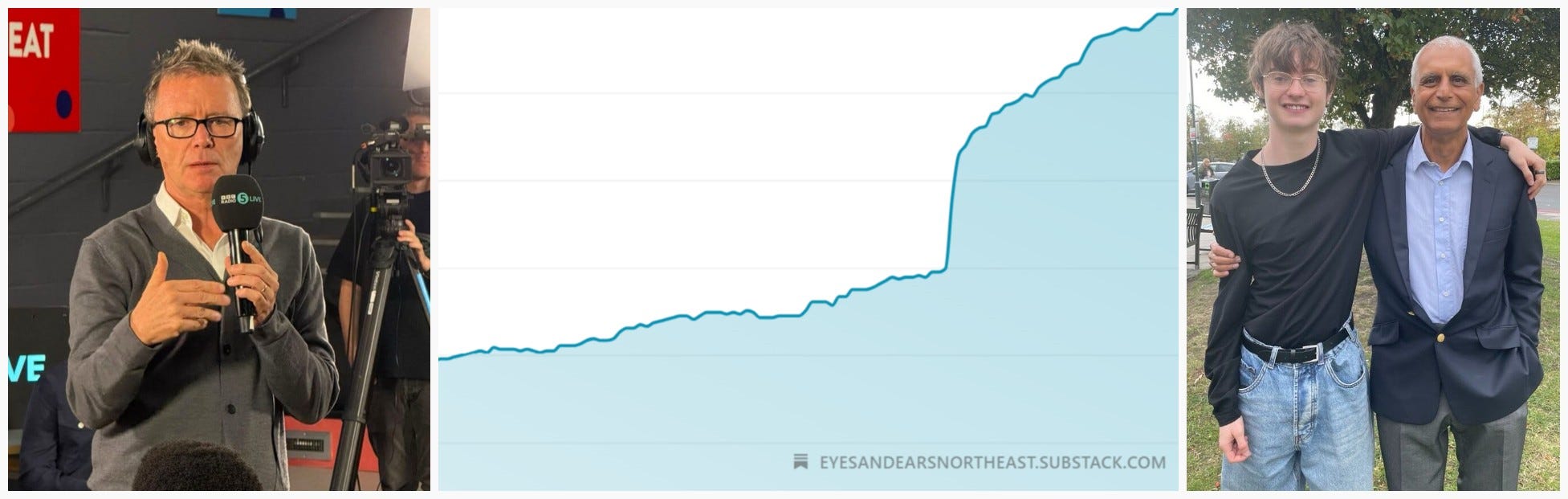
Also in today’s edition there’s the pioneering Newcastle heart surgeon who you can see on TV tomorrow night receiving a Pride of Britain lifetime achievement award, which he knew about. Then being joined on stage by 19 young people who are still alive thanks to his skills, which he didn’t know about. Barely a dry eye in the room.
And Newcastle College students are still buzzing after hosting Rachel Burden, Nicky Campbell and the BBC Radio 5 Live crew for live broadcasts yesterday morning - and taking part in a Teen Summit.
Brian Aitken
Editor
Words matter
A milestone was reached yesterday - The Source now has 3,000 subscribers. Here’s a graph which shows how our database has grown over the last 180 days - and it’s not difficult to see when our launch event with Steph McGovern (I’ve got news for you) at the Helix was held.
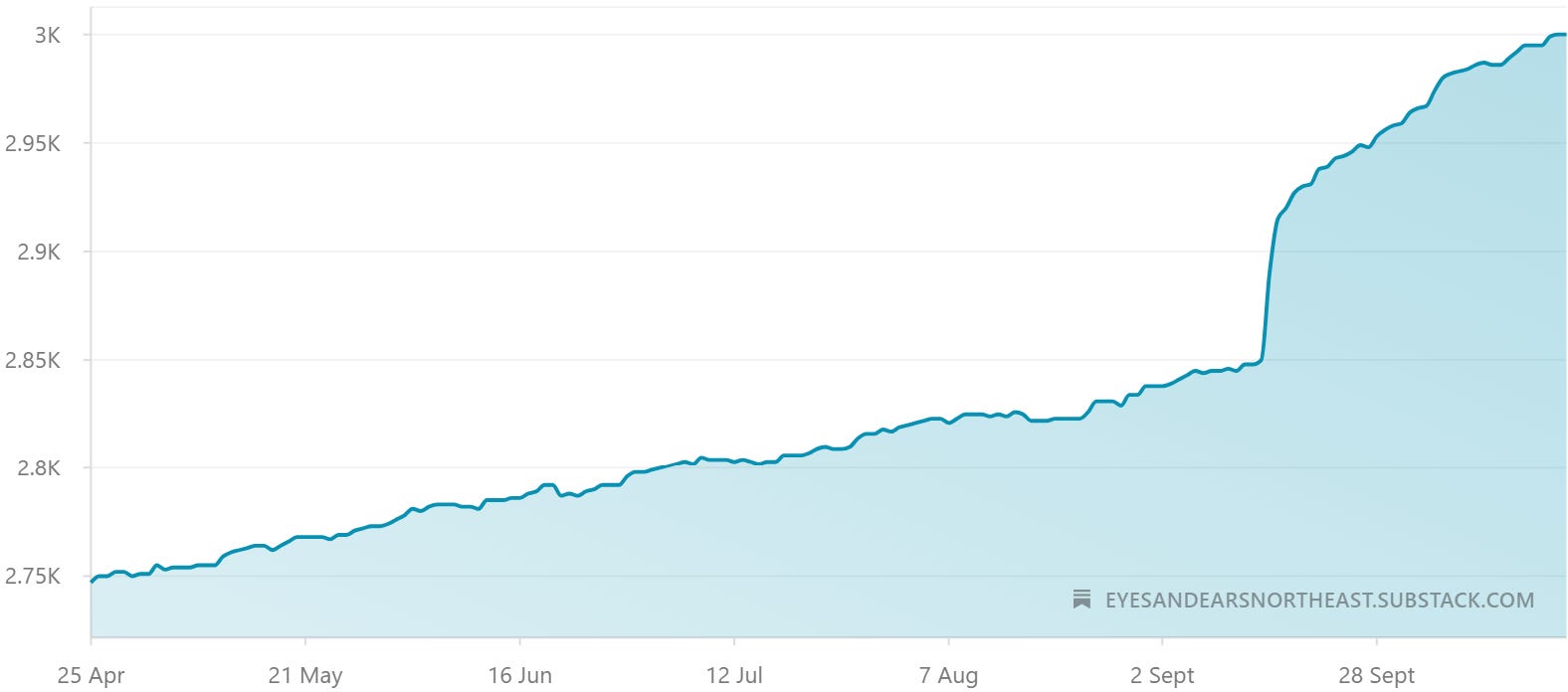
We now need to push on and get to the 4,000 mark. You can help with that - by telling family, friends and colleagues about The Source and how it is a trusted ‘source’ of quality journalism. Independent, politically-neutral but North East biased. And it’s free.
Here are five recent features from our team of contributors that you can share with them - the kind of articles we can produce more of if we can get that graph showing an even steeper upward curve.

SIMON RUSHWORTH sat down with a man who passionately believes North East investments and pension contributions should be used to benefit the region. “Think of it like a giant holdall of North East cash. We drop it off at Newcastle’s Central Station and wave it off to London, never to be seen again.”

Football, whatever a famous manager said, isn’t more important than life and death but it can stir deep emotions. Author Chris Bowlby told DAVID WHETSTONE how it keeps memories of his son alive.

As parents protested about the closure of Durham High School, BOB HUDSON took a closer look and reported that its Chinese owners were not present, not visible and not listening.

For decades, we complained about the region being overlooked. Now travel writers, lifestyle journalists, influencers and property experts are declaring the North East the next UK hotspot. Is it time we shut up about how great we are, asked BETHANY USHER.

Our prisons are overcrowded. And 37% of those who are released end up back inside. CHRIS JACKSON reported on a North East charity where only 3% of the offenders it mentors return to a life of crime.
Plus there’s the weekly Eyes & Ears column that we publish every Friday - my curated round-up of what’s been happening in the region in the past week. It’s things you know, things you didn’t know and things you didn’t know you needed to know.
Free for all - for now
The Source is free for everyone to enjoy but we do have a paid subscription rate of £6.99 a month or £69.99 a year. It’s voluntary - but successful independent media outlets with an operating model similar to ours only make half of their content available for everyone to read.
If we are to have a sustainable future then we may need to consider doing the same. Their experience is that 10% of free subscribers convert to paid - we are running at 4%.
In the meantime, it would be hugely appreciated if you were to upgrade to a paid subscription. Here are comments left by four people who decided to support us with a paid subscription:
“Delighted to support such intelligent, interesting and often amusing reportage. There is no print alternative that comes near for well thought through local reporting” - Fiona Ellis.
“Consistently informative and insightful, providing breadth as well as depth. A joy to read because of the quality of reporting and commentary. It reaffirms journalistic standards that are even more relevant than ever. Keep up this important work” - LJ Hudson.
“Eyes & Ears has been such a useful tool, providing that weekly round-up... now, The Source is a chance at another life for regional media - supported by and operating for the people of the North East” - Arlen Pettitt.
“I support your work because it’s essential for democracy and society to have well-informed independent journalism powered by curiosity, rooted in rich life experience and communicated so well. The reader gets right to the end before they know it. Many thanks for all you do and how you do it!” - Olwyn Hocking.
Surprise for a hero

A pioneering heart surgeon who has saved and transformed the lives of thousands of children has received the Lifetime Achievement Award at the Mirror’s Pride of Britain Awards.
Asif Hasan, who retired earlier this year from the Freeman Hospital, has dedicated more than three decades to caring for children with complex heart conditions and helping establish Newcastle as one of the world’s leading centres for paediatric heart surgery and transplantation.
He knew he was getting the award, but didn’t know that backstage there were 19 young people waiting to join him - every one of whom owes their life to a remarkable man who would spend his ‘holidays’ in Pakistan carrying out surgeries and training doctors. You can see this tear-jerking moment when the awards are screened on ITV tomorrow at 8pm.
Among the 19 was Seb Hollingsworth from Whitley Bay. His dad Ivan said on his LinkedIn said: “To be there and witness that moment with other parents, as Seb and his fellow Heart Heroes came together to recognise the extraordinary impact Asif has had on their lives, was something I will never forget.
“What made it even more special for us was that Seb was given the opportunity to say a few words on stage and thank the man who saved his life when he was just 16 weeks old, and again when he was 13.
“Asif’s response to receiving the award was typically understated: ‘I was just doing my job’.”
5 - live in Newcastle
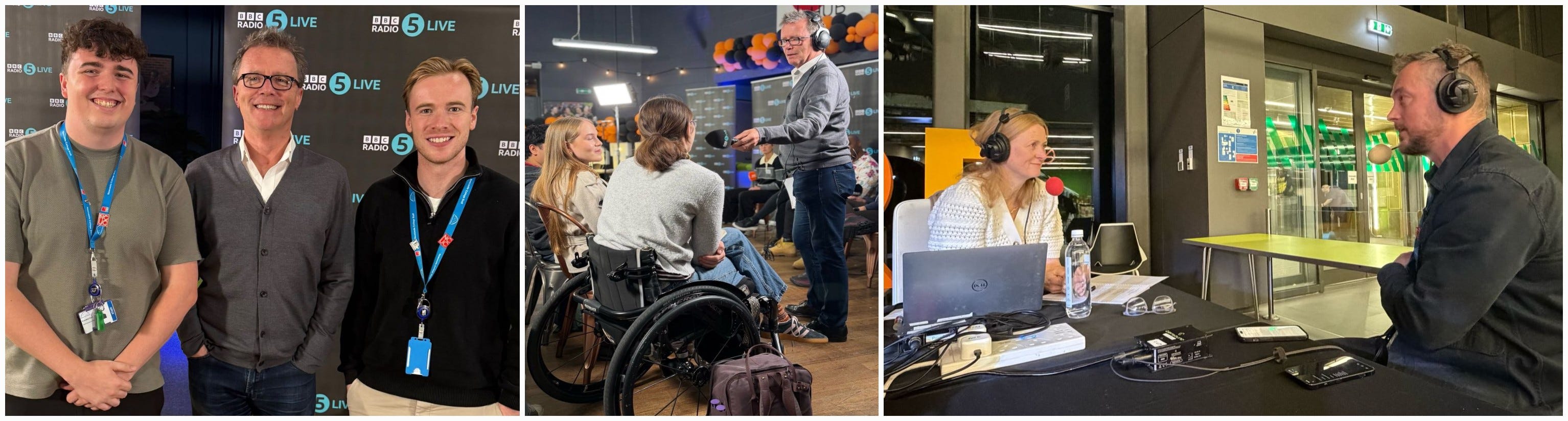
Radio 5 Live was broadcast from Newcastle College yesterday morning with Rachel Burden and Nicky Campbell leading the programmes - something that PR and Comms lead Henry Winter later revealed was in the planning for months.
“I think it’s fair to say this has been the most challenging and rewarding project of my career in PR so far,” he said. “From having our Principal Jon Ridley live on 5 Live Breakfast to helping brief our students ahead of the Teen Summit, there’s been an enormous amount of work behind the scenes. But seeing it all come together and watching our students share their views on national radio made it all worthwhile.”
Sheep
By Harry Pearson
It is tupping season in Northumberland. On moor top and down dale the expectation of romance crackles like static. A friend who farms out by Greenhead says that when the ewes sense the ram is coming the tone of their bleating changes. “It’s a higher pitch, quicker. They’re all of a flutter,” she says. Their tup is a burly Suffolk with a thick head, powerful shoulders and gleaming black eyes that simmer with the kind of surly menace that would send bosoms heaving in a Gothic bodice ripper. His fiery look is more than just posturing, I should add. I once saw him butt a five bar gate in an attempt to get at an inquisitive dog. Off a two pace run up, he hit it so hard it thrummed.
“Afterwards, they do this kind of cooing chatter back and forth,” my friend says, “Like teenage girls mooning over a pop star.”
“Do they never sound a bit let down,” I ask hopefully because to me the tup has the strutting, mean and self-satisfied look of an office bully. “Maybe a palpable sense of anti-climax?”
My friend says not. She says the tup gets taken away before the passion dies and ewes start to notice his irritating habits.
“Like chewing with his mouth full,” I suggest.
My friend looks out of the window to the yard where her husband is standing in the drizzle hitting a blocked drainage pipe with an adjustable wrench. “Or cutting his toenails in bed,” she says.
At Hexham Mart a few days later the air is filled with the pungent scent of lanoline, testosterone and urine. Lanoline, extracted from sheep’s wool, was once a key ingredient in shaving cream. Perhaps that’s why the smell at a day sale of rams calls back memories of a pub gent’s toilet on a Saturday in 1975, albeit without the bass notes of Brut and yesterday’s cabbage. In the show ring a cluster of prize Texel shearling rams are being primped and posed by their owners, big men in XXL polo shirts and feed store jeans held up by leather belts with elaborate buckles. The Texels have black moustaches, flaring nostrils and scowling faces. Their bodies are tubular with muscle. Compared to them my friend’s Suffolk looks vaguely effete - Hugh Grant in a world of Tom Hardys.
The Texels stand four-square with their heads held high and their rear legs spread, their fleeces are the colour of saffron. The first celebrated ram in British agricultural history was a New Leicester bred by Robert Bakewell of Dishley near Loughbrough in the 1780s. He was so famous Catherine the Great sent ministers to study him. Bakewell’s ram was called Two Pounder. The briefest look at a painting of Two Pounder is enough to confirm how he got his name. The Texels, however, are of an even higher calibre than this famous beast – four-pounders at least.
Size, naturally, is not everything. The seasoned expert is also looking for tone. Some ram scrotums look impressive but are padded out with fat. Heavy fat layers overheat the testicles and lower sperm count, the ovine equivalent of wearing tight pants. Farmers tend to fret about fertility more than the rest of the population. At the moment more so than ever. A variant of the insect-born bluetongue virus is ravaging flocks. Over 1,600 farms in England, Scotland and Wales are infected. Bluetongue shuts down sperm production. Around a fifth of rams never recover, the rest will be knocked out of action for upward of three months, missing the one time of the year when they are of any real use to anyone. Already there are fears that the numbers of spring lambs will be drastically reduced nationwide.
Northumberland is so far mercifully free of bluetongue. This has led to a last minute scrabble from infected farms – largely in the south-west - for virile Northern rams. There is chatter about prices spiking. For prize Texels these can be eye-wateringly high. In 2020 a six-month-old ram named Double Diamond sold at auction in Lanark for £367,500.
There’s nothing so head-spinning as that figure at Hexham, but the ruby-cheeked auctioneer’s cudgel-like gavel bobs up and down to a high energy rhythm while his voice calls off the bids at such ascending speed that he sounds like a southern Baptist speaking in tongues. In a blizzard of waves and nods and twitches one shearling ram goes for £7,500, another for £5,500, a third for £3,500.
Robert Bakewell reputedly rented out Two Pounder for 1,200 guineas per season (a staggering sum in an era when the sort of country estate an ambitious Jane Austen heroine might aspire to could be had for £100 a year), but because of bio security rams are no longer hired in the same way. The life of the woolly roaming lothario is over. Instead the tup stays at home with his familiar flock. He is, as my friend remarks, “Faithfully polygamous”.
Just as in the days of Bakewell, the value of a prize ram is based on the improvement his genes can bring to a flock. He is a long-term investment. On average a ram has a career span of about four seasons and in that time will impregnate around 180 ewes. Some of these may turn out to be prize rams, too and the money invested will be easily recouped. While the genetics of stock breeding are better understood today than they were in Bakewell’s time, such investment remains a gamble and diseases like bluetongue lengthen the odds.
For a ram the stakes are even higher. Fertility is all that stands between him and the abattoir. “Our old fella is coming to the end of his run,” my friend says with a note of regret. “Last autumn after he’d serviced all the ewes, he disappeared. When we went looking for him we found him lying flat on his back in a stream, the icy water flowing over his nethers, all four legs stuck straight up in the air. I swear he was snoring”.
Harry Pearson is a former columnist for The Guardian and is a regular contributor to the magazine When Saturday Comes. His book The Far Corner: A Mazy Dribble through North East Football is widely regarded as a cult classic.
If you enjoyed Sheep, then you may want to read some of his earlier contributions for us. His first column was about how dementia was affecting his family (If you didn’t laugh, you’d cry). Then came the weighty funeral instructions he received from his Dad (Ashes to ashes), the missing item that came to dominate his Dad’s mind in his last few months (Poignant mystery of the hunting horn), and his observations from the dementia ward (The York Fruits).
In February, as he prepared to become a grandfather for the first time, he brought us some childbirth stories that bear some relation to the Monty Python Four Yorkshiremen ‘we were so poor’ sketch (Hell and hot water). As the 82nd anniversary of the D-Day landings approached, Harry wrote about his uncle, a reporter with the Evening Gazette in Middlesbrough who joined the RAF but didn’t live to see that historic day (The kindest lie - Eyes & Ears 29.05.26).
You can read any and all by clicking on the underlined link.