

Happy Bank Holiday Monday. We have a wonderful column for you today from Professor Bob Hudson, a man who is always worth listening to.
Reform is now in control of four of the seven councils in the North East. The grind of being a locally accountable representative of a community will be a shock to many new councillors with no record of political activity, he says.
“If newly installed councillors think they have a blank sheet of policy paper to fill out, they will soon be disabused. England is a highly centralised country with local government, in effect, simply implementing numerous national requirements.
“Councillors will rapidly learn that there are few savings to be made by scrapping climate and diversity programmes; rather they will be struggling to meet the growing demand for adult social care, children’s social care and SEND provision, let alone filling in the potholes.”
Before you hear from Bob, here are a few Eyes & Ears extras…
No accord
Still no news of an accord between the parties at Newcastle City Council which makes it likely that the Lib Dems will run a minority administration - they won 25 seats at the recent elections, one more than both Reform and the Greens. The council AGM is on Wednesday. There’s an interesting take here from independent councillor Marc Donnelly on the leadership: “I cannot be the only person observing events and wondering what comes next for Jamie Driscoll. I have yet to meet anyone who genuinely believes he will be content remaining simply a ward councillor indefinitely.”
Sam’s No.1
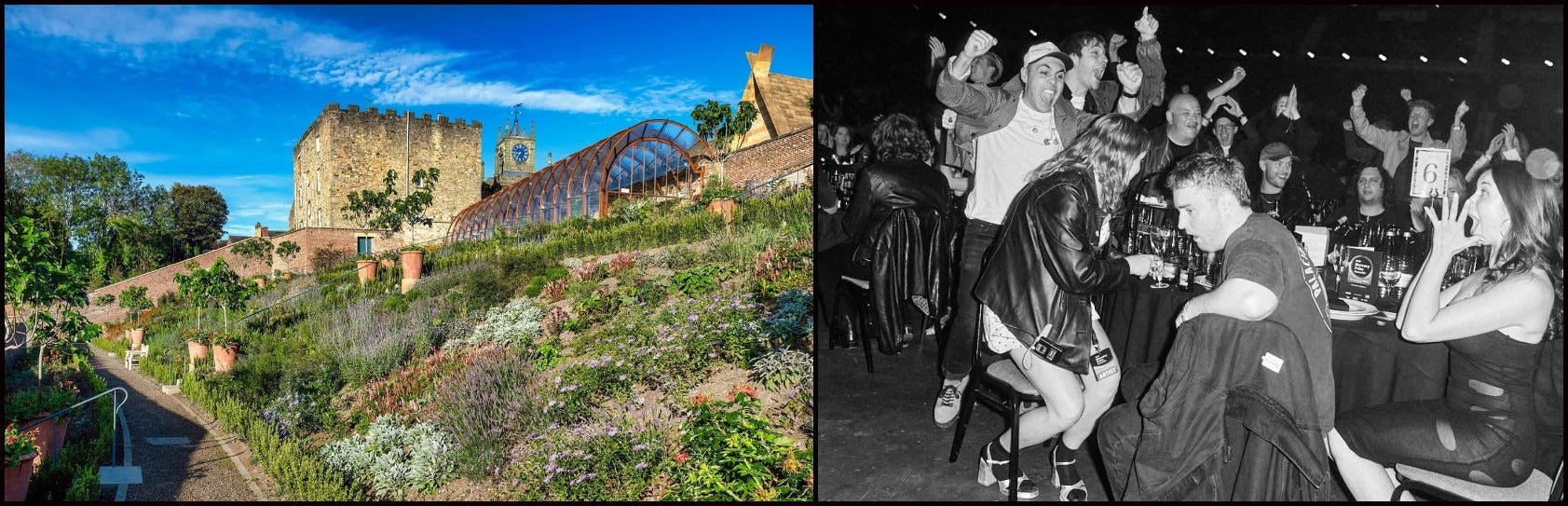
North Shields singer-songwriter Sam Fender has been named Songwriter of the Year at this year’s Ivor Novello Awards, cementing his reputation as one of the UK’s leading musical voices. He was recognised for his “sharp social commentary and emotionally honest songwriting”.
Speeding things up
Drivers are spending less time stuck in traffic at six congestion hotspots thanks to a smart road technology project using AI. New figures from the Tees Valley Combined Authority show delays were cut by up to 50% and that motorists saved a total of 5,000 hours over a year.
Innovation made easy
Newcastle University has launched Newcastle Innovations, a platform created to simplify how businesses, investors and external partners access the institution’s research, expertise and commercial support. Director Estelle Blanks said: “We are responding directly to feedback from industry, so that more companies can access our support and expertise to accelerate growth, attract investment and create a skilled workforce.”
Top of the class
The transformation of a historic walled garden from dereliction to a renewed productive life has made it one of the picks of a crop of North East architectural prize winners. The Auckland garden, with its listed walls, is one of the five winners of the 2026 RIBA North East Awards, which is marking its 60th anniversary. Tony Henderson has the details and pictures.
Gap award
North Shields-based Helix Arts and George King Architects have won the competition to turn the wood of the illegally felled Sycamore Gap tree into an artwork. Their collaboration, The People’s Tree, combines public participation, sound, architecture and storytelling. David Whetstone has more.
RIP Bob
Tributes have been paid to much-loved North East comedian and pantomime dame Bob Stott, who has died aged 80. Best known to South Tyneside audiences as Dame Dotty at The Customs House, Bob entertained generations of theatre-goers during a stage career which also included a long-running comedy partnership with Ray Spencer.
Now that’s unusual
There is one thing I can count on every week - that the TV ad break from the past will be the most clicked on link in any Friday edition of Eyes & Ears. But Howard from the Halifax ad came only third in the most recent edition. That was down to two things: the popularity of the Built Here short film, unveiled at UKREiiF last week to showcase investment opportunities in the region, and so many of you wanting to see the ‘de-aged’ Rolling Stones in the video for their new single.
You can see them all here:

Reform in charge: What now?
By Bob Hudson
The local election results are in and repetition is unnecessary. Three of the Tyne-Wear councils - Sunderland, South Tyneside and Gateshead - are now firmly under Reform control. The political earthquake of last year in Durham is now a regional avalanche.
What are we to make of it all? How will Reform’s political culture of insurgency and grievance translate into local governing? Is a party with no political experience capable of delivering anything other than a protest vote? It’s a question of national as well as local significance.
The Politics of Inexperience
Across Europe it is not uncommon for completely new parties to be elected to power - Macron’s En Marche! in France; the comedian Beppe Grillo’s Five Star Movement in Italy; Podemos in Spain; and currently Peter Magyar’s Tisza Party in Hungary. There are lessons to be drawn from these national experiences, but far less is known about such sweeping shifts at local level, especially in England.
Inexperience of the grind of local politics and the mechanics of local governing are already evident. Reform managed - at very short notice - to put up around 4,700 candidates at the recent local elections, sometimes resorting to cold calling members of the public who had simply subscribed to their email updates.
Inevitably such a loose vetting process has quickly thrown up some extreme cases of racial hatred and religious intolerance in the region, with local MP, Bridget Phillipson, accusing the party of misogyny, homophobia and conspiracy theories.
This general incivility in public life has also been a recurring feature of Reform’s behaviour in Durham over the past year, especially in the case of the deputy leader, ex-GB News host, Darren Grimes. Even the leader of the council, Andrew Husband, has had to defend himself against allegations of making homophobic slurs. New regimes also tend to be associated with internal turbulence. Reform in Durham has lost eight of its ranks since the election victory, down from 65 to 57 – not that far off the 50 needed to retain overall control.
The grind of being a locally accountable representative of a community will be a shock to many new councillors with no record of political activity. A councillor in Staffordshire has resigned within days of being elected on the grounds he finds the role to be ‘dull and boring’; a newly elected Gateshead councillor has quickly discovered she is a bit too busy at work to continue; and the leader of Reform in Suffolk has admitted it will take six months for his team to be trained up for the job.
The loss of so many experienced councillors in the region is a serious blow to institutional memory, leaving senior officers as the repository of experience.
The Limits of Local Power
If newly installed councillors think they have a blank sheet of policy paper to fill out, they will soon be disabused. England is a highly centralised country with local government, in effect, simply implementing numerous national requirements.
Councillors will rapidly learn that there are few savings to be made by scrapping climate and diversity programmes; rather they will be struggling to meet the growing demand for adult social care, children’s social care and SEND provision, let alone filling in the potholes.

However, the landscape of centralisation is changing at a different level following the creation of regional mayors and promises of further devolution in the English Devolution and Community Empowerment Act. The newly-badged North East Strategic Mayoral Authority is led by Labour mayor, Kim McGuiness, but decision-making does not rest in her hands alone. The strategic mayoral authority has eight voting members – the mayor herself and the leaders of the seven councils that make up the region.
Four of these votes will now be in the hands of Reform leaders. In addition to Andrew Husband (Durham), the three new arrivals are: Paul Mackings (South Tyneside) ex-CEO of Wynyard Hall and heavily involved in school and college academy trusts; Chris Eynon (Sunderland), a financial advisor; and Nick Allan (Gateshead), a retired businessman. They will have to decide whether to bring divisive politics into the regional decision-making process or to support the Labour mayor in her efforts to bring greater prosperity to the region.
The green agenda will be a touchstone issue. Mayor Kim McGuinness has just announced a ‘green jobs’ taskforce to boost the region’s offshore and clean energy sectors, something that flies in the face of Reform’s opposition to green energy and net zero. Durham’s council leader has placed his opposition to green energy on the record. Will the new leaders follow suit? In extremis the mayor has the power of veto over decisions, and could use new powers to appoint her own ‘mayoral commissioners’ to advance and deliver her policy agenda. Given Reform’s rhetoric on the issue, are we heading for collaboration or conflict?
Cutting Costs
One of Reform’s national leaders, ex-Tory Chancellor Nadhim Zahawi, has recently declared that only national, county or armed forces flags will be flown outside the buildings of councils controlled by his (latest) party. However, once this performative trivia has been instituted, the serious business becomes inevitable - notably pledges to freeze or cut council tax.
The Durham experience is instructive in this respect. Here the Reform council came to power committed to reducing the ‘burden’ of council tax but found it difficult to do so – early noise about Elon Musk, Doge-style, savings never materialised. Despite receiving substantial additional funding from the government (which could have been used as a reprieve for service cuts) the council chose to use the money to raise bills by a lower amount (3.1%) than was permissible (4.99%) and to institute service cuts.
The civic casualty list is endless: ending the exemption from paying council tax for the poorest households; parking charges up 30p per hour; a 40% rise in resident parking permits; school crossing patrols reduced; bus routes withdrawn; cuts to the Care Connect service; grants to town and parish councils axed; crematorium charges increased; garden waste collection charges up; ending transport to school for children living at a distance; the loss of 88 FTE posts, and much more. Our already crumbling community infrastructure is further decimated.
It is unlikely that measures such as these will be well-received by those who voted for the new regimes, and in turn this raises some much bigger questions about our domestic politics. The campaigning journalist, Sam Bright has pointed out that voters now have historically high expectations of their leaders and are impatient for improvements to their lives. This is a problem for any party elected on the ticket of ‘change’ - Keir Starmer has found this out, as will the newly elected Reform councils.
In an era when all politicians are viewed with mistrust bordering on contempt, our new Reform councils are unlikely to be given the benefit of the doubt for very long. People want lower taxes but at the same time they demand better public services and a standard of living safety net - an unrealistic stance that has been fuelled by politicians (local and national) who feed the myth that the people can have everything.
When an abysmal level of political literacy meets the naïve promise of populism, a happy outcome is unlikely. Time will tell, probably in fairly short order..
Bob Hudson,
Visiting Professor in Public Policy,
University of Sunderland.