

I don’t think I have ever presented you with an edition as diverse as this. In fact, I’m sure I haven’t.
There’s deprivation, renewable energy, culture, Russian interference in UK politics, a femme fatale, ‘woke wasters’, Sting, and how many sausages there should be in a tin of Heinz beans and sausages (a marriage-breaker, apparently, if you make a formal complaint about it).
In one story alone the legendary Tony Henderson covers spying, archaeology, air raid shelters and former England footballer Trevor Steven. Yep, one story! It’s as if an AI content generator had been fed LSD.
Today’s Eyes & Ears edition features Professor Bob Hudson’s insightful take on Reform’s first six months in power in County Durham.
First, here’s some Eyes & Ears extras - and you won’t want to miss the ‘And finally’ section at the end.
Sending out an SOS

While Björn Again were filling The Glasshouse next door with Abba hits, another kind of revival was taking place on Gateshead Quayside - as Sting returned home to help launch Baltic’s ambitious £10m Endowment Fund campaign.
Cultured. North East reported on the North East music legend’s intimate performance at the Centre for Contemporary Art, headlining the gallery’s first endowment fundraising gala and marking the start of a major new chapter for the landmark cultural venue.
The 17-time Grammy Award-winner, who made a personal donation to the fund earlier this year, took to the stage alongside long-time collaborator Dominic Miller for a performance which had undoubtedly contributed to a packed audience, which included well known faces Alan Shearer, Jimmy Nail and Jim Moir (Vic Reeves).
Sting said: “When I was a kid my Dad used to bring me down to the quayside on a Sunday morning and I’d look at this building and wonder what it was. Never did I imagine it would become an amazing art gallery, or that I would have the opportunity to support it.”
£2m investment
The Offshore Renewable Energy (ORE) Catapult has announced a £2.1m investment in an offshore wind cable testing rig at Blyth.
Funded by the North East Combined Authority, the facility will speed up nationwide production, shorten time to market for new technology and deliver improved cable system reliability.
North East Mayor Kim McGuinness said: “This will be the only facility like this in the UK – underpinning the North East’s status as the UK’s leading region for clean energy.”
Good - not good
Last week I reported that the Labour government was quietly - probably too quietly for their own good - levelling things up. And that the North East was benefitting.

This week emphasised why that is important. New figures from the Ministry of Housing, Communities and Local Government show that more than a third of neighbourhoods in the North East Combined Authority area and nearly 40% in Tees Valley rank among England’s most deprived.
Middlesbrough ranked top/bottom of the 296 authorities with 50% of their neighbourhoods described as ‘highly deprived’. Hartlepool were third with 42% and Sunderland 20th with 28%.
All 12 councils in the wider North East were in the top/bottom 100 with North Tyneside ranked 100.
I spy
Tony Henderson’s stories are legendary. The man himself is a living legend. The former Journal writer was a contributor to The QT and now Cultured. North East.
This week he tells us about the radio whizz who became a back garden spy and how excavating a buried air raid shelter revealed an extraordinary story that somehow involves England international footballer Trevor Steven. I’ll tease you no more. Click on the underscored words to get the full story.
If you enjoy that story then you will love this one from Tony… it’s about a tiny Tyneside airman who spent the Second World War carrying out a series of audacious and barely believable PoW escapes.

RIP Stan
1966 wasn’t just the year England won the World Cup, it was the year poet, dramatist and amateur archaeologist Stan Beckensall made a life-changing discovery in Northumberland.
Walking on Old Bewick Moor with his daughter and niece, he came across a huge piece of sandstone on which had been carved various shapes. This rock art, he learnt, dated back to prehistoric times, created perhaps some time between 3500 and 2000BC.
So began a lifetime of work. Stan has died aged 93 and The Times has published his obituary. His unique archive of prehistoric rock art was donated to Newcastle University and turned into a renowned website which won national awards and an international reputation.
‘Truth is taking second place to belief’
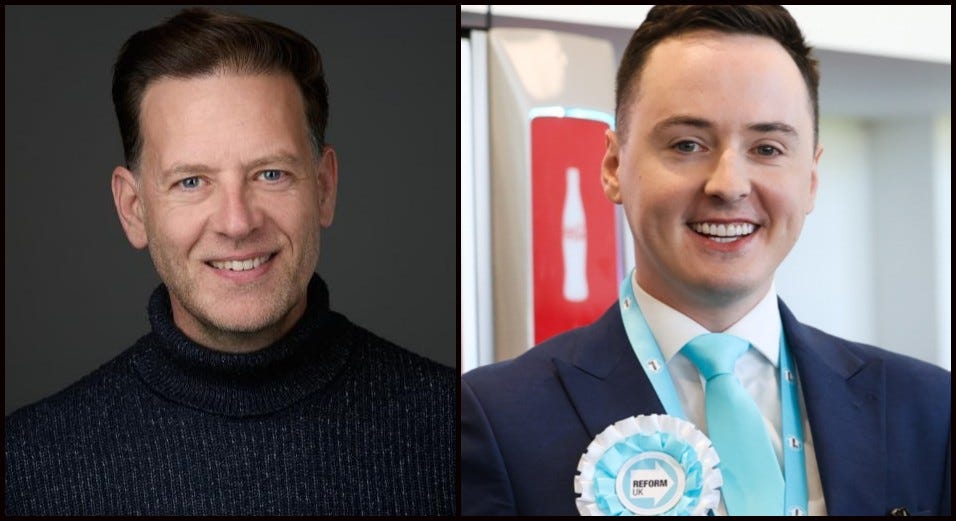
By Professor Bob Hudson
In County Durham, little reminder is needed of last May’s astonishing local election result, when Reform captured 65 seats out of the 98 available. Nigel Farage began his national victory lap in Durham where the new council was paraded as the local shop window for what a Reform government could look like.
In an earlier piece for Eyes & ears I looked at the situation one month in but how is it looking six months down the line?
Six recurring themes are noticeable.
Promoting division over inclusivity
The first actions taken by the new council were symbolic rather than substantive, intended to purvey a contempt for ‘wokeness’. Removing the Pride and Ukraine flags from County Hall represented an easy win, and one that was taken without any formal decision-making process or paper trail.
Next up was denying climate change, as Durham became the first local authority (from a group of over 300) to rescind a 2019 declaration of a climate emergency.
Wider stoking of division has emanated from the prolific social media posting by Darren Grimes, the deputy leader of the council. His seemingly unending stream of monetised invective has led to numerous complaints (of which more later) and the simplification of complex issues (again, of which more later).
Grimes’ antics eventually led the North East mayor, Kim McGuiness, to brand him as ‘inciting racism and hate’ but this only seems to have encouraged him to redouble his messaging.
The rotten apples problem
Every political party has its ‘rotten apples’ but Reform nationally seems to have more than its fair share. Indeed, a survey by the website, Politics Home, has discovered that the party has already lost an astonishing 5% of its elected councillors.
In Durham, Councillor Paul Bean was suspended from the Reform group on the council (and indeed from his post in the Home Office) following reports of misogynistic slurs and criticisms of asylum seekers.
Shortly afterwards his fellow councillor Jack McGlenen was suspended – and subsequently expelled - for a display of public drunkenness and abusive behaviour at an Armed Forces Day event.
Other parts of the region tell a similar tale. In Northumberland, Councillor John Allen was suspended (and subsequently expelled) for posting racist and homophobic comments and expressing a fantasy about shooting Keir Starmer. In Redcar and Cleveland, Councillor Craig Holmes fared rather better – despite being photographed urinating against a brick wall, he romped home in a by-election with a massive 65% of the vote.
These and other incidents might suggest a need for tighter screening of candidates for public office but – bizarrely – Reform nationally is proposing less stringent vetting procedures.
Facing financial reality
Reform took control of local councils and mayoralties with a pledge to cut council tax modelled on Donald Trump’s ‘department of government efficiency’ (Doge). Reality rapidly dawned – after 14 years of austerity, councils were already cut to the bone and council tax increases are now widely anticipated across Reform-controlled councils.
Durham is no exception to this reality with the council leader, Andrew Husband, acknowledging that ‘stark choices will have to be made between council tax increases and cuts to vital services’.
In the meantime, the council has embarked on a series of niggardly cost-cutting measures. There are, for example, plans to reduce (or even eliminate) the Council Tax Reduction Scheme that helps the poorest households with their payments – the most impacted areas in Peterlee, Stanley, Bishop Auckland, and Ferryhill are all Reform strongholds.
Other measures include: rescinding an agreement with an athletics charity to build a new facility in Sedgefield; scrapping plans for solar panels on buildings throughout the region; and apparently declining to continue support for the prestigious Durham Lumiere.
These marginal savings are coexisting with egregious boasting, with Husband claiming to have ‘saved’ a whopping £244m by renegotiating the contract for the controversial Tees Valley Energy Recovery Facility. In fact the contract has been several years in the making and Husband’s claims have drawn apoplectic responses from other council leaders in the region, as well as a pop at his own dismal record as a businessman.
Avoiding accountability
The cause célèbre of avoiding accountability is Nottingham, where the Reform council leader declared that his group members would no longer speak to the local newspaper, the Nottingham Post. Ironically for a Europhobic party this decision was rescinded when the Post asserted its rights to freedom of expression under article 10 of the European Convention on Human Rights.
Durham has its own version of freedom of expression, courtesy of the aforesaid Darren Grimes. In this twist of the tale, Grimes has complained that ‘woke wasters’ are trying to silence him by lodging ‘vexatious complaints’ – 144 of them have been processed via the council Code of Conduct.
The allegations contained in these complaints include bringing the council into disrepute, failing to treat people with respect, and not representing people of a differing view.
This volume of complaints is certainly unusual but perhaps to be expected given the scale and intensity of the barbed epithets delivered by the deputy leader. In South Tyneside, by contrast, (another politically troubled council) 328 Code of Conduct complaints were made between 2020-25. However, whereas South Tyneside has a respected independent Chair of the Standards Committee, Professor Grahame Wright, Durham has decided to remove the involvement of the independent member and rely solely upon county councillors (overwhelmingly Reform councillors) to monitor standards.
What these standards will look like is also subject to radical change. Grimes has proposed what he calls a ‘free speech amendment’ to the council’s Code of Conduct which would permit ‘a degree of immoderate, offensive, shocking or provocative expression’.
With a Trumpian sense of self-importance, he has declared: ‘I will not be silenced in speaking up for my residents, county and country’.
False dichotomies
The setting up of false policy dichotomies has become a Grimes stock-in-trade. Examples abound: that the money spent on investigating complaints against him (a mere £11k) should be spent on ‘care for our most vulnerable residents’; that ending solar panel profit margins will fund support for SEND children, as well as deliver ‘wheelchairs over windmills’ – a bizarre depiction of adult social care.
None of the sums involved here would make the slightest dent in the budgets for adult social care or children’s services. But what such simplified dichotomies do is serve as a gateway to something politically corrosive – the undermining of truth, reason, and evidence. Which brings us to message number six…
Avoiding political contamination
Reform politics locally, regionally, and nationally is in rude health. Polling is positive, by-election performances are good, the Labour-held councils in Tyne and Wear will surely be dreading next May’s local elections, and Nigel Farage routinely portrays himself as a prime-minister-in-waiting. The impact of poor local governance by Reform councils has yet to be seriously tested at the ballot box, and Durham seems by no means to be the worst of the bunch.
Nevertheless, what Donald Trump has seemingly demonstrated is that serious evidence-based politics is no longer integral to political success. Truth is increasingly taking second place to belief, and when beliefs harden into identity, reversing opinion becomes harder.
The Grimes model of democracy is that if everyone (especially himself) is unshackled to speak freely, then truth will rise to the top. It does not. Rather it is a model that contains its own very dangerous dichotomies – engagement not accuracy; confusion not clarity; and simplicity not complexity.
This is a Trumpian path we should all be desperate to avoid.
- Bob Hudson is Visiting Professor in Public Policy at Sunderland University.
Bear necessities

The Bear is a writer I follow on Substack. I like his writing. He’s feeling poorly just now so has stopped writing for a while - but he’s obviously still reading.
It’s interesting that he has highlighted this important piece of work by investigative journalist Carole Cadwalladr - because I was already going to bring it to your attention. He’s just saved me some time and effort.
Carol is baffled by the media silence about a high-level Kremlin spy ring targeting UK politicians, including Nigel Farage.
“Because if there’s one thing I thought one could reliably depend on, it’s that no British newspaper could possibly turn down a political scandal involving a young blonde woman and a series of revealing cleavage shots.”
Let them heat cake…
‘Heat or eat’ has, depressingly, become an all too familiar phrase for the past few winters. The Telegraph have a different take on the same message.
I don’t think the two headlines below are connected…

And finally…
Fesshole is a crowdsourced Twitter account where people anonymously confess their most outrageous, awkward or hilarious secrets — from petty crimes to guilty pleasures. This seems to be unbelievably true.
