

Just over a week ago, we brought you news of the benefits North East entrepreneurs were getting from AI (Headstones, headlines and the business of AI).
Today, we have a follow-up column on the capacity equation: technological capacity is accelerating, human capacity needs expansion, and economic expansion depends on both.
“Saving time is not the same as creating value,” says columnist Anni Hood. “There is a paradox inside those saved hours and productivity gains. When AI takes on the routine tasks, what is left is the hard work: judgement, ambiguity, decisions and relationships.”
Meanwhile, Simon Rushworth reports from Sunderland Business Week where “there’s such a buzz about the place”. And you can understand why.
We also cover the announcement of a 10-year North East strategy to create 10,000 jobs in the creative, cultural and sporting sectors. Before we get too excited, this does not appear to be a “new” announcement - more a pulling together of funding we already knew was happening.
And then there’s the NEETs - such a horrible acronym. The North East has the highest rate of 16 to 24-year-olds who are not in employment, education or training in the country.
The man who is leading the review into this national crisis was brought up in the West End of Newcastle and is a former Darlington MP. Alan Milburn is confident the Government will “put its hand in its pocket” to solve the issue.

10 years, 10,000 jobs
A 10-year strategy to create 10,000 jobs in the North East’s cultural and sporting industries has been announced by the North East Mayoral Strategic Authority.
Mayor Kim McGuinness said she wants to make it easier for talented young people to pursue careers in the arts without having to leave home. “For too long, talented people have had to look to the capital for good careers, and we’re changing that, creating opportunities for local people, here in the region,” she said.
The 2026-2036 Culture, Creative Industries, Heritage and Sport Strategic Framework describes how the North East MSA will use its powers, investment and influence to grow culture, creative industries, heritage and sport over the next 10 years, rallying partners across the North East behind these shared goals.
There isn’t any new money behind this announcement, as far as I can see. The strategy is underpinned by £104m of investment in the sector, announced earlier in the year, which already includes:
The North East Mayor’s Small Venues Fund launched in June, announcing £2.2m to support arts, culture and music venues across the region.
The Mayor’s £11m Events Fund, enabling events throughout the summer, including BBC Radio One’s Big Weekend, Newcastle Pride and Durham Book Festival.
£38m Crown Works Studios development, which has passed another important milestone, with planning approved by Sunderland Council.
Help - if you can

I’m biased, but I know The Source is great. Quality journalism. Independent, politically-neutral and North East-biased. What’s not to like?
It’s free for everyone to read but we could do with your help. We are trying to raise money to hire a reporter who would be dedicated to public-benefit journalism. Contributions so far have ranged from £5 to £2,000. The Crowdfunder can be accessed here: crowdfunder.co.uk/p/thesource
Another way to help would be to become a paid subscriber. It costs only £6.99 a month or £69.99 a year. Compare that monthly cost to what you would pay for a glass of wine in many bars and restaurants.
If every one of you who are reading this right now signed up to pay using the button below then I would be able to begin the process of hiring that reporter tomorrow.
Spend and save
Former health secretary Alan Milburn is leading the Government’s review into the issue of 16 to 24-year-olds who are not in employment, education or training (NEET). Latest Government figures put the NEET rate in the region at just under 20% - the highest rate in the country, affecting around 60,000 people.
The former Darlington MP, who grew up in Benwell in Newcastle’s West End, was at St James’ Park on Friday for the launch of a new commitment from the Premier League to support more than 250,000 at-risk children and teenagers over the next five years.
The funding will enable more than 100 football club charities, such as the Newcastle United Foundation, to work with schools and employers to identify young people in need of support and give them the skills and connections they need to avoid becoming disengaged.
The second part of Milburn’s review is reported to have been pushed back until after this month’s Budget. He told the Local Democracy Reporting Service that discussions were being held with Prime Minister Andy Burnham and Chancellor John Healey and that the issue “will be fully resolved in the Spending Review”.
He said: “They are not daft and they realise this is going to require the Government to put its hand in its pocket, because it has to. But the prize is that if we can get young people into work we can get them off welfare.”
A quick word
National League side Gateshead FC has been taken over by US-based private investment company Flacks Group. It is expected that one of the first things to happen will be players and staff receiving their September wages. A company spokesperson said: “Gateshead FC has a tremendous history and we look forward to moving the club forward and to see it realise its true potential.” STACK Leisure has shelved plans to open food, drink and entertainment venues in Whitley Bay and Durham. The company blamed the “difficult” decision on unforeseen development costs, slow planning and legal processes, infrastructure demands and wider pressures on the hospitality and leisure industries. Labour MP Mary Kelly Foy said the decision showed a “total disregard for the people in Durham”. The second of two men who chopped down the Sycamore Gap tree has been released from prison. Daniel Graham, 41, from Cumbria, was sentenced to four years and three months for causing criminal damage to the famous tree beside Hadrian’s Wall
Sunderland: Building big and getting better
By Simon Rushworth
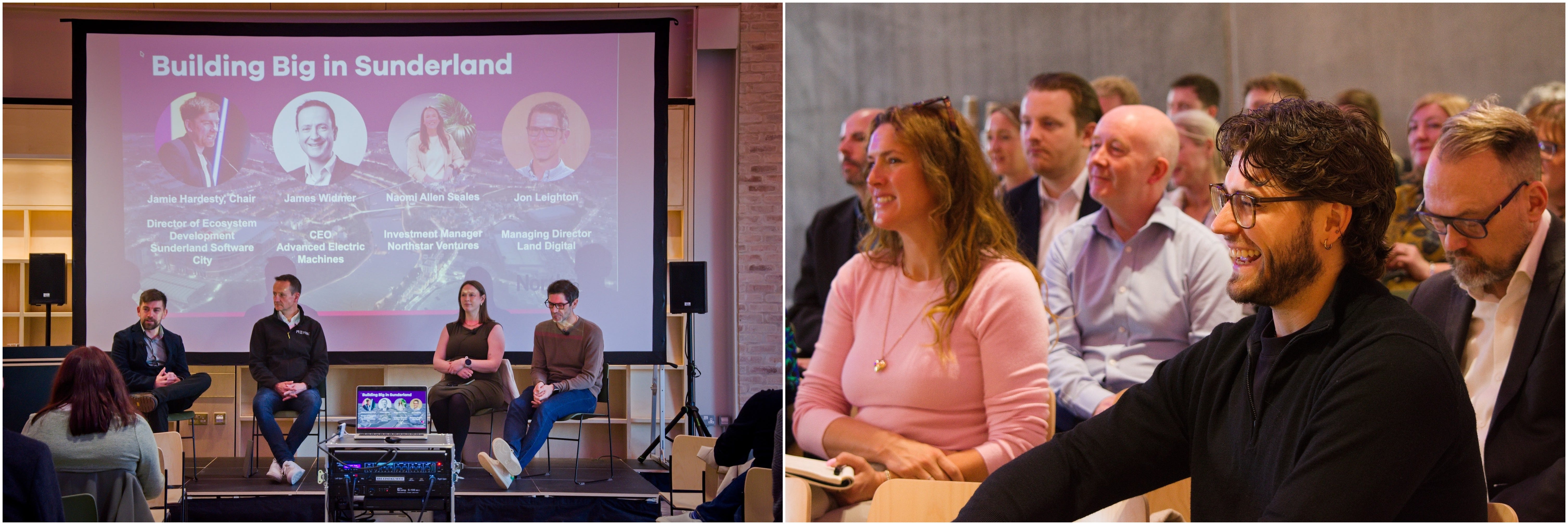
The message was clear as the city’s impressive Culture House played host to business leaders from across the North East: Sunderland is a springboard for growth during a new age of opportunity on Wearside.
On day two of Sunderland Business Week, Northstar Ventures hosted a bullish panel discussion hosted by tech expert — and contributor to The Source — Jamie Hardesty.
The Director of Ecosystem Development at Sunderland Software was joined by James Widmer (CEO and founder of Advanced Electric Machines), Jon Leighton (MD and founder of Land Digital) and Naomi Allen Seales (Investment Manager at Northstar Ventures).
And if all four pointed to a series of familiar challenges still faced by those willing to join the Wearside revolution — skills gaps, a fragile manufacturing chain and distance from the capital — then there was a collective insistence that Sunderland is better placed than ever to realise its potential and power the regional economy like never before.
“There’s a real sense of collaboration and, as a city, Sunderland is so ambitious right now,” said Naomi. Northstar manages the £16m Venture Sunderland Fund and supports businesses looking to secure funding and scale. “Sunderland University has introduced business clinics and knowledge transfer partnerships and the City Council is very forward thinking,” she added. “There’s so much here to help early stage founders and business leaders.”
James revealed Washington-based AEM aims to use its magnet-free motor technology to build 100 million electric vehicles per year by the 2040s but he admitted: “We can’t do it alone and we operate within a very supportive community. I know so many talented people in Sunderland and the surrounding area who really understand what businesses like AEM need.
“We moved to Washington in 2019 but even then we felt we needed to put people up in Newcastle when they came over to visit. Now they stay in Sunderland — a city that’s thriving in every respect. Every time I come here there’s a new building that’s popped up and there’s such a buzz about the place.”
Jon — like James — moved Land Digital south of the Tyne after recognising Sunderland’s potential as an ambitious base for growing businesses. He told the Culture House audience: “A lot more people are talking about Sunderland and more people want to live and work in Sunderland.
“It’s about the lifestyle as well as the business benefits. When Land Digital first moved here there was a choice of German Doner Kebab or McDonald’s for lunch! Now we’re surrounded by amazing places to eat. The city’s become a more desirable place to be.”
Both AEM and Land Digital have been supported by the Venture Sunderland Fund and Naomi is keen to bolster more businesses across Wearside. “We’re not naïve enough to ignore just how big a deal it is for a founder to bring an investor in,” she told the Building Big In Sunderland event. “People who have built up their own businesses are naturally concerned about diluting control.
“From our point of view it’s about reassuring those founders and ensuring everyone’s on the same page. We’re all on the same team. Together we’re focused on executing a plan. Of course there’s an extra layer of governance and expectation but I like to think that can be a positive for ambitious businesses looking to grow. And Sunderland is a place where that can happen.”
Sunderland Business Week continues until Friday with events across the city. Visit sbweek.co.uk for details.
Be wise with water
Reservoir levels across the region remain below average following a dry September and Northumbrian Water is encouraging everyone to keep using water wisely.
The national picture is even worse. Five successive heatwaves and the warmest summer on record have left millions living in drought conditions. Last Friday, Yorkshire became the latest area to declare a drought, joining all of central, southern and eastern England in drought status- and there are fears that the situation may not change until next Spring.
Research from the Environment Agency showed the country will need above-average rainfall throughout both autumn and winter for most areas to be out of drought by April 2027.
Miriam Glendell, a hydrologist and director at the Centre of Expertise for Waters told The i Paper that many households must expect to experience a drought every year.
“It’s not unusual any more to be in a drought. The spring and autumn months can become as dry as midsummer and now water resources fail to always replenish in the winter,” she said. “Water scarcity is a big risk to people and we need to do our best to save water and use it wisely, whether it’s in the household or more widely across the public and private sectors.”
The Capacity Equation

by Anni Hood
The North East has answered the first question about AI, almost every business owner is now using it. In the Entrepreneurs’ Forum’s latest Pulse Survey, 97% of the 113 entrepreneurs who took part use AI in some form, and 89% of those report a measurable benefit - as reported in The Source last week (Headstones, headlines and the business of AI). A third are saving up to five hours a week, and nearly one in four report gains worth more than 50 hours. Twenty-seven per cent now have AI embedded across several business functions, up eight points since May.
Those are excellent regional confidence indicators, the next question is a different one.
As we exponentially increase technological capacity, how do we ensure human capacity increases alongside it?
The hours are the easy part
Saving time is not the same as creating value. Boston Consulting Group’s 2026 AI at Work study surveyed around 12,000 employees. It found that 42% of regular AI users save at least a working day each week. Yet two-thirds get little or no guidance on how to use that time, and more than half don’t put it into more strategic work.
AI frees up capacity, but it doesn’t decide where that capacity goes. People do. And people can only redirect what they have the energy, clarity and confidence to redirect.
This is why BCG’s best-known finding matters. Its 10-20-70 principle says a successful AI transformation puts 10% of the effort into algorithms, 20% into technology and data, and 70% into people and processes. Most organisations do the reverse, and BCG’s value research shows the result. Their latest research shows progress, but substantial value remains concentrated among a small minority; Just 7.5% of companies surveyed qualify as BCG’s most AI-mature organisations, generating substantial value from AI.
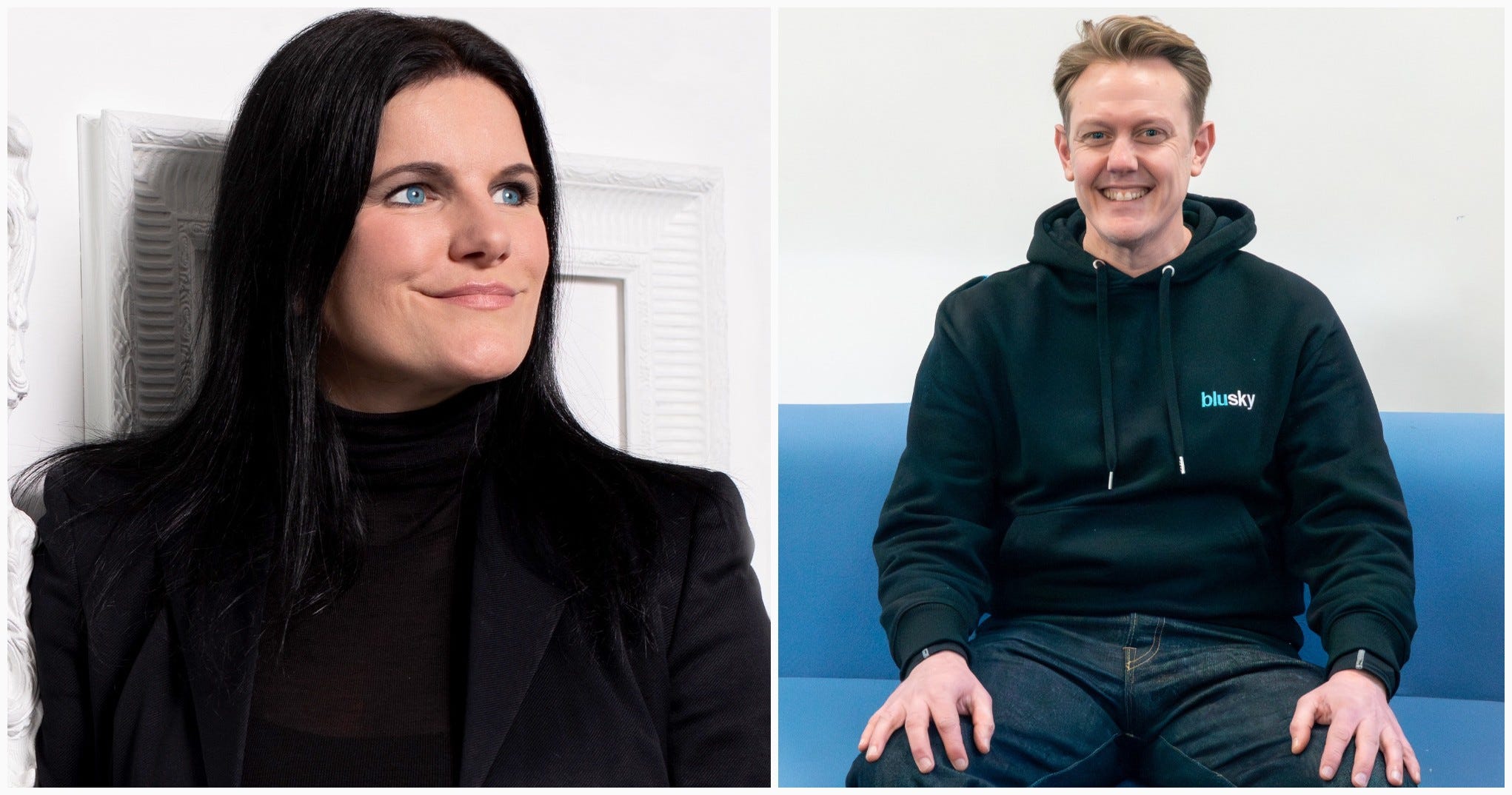
Jon Dudgeon, co-founder of accountancy firm Blu Sky, bucks the trend BCG describes. He has mapped and carefully curated the integration of AI technology and agents throughout his 30-strong team as a consciously controlled osmosis. He described his handle on that employee behavioural change curve: “Critical thinking, initiative and softer skills are more important than ever. We run sentiment analysis through our email systems that allows us to be aware, in real time, of any bandwidth pressures being felt, either by the team or our clients. This, alongside engagement and fulfilment surveys and an open comms policy, means we see any bumps nice and early and smooth them out.”
The work is getting lighter, and heavier
There is a paradox inside these saved hours and productivity gains. When AI takes on the routine tasks, what is left is the harder work: judgement, ambiguity, decisions and relationships. Blusky have taken this in their stride. In BCG’s study, 67% of employees say AI has moved them towards more complex work, and 60% say performance standards have risen. Some 48% of leaders report more mental strain, 72% say the skills expected of them have changed, but only 36% feel they have been properly upskilled.
So the hours saved on routine tasks are quietly being spent on harder ones, with more mental load, faster decisions required and rising expectations. Unless capacity is deliberately expanded it is being used up. That can easily become an initially invisible depletion. Without awareness it shows up as disengagement, poor decisions, sickness absence and people leaving.
Why this matters more in the North East
Poised potential is considerable. The North East AI Growth Zone at Cambois brings a £10 billion data centre commitment and could support up to 5,000 high-quality jobs. There are also plans to train 80,000 students in digital and AI skills by 2029 including primary school provision.
But the region also starts from a more fragile human baseline. Earlier this year, 25.1% of working-age adults were economically inactive. That is the highest rate in England and more than four points above the UK average. Almost a third of them are out of work because of long-term health conditions. The Northern Health Science Alliance estimates that better mental health alone could add £6.6 billion to the North East economy. And BDO’s latest mid-market tracker found that 38% of North East businesses see AI and technological change as their biggest challenge, with a quarter unsure what skills they will need.
Put simply, major investment in AI infrastructure is planned for the North East, while the region already faces significant barriers to workforce participation.
John McCabe, chief executive of the North East Chamber of Commerce, describes the risk well: “AI has enormous potential to boost UK productivity, create new, more and better jobs and open up new opportunities. However, technology alone does not create sustainable economic growth. We need to invest in people alongside investment in AI – building the skills, confidence and capacity to make the most of this technology. If we fail to do that, we risk leaving people behind and missing out on the full economic potential of the AI revolution.”
Three capacities, one economy
The equation is simple to state.
Technological capacity is accelerating.
Human capacity needs expansion.
Economic capacity depends on both.
No business keeps growing on technology alone. Every gain from AI still has to pass through a person. Someone has to ask the right question, challenge the output, make the call, hold the client relationship and lead the team through change. If that person is depleted, the return on every pound spent on technology falls with them.
It’s why the next phase of AI adoption is less a technology decision, more a human one. Lucy Batley, owner of Mankind AI agrees: “AI adoption fails when organisations treat human behaviour as an implementation detail.”
What leaders can do now
First, treat human readiness as an investment, not a discretionary cost. If BCG is right that 70% of the value sits with people and processes, the budget should reflect it.
Second, decide where the saved time goes. Hours freed by AI should be directed on purpose: towards customers, creativity, development and recovery. Otherwise they simply fill up with more of the same work.
Third, invest in what AI can’t do. Jon Dudgeon names the skills directly; kindness, fun, judgement, creativity and the ability to work comfortably with the technology. These are human capacities. They grow when they are developed and protected, and they erode when they are not.
Fourth, measure capacity, not just output. Productivity figures will tell you what AI has made faster. They won’t tell you whether your people have the energy, clarity and resilience to keep up.
The question for every board
Entrepreneurs’ Forum CEO Elaine Stroud is right, the next question for entrepreneurs is what AI means “for the people and skills they will need in future.” I would go one step further:
As AI accelerates technological capacity, what are we doing to protect and expand human capacity, and what is the economic consequence if we don’t?
The North East has shown it is ready to adopt AI. It also has the chance to show how to make the gains last, by becoming the place that grows its people as deliberately as it grows its economy.
Anni Hood is a human systems and infrastructure architect. As founder of Well Intelligence, she provides consultancy insight and business modelling that deliver framework and protocols, via the AstralMandala welltech platform, for de-risking human capital.
And finally…

For sale on Reich Move, according to the post I saw on social media.
The 10-20-70 split is the right frame. The harder question is who owns the 70. In most organisations it sits nowhere; not with the CTO, not with HR, not with the CEO until something breaks. The capacity depletion you’re describing often isn’t visible until it’s already a retention or performance problem. The organisations getting this right have usually named someone to hold that question before it becomes a crisis.