


The North isn’t a charity case, it’s an investment opportunity the UK keeps on ignoring. That’s the view of Sir Nigel Wilson, the former longtime CEO of Legal & General, now the Chair of the Canary Wharf Group, and an advocate of “inclusive capitalism”.
The Newcastle United supporter from County Durham tells Alison Dunn in her This Is The North podcast why he deliberately pushed for investment outside London, argues the UK economy won't grow unless towns and cities beyond London grow, and says ‘levelling up’ was never implemented meaningfully.
It was during his 12 years in charge that Legal & General became the long-term investment partner and developer of Newcastle Helix - and then Riverside Sunderland.
Alison’s report on her interview with Sir Nigel comes at the end of this edition - and there’s also a link to the podcast which is well worth 23 minutes of your time.
First, some Eyes & Ears extras - I did say in Friday’s edition that it had been such a busy week for news, thanks in no small part to the raft of important announcements from Maylor Kim McGuinness ahead of this week’s North East Combined Authority Cabinet meeting - the last one before May’s local elections.
If you haven’t seen that edition yet then you can click on the link below:

The loan ranger
Graduate Gina Tindale woke up on Wednesday morning and never imagined that she would be taking part in a live interview on BBC Newsnight before she went to bed.
She had travelled to London for the National Union of Students’ Don’t Freeze Our Futures campaign day with the aim of lobbying MPs about the unfair terms of Plan 2 student loans (Martin Lewis is on their side so you know they have a valid case).
Events took an unexpected turn, as she said on her LinkedIn. She became a popular interviewee for journalists once they discovered that she already has a debt of more than £90,000 at the age of 22 - made worse by the fact she comes from a low-income background.
Gina, now the academic officer for Newcastle University Students’ Union, said: “Live on air I got to expand on how the reality of Plan 2 loans have been entirely missold to young people. I got to explain how people from low-income backgrounds are being pushed out of university, frightened by the amount of debt they have to undertake to get a degree. A degree which is, in this incredibly competitive job market, an essential to getting almost any job that pays enough to keep the lights on and a roof over your head.
“I got to contribute to a discussion about the world which young people are inheriting - one with no jobs, skyrocketing housing and living costs, whilst the average student graduates with £53,000 of student loan debt. It is simply not fair.”
If you click on the above link to her post, you will also be able to watch her four-minute interview with Nicholas Watt.
Generation (but it’s not a) game
Let me repeat that last paragraph from Gina: “I got to contribute to a discussion about the world which young people are inheriting - one with no jobs, skyrocketing housing and living costs, whilst the average student graduates with £53,000 of student loan debt. It is simply not fair.”
Then hear what Sir Nigel Wilson had to say in his interview with Alison Dunn: “My generation have been the selfish generation. We got free education at university, including not just your fees paid, but all your living allowances paid. We got very cheap housing and we also got Defined Benefit pension schemes, and my generation has basically stopped all of that.”
Just saying.
Behind Operation Dinosaur
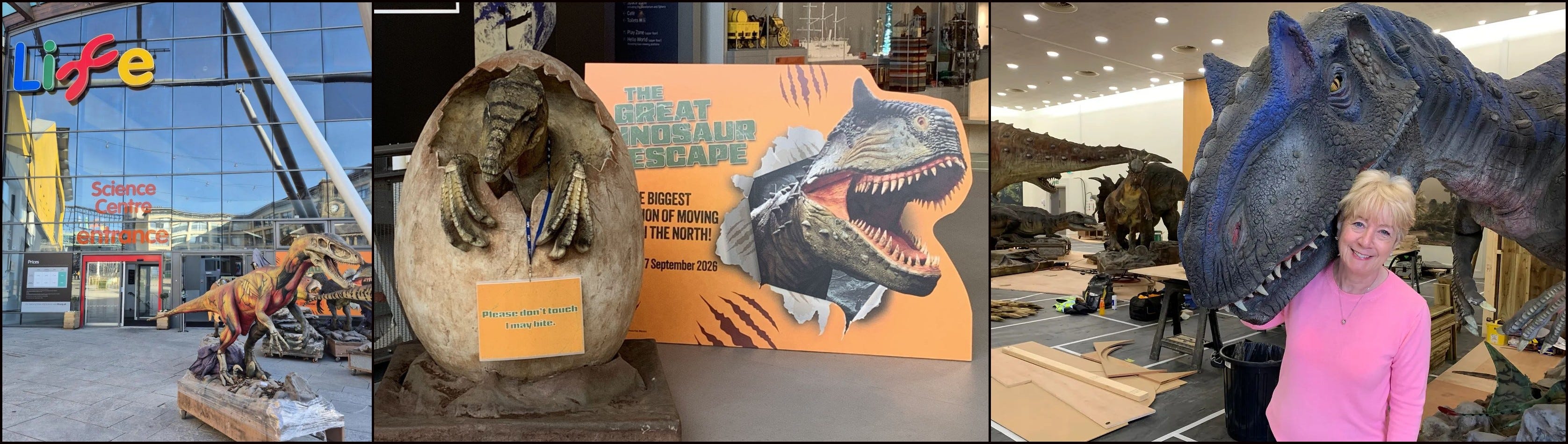
The new exhibition at Life Science Centre in Newcastle has already generated a lot of excitement. And that’s just among the people who have been storing and looking after the 20 dinosaurs. What will happen when children get first sight of The Great Dinosaur Escape, wonders David Whetstone in this week’s Cultured. North East.
“Actually one exhibit, a hatching dino-baby, is already positioned near the ticket desk, a reptilian teaser blazing a trail for its larger co-stars, all making their first appearance in the UK.”
He spoke to Linda Conlon, chief executive of the International Centre for Life, about the launch of Operation Dinosaur and the exhibition which opens on March 28 and runs until September.
A quick word
Durham Police are working to establish if any criminal offences were committed in light of concerns over the care of breast cancer patients at the County Durham and Darlington NHS Foundation Trust (CDDFT). Gateshead Council is looking to secure £4m from the National Lottery Heritage Fund to repair and restore the historic Dunston Staiths to make sure the public can continue to access the site. Wallsend-based clean technology company Kinewell has secured more than £1m of funding, including the first-ever investment from the North East Accelerate Fund, to scale their technology which helps wind farms save time and money. Staff at the John Lewis Partnership are to get their first bonus in four years. The 2% payout - roughly an extra week of pay - signals growing stability for the employee-owned retailer and renewed confidence in the company’s long-term recovery strategy. The public is being asked by the National Trust to vote on which of six shortlisted artists should create an artwork from the wood of the illegally felled Sycamore Gap tree. Owners of The Boat Club in Durham have appealed a decision by the county council to turn down its retrospective application for planning permission for a mural on the side of the pub which features a toucan balancing a pint glass on its beak alongside an illustration of Durham Cathedral. The Pussycat Dolls are reforming after 16 years (well, three of them at least) and will be performing at the Newcastle Utilita Arena on Friday October 9. North East businesses are increasingly integrating AI into their work, with 85% seeing increased productivity and 42% reporting higher profits in the past 12 months, according to the Lloyds Business Barometer.
Dandy sum for a Beano
It was a sum which the Beano’s Lord Snooty would not have sniffed at as bidders at a Tyneside comics auction splashed out more than £100,000, including fees.
The two-day sale of 500 lots of comics material by Newcastle auctioneers Anderson & Garland was the first in a series based on the vast collection of Peter Hansen, who grew up in Byker and stored his collection in a Northumberland barn.
He’s moving to Canada and selling his collection in job lots, as we reported last week (Comics, cars, cafes and charity). Tony Henderson reports that in the first two-day auction the Beano Annual No. 1 sold for £3,125, significantly above expectations of its £1,000–£1,800 estimate, and the Roy of the Rovers original artwork, signed by Bobby Robson, Peter Beardsley and Matt Busby, sold for £400.

The money’s there - go and get it

By Alison Dunn
Charity CEO and host of the podcast series This is the North
When Sir Nigel Wilson was running Legal and General, American state governors would fly to London to have lunch with him. Not to lobby. Not to ask for a favour. To pitch.
They’d sit across a table from the people who controlled the capital and make the case for why an investment in Illinois or Texas or Massachusetts would deliver returns. They were prepared, they were hungry, and they understood something that most British politicians still haven’t grasped. The money exists. The job is to go and get it.
Nigel told me that story during our conversation, and it stuck. Not because it was surprising. Because in all the years I’ve been doing this work, talking to politicians and civic leaders across the North of England, I have never once heard someone describe a British regional leader doing the same thing.
Nigel grew up in Newton Aycliffe in County Durham. Happy childhood, good schools. He’s open about the fact that he was lucky, and he doesn’t romanticise it beyond that.
What came next was a PhD at MIT on a Kennedy Scholarship, a job at McKinsey, and a career that eventually put him in charge of over £1 trillion in assets. But the story that stayed with me was about a house.
When he came back to England and tried to buy a house, the building society he’d saved with since he was a boy questioned him about the mortgage. A five-bedroom detached house in London for £60,000, on a salary that more than covered it. At the time, that same money would have bought six good houses in the North. They didn’t think someone his age should be spending that much. He got approved elsewhere in 90 seconds.
He tells that story to make a point about risk, capital expenditure and his generation. “My generation have been the selfish generation,” he said. “We got free education at university, including not just your fees paid, but all your living allowances paid. We got very cheap housing and we also got Defined Benefit pension schemes, and my generation has basically stopped all of that.”
The older generation have been largely shielded from the worst of the cost of living crisis. The question he’s asking is what we do about the people who haven’t.
Nigel’s starting point is blunt: “The UK economy is not going to grow unless the towns and cities outside of London grow.”
His deeper argument is about where the money actually sits. The world, as he sees it, is awash with money looking for productive places to land. Nobody’s connecting it to the places that need it.
“Too many times the people from the regions come down to see the Government to ask for money. The Government tells them there isn’t any. Both sides go home. The conversation goes nowhere. Meanwhile, the private capital that could fund housing, regeneration, and new businesses sits in holding patterns because nobody with political authority has walked into the room and made the case.”
The data supports his frustration. According to Beauhurst, which tracks equity investment across the UK, London’s share of high-growth companies rose from 26% to nearly 32% between 2015 and 2025. The North East saw its investment value nearly triple over the same period, from £788 million to £2.3 billion, but its share of total UK deals actually fell. More money going in. The gap widening anyway.
Numbers like those are abstract until you think about what they mean at street level. A graduate from Newcastle or Sunderland has a good idea but no access to the capital that would let them build it where they live. Our cities have strong universities and a growing tech sector but still can’t retain its best talent, because the funding, the networks, and the visibility all sit 200 miles south.
He wants universities producing entrepreneurs, not just graduates. The pipeline from degree to startup needs to be as visible and supported as the pipeline from degree to corporate job. Right now, it isn’t. And every year it isn’t, another generation of talent leaves.
Nigel has said he intends to come back to the North East. He wants to connect with the people he describes as progressive: the vice chancellor of Newcastle University, the region’s political leaders, the entrepreneurs coming through. Whether that translates into concrete change remains to be seen.
I asked Nigel what the North could look like in 10 or 20 years. His answer skipped the policy language entirely. “I dream of a better, fairer society,” he said. “But an exciting one where there’s growth and opportunities for everyone.”
We talk about the North being left behind as though it’s something that happens to us. Nigel’s argument is less comfortable than that. The capital exists. The opportunities exist. What’s missing is someone from here walking into the room and refusing to leave without a commitment. That’s not London’s job. It’s ours.
Listen to the full episode with Sir Nigel Wilson: Spotify | Apple Podcasts