

Let’s begin today’s edition by turning the clock back to May 2013 and the formation of the North East Initiative on Business Ethics.
Caroline Theobald, city centre chaplain the Rev Glyn Evans and Kevan Carrick were the founders of an organisation which you would have to say passed the Ronseal test. They came to me as editor of The Journal to express their primary concern about the late payment of bills putting too many businesses, especially small businesses, under threat.
Our conversations gave birth to the Pay Fair campaign which we launched in 2014 to highlight how late payments were putting an unnecessary strain on the cash flow of some businesses and increasing the risk of insolvency.
Insolvency trade body R3 were involved - and their latest figures make a very good case for going ‘back to the future’ and reviving what was a successful campaign. More on that below.
Turning the clock back even further, the Meadow Well riots were in 1991. Memories were revived on Bonfire Night when police and members of the fire service came under attack from a mob on the same North Shields estate who attacked a building they thought was earmarked for asylum seekers. They were wrong (but, even if they were right, they were wrong).
Northumberland County Council has found what it says is compelling financial evidence for the dualling of the A1. It is being argued that the benefits can be measured not just by time saved, but also by the reduction in driver frustration.
I have to admit that, as much as I’d like to see the road upgraded, I’m not too clear on how this is converted into an economic benefit of £200m over 60 years. Still, stick the figures in the Green Book and see what comes out.
We also have a Gateshead Council row over women being “silenced”, a Northern initiative to harness the potential of middle-sized businesses, a funding boost to help grassroots sport in the North East, and the 20 firms to keep an eye on.
Meadow Well Pt 2
Some 35 years after the notorious Meadow Well riots, the North Shields estate was back in the news again after emergency services came under attack from bricks, missiles and fireworks in “pre-arranged” disorder on Bonfire Night.
A group congregated outside a building which was being rammed by a car and attacked by fireworks because the word on social media was that it was going to become a house of multi-occupancy (HMO) for asylum seekers.
The mob turned on police and the fire service when they arrived. A number of officers were injured and five police cars and three fire engines were damaged. Six arrests were made - with the prospect of more to follow.
The reality? The building is set to become a supermarket with private flats above. It’s yet another example of misinformation being spread online and fuelling community tensions, protests and civil disorder. And it once again highlights the need for reliable and trustworthy sources of news and information.
Trusted sources
On that note, The Source, as you should know by now, is independent, politically neutral and North East biased - and a trusted source of news and quality storytelling.
We were unsuccessful in obtaining funding from the Government’s £6m Local News Fund, where we had hoped to secure the money to hire a reporter who would bring you more public benefit journalism. The North East did not fare well in that funding round (London did) and I will return to this subject in Wednesday’s edition.
In the meantime, it is even more important that our growth is supported by people who like what we do. If you are a free subscriber, would you upgrade to paying £6.99 a month? You can do that here:
We have also launched a Crowdfunder to allow us to continue with the recruitment of that specialist journalist.
Here’s a lovely little clip from The Source launch event at the Helix in Newcastle six weeks ago. It’s Steph McGovern and Richard O’Neill from Seven Stories talking about the North East having the best storytellers.
Steph is investing in The Source. You can help too by contributing to:
www.crowdfunder.co.uk/p/thesource
Dual benefits
Research commissioned by Northumberland County Council shows that dualling the A1 would deliver £200m more in benefits than previously thought. An earlier appraisal of dualling the 13 miles north of Morpeth showed an estimated £280m worth of economic benefit. The new assessment, based on the appraisal of dualling the A9 in Scotland, shows an extra economic boost of £200-225m over a 60-year period.
Council leader Glen Sanderson said: “This study clearly demonstrates to the Government why the business case for dualling is now more compelling than ever. Northumberland is thriving, but our main road through the county isn’t fit for purpose. Our study shows up to half a billion pounds of benefits could be generated.”
Council accused of ‘silencing women’
Gateshead Council has been accused of “silencing women” after a decision was taken to hold meetings of its women and girls committee in private. Leader Nick Allan said the decision was recommended by council officers, not by the ruling Reform party, after accusations some committee members and members of the public “got out of hand” at a meeting.
Opposition councillors requested that the meetings continue to be held in public until it could be proved there was a legal basis to making them private - but the request was refused. The decision may be reviewed, however, with Allan telling the Local Democracy Reporting Service that the chief legal officer has written to say that, on reflection, it might have been too hasty.
The critical middle

The North’s most ambitious mid-sized businesses are being backed to drive economic growth in a new initiative led by The Great North partnership of mayors.
Funding to deliver the Northern 500 programme was confirmed by the Chancellor in the Budget, which also highlighted private sector involvement, including NatWest, Lloyds and Sage.
North East Mayor Kim McGuinness, who chairs The Great North, and NatWest Group chief executive Paul Thwaite co-chaired the first Northern 500 Partners Council meeting in Newcastle last week.
Research by NatWest found that mid-market firms employ 7.3m people and generate around £420bn in economic value each year. Adding just 1% additional growth among these businesses could generate an extra £24bn for the economy outside London and the South East by 2030.
“Mid-sized businesses are already economic powerhouses,” said Mayor McGuinness. “Just imagine what more they could achieve with the right backing, connections and opportunities.
Event for a legend

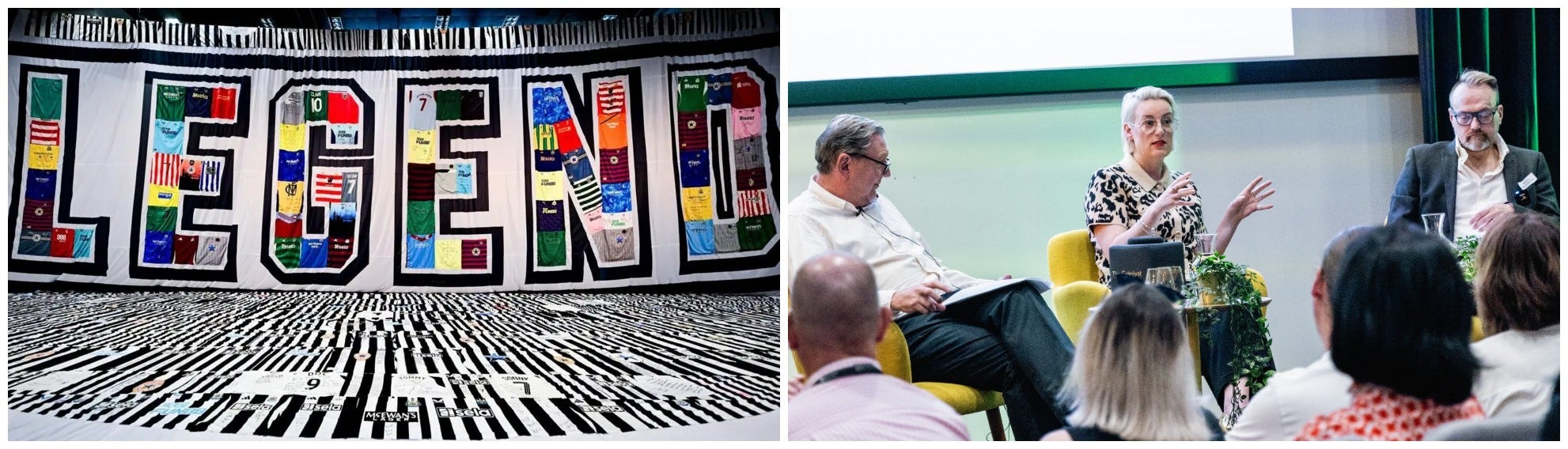
Almost 4,000 people attended the Baltic Centre for Contemporary Art last weekend to see an exhibition featuring hundreds of shirts left outside St James’ Park following Kevin Keegan’s death in July. The free event included a commemorative film on the life of the former Newcastle United player and manager and a 57ft banner designed by fan group Wor Flags.
A quick word
The future of National League club Gateshead has been secured following the completion of a takeover by US private investment firm Flacks Group. Interim chair Graham Wood said: “Staff and players have now been paid and funds are in place to satisfy HMRC and other creditors.” Kynren – The Storied Lands has been named the UK’s Best Tourism Project by the British Guild of Travel Writers at the International Tourism Awards in London. Chief executive Anna Warnecke said: “What makes this particularly special is that the recognition comes from professional travel writers who have experienced The Storied Lands for themselves and understand what makes it different.” Former Sunderland Echo editor Rob Lawson is returning to lead Education Partnership North East (EPNE) as its new Chair of governors. During a previous eight-year spell as Chair of Sunderland College, he oversaw the mergers with Hartlepool Sixth Form College in 2017 and Northumberland College in 2019, forming the current regional group. Accountant Rob Hughes, who has 10 years experience at PwC and Sage, has launched an app designed to simplify tax returns for self-employed tradespeople - and has attracted nearly 1500 users within weeks of going live. “The aim of Bosh Tax, is very, very simple,” said Rob. “Getting tax sorted for tradespeople.” He developed the idea after helping friends in construction with their finances, including one who was paying hundreds of pounds in fees for relatively straightforward tasks. The North East is to pilot a scheme to boost entrepreneurship among young people that is backed by one of the world’s largest financial institutions. The programme run by the Careers & Enterprise Company (CEC) has received backing from Goldman Sachs Gives, as well as HomeServe founder Sir Richard Halpin. Ten schools in the region will work with local entrepreneurs, start-ups and scale-ups to tackle real-world business challenges, gain the confidence to turn their ideas into opportunities and explore entrepreneurial pathways.
Grassroots sport backed
Sport Newcastle has secured funding worth £83,000 from the North East Mayoral Strategic Authority to support grassroots sport across the whole of the region.
The news was announced at the 2026 Sport Newcastle Awards at Newcastle’s Civic Centre by Chair Roger Tames who said: “This is a landmark investment for Sport Newcastle as we prepare to celebrate our 60th anniversary. It will allow us to significantly increase the support we provide to talented young athletes and the community clubs that make such an important contribution to life across our region.”
Twenty to watch
The region’s first Ones To Watch Index was announced at an event at Durham University Business School last week - with 20 businesses selected from 110 nominations.
Created by the Entrepreneurs’ Forum in partnership with Castrius Capital Partners, the company launched by Fairstone founder Lee Hartley, the index has been created to put these businesses on the radar of people across the region who could help them grow, whether through investment, introductions, mentoring, sharing experience, or becoming customers.
Elaine Stroud, chief executive of the Entrepreneurs’ Forum said: “We’ve got some fantastic businesses being built across the North East, but a lot of them are flying under the radar. We wanted to find 20 that we genuinely believe can go on to become really significant, and make sure more people know about them.”
All 20 businesses, which are listed here, will be in contention for the One to Watch Award, which will be announced at the annual North East Entrepreneurial Awards at Hilton Newcastle Tyne Bridge on November 19.
Time to Pay Fair (again)
Late payments are causing problems for businesses in the region. There were nearly 570,000 overdue invoices during the third quarter of 2026, according to the R3 Business Health Report. That’s a 14% increase compared with the same period last year and a 55% rise on the previous quarter. It’s also the highest year-on-year increase in England.
Kerry Pearson, chair of R3 in the North East and restructuring and insolvency director at Armstrong Watson LLP, said: “The rise in overdue invoices is a real concern and shows the scale of the challenge facing businesses when it comes to getting paid on time.
“Late payments can have a significant impact on a company’s cashflow and its ability to pay staff, suppliers and other bills, particularly when businesses are already dealing with high operating and employment costs.”
This sounds all too familiar.
In 2014, The Journal launched the year-long Pay Fair campaign, highlighting how late payments were putting an unnecessary strain on the cash flow of some businesses and increasing the risk of insolvency.
We urged companies to demonstrate their support by signing up to a pledge created by the North East Institute of Business Ethics (NIBE), an organisation set up by Caroline Theobald, city centre chaplain the Rev Glyn Evans and Kevan Carrick.
NIBE’s vision was for a business community that acted ethically, treated its stakeholders fairly and delivered on its promises. Including paying bills on time.
The original steering group and supporters included some high-profile names: Lucy Armstrong, James Ramsbotham, Hugh Welch, Paul Woolston, Barry Speker, Lucy Winskell and Chi Onwurah to name but some.
Was it a success? Catriona Lingwood, Chief Executive of Constructing Excellence in the North East wrote in her New Year message at the start of 2016 that the money owed to small businesses had reduced and that the campaign should continue as it was making a difference.
Ironically, one of the early supporters of the campaign was John Dickson, Chair of the Owen Pugh Group. He said: “I applaud what The Journal is doing as it can be difficult for people to say anything about this issue. One wrong word and you could find you won’t get any more business from some of these customers. But if The Journal can lift the lid on it, that could make a real difference.”
He instanced one supplier who insisted on 30-day payment terms when it is owed money, but set 60-day terms when Owen Pugh had carried out work for it. “I consider that rank hypocrisy and it is rife in this industry,” he said.
Owen Pugh went into administration in 2017.
“We ran out of money and we ran out of luck,” said John. “I’m desperately sorry for what’s happened. I’ve lost a lot of money and I’ve lost my home.
“I’ve gone through three years of absolute hell trying to keep the business going and I’ve done everything I possibly could to make things work but it’s not been enough. We’ve had the most extraordinary bad luck and this is a particularly tough industry at a particularly tough time.
“I have to say that some of the companies we’ve worked for have shown a complete lack of moral scruples. Some of the main contractors are often just bullies.
“In most industries you will put in an invoice for your work and expect to be paid for 95% of it; we were sometimes getting 10 or 15%. The law allows companies to do that and there’s no incentive to behave properly.
“We could go to adjudication, but it would cost us £50,000 before it even started and all we’d get back is the original sum. There’s no penalty for the bad behaviour. This doesn’t happen in other countries and it doesn’t happen in other industries. It’s a thing that happens in construction.”