

Today’s edition features an article by former QT columnist Arlen Pettitt which straddles the personal and the professional. The subject matter is looking after, and educating, children with special education needs - a massive financial headache for cash-strapped councils up and down the country. And a big problem for headteachers.
Before that, here are are few Eyes & Ears extras…
25m cultural boost

The North is to get the lion’s share of a £150m pot to help creative professionals and businesses innovate, up-skill and attract private investment.
Six mayoral authorities will get an equal share of the Government’s Creative Places Growth Fund, including the North East, Greater Manchester, the Liverpool City Region and West Yorkshire. The West Midlands and West of England are the other two.
The money will be split over three years with the first allocation being made in the 2026 financial year.
North East mayor Kim McGuinness said: “There are so many amazing, creative people in our region and we want to give them the chance to shine and build thriving careers that match their ambition.
“This is a £25m boost to our ambitions for culture in the North East. I meet people all the time who have the ideas and the talent but just need a little helping hand to set them on their way,” she said.
I know of one highly regarded micro business operating in the digital publishing sector which has an increasing number of regular readers with ambitions to grow and create employment for more journalists.
Don’t think I can wait until April 2026 though.
Coming clean on tax
Eyes & Ears does have some very knowledgeable readers. One of that number, who prefers to remain anonymous (not to me, obviously) got in touch after reading the good news about Port of Tyne’s £150m investment into the Tyne Clean Energy Park (edition 19.09.25 - the one filled with lots of jobs stories).
“I want to make one small point of clarification,” he said. “While the site may well benefit from its association with the North East’s Investment (now Industrial Strategy) Zone, business activity in the Clean Energy Park won’t qualify for the suite of tax reliefs mentioned.
“These reliefs only apply on activity taking place on specific sites - designated in law by HMRC - within Industrial Strategy Zones. In the North East’s case, those sites are at Blyth, and at the International Advanced Manufacturing Strategic Site (IAMSS) in Sunderland. You can see the exact sites here.
“Nonethless, more good news for a region on the up - and, as ever, expertly reported by Eyes and Ears.”
Knowledgeable - and astute!

£46m difference
Healthworks marked their 30th anniversary with a celebration event at the Crowne Plaza in Newcastle where the speakers included patron Sir Michael Marmot and Professor Bola Owolabi of the Care Quality Commission.
The charity also unveiled their Impact Report 2024–25 - the highlight being an estimated £46.2 million in savings to the NHS and social care through their prevention and early intervention work in the North East and North Cumbria.
Chief executive Paul Court said on his LinkedIn: “The NHS 10-Year Plan calls for more integrated, preventative, person-centred care. Healthworks is already delivering it — and we have been for decades. We’re improving population health, lowering healthcare expenses, and creating a more sustainable healthcare system.”
I like to provide links so that anyone interested in a particular story can read more. I failed to find one for this, so the only link I’ve provided is for the impact report on the charity’s website. That may suggest Healthworks need to be more media savvy - or it could say something about the newsgathering capabilities of media organisations today. You can draw your own conclusions.
Finishing time
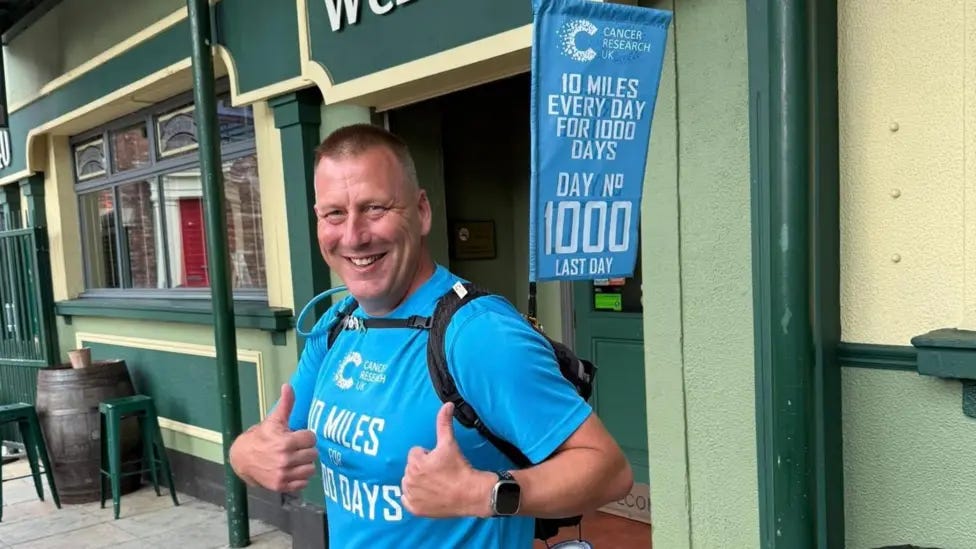
David Ansell has walked 10 miles every day for two years, eight months, three weeks and five days, a 1,000 day challenge to raise £28,000 for cancer research after losing his father and a friend to cancer - burning through 22 pairs of trainers in the process.
About 45 people joined him for his final walk on Tuesday, starting at the Stadium of Light, taking him through Seaburn and Cleadon in South Tyneside, before finishing with a celebration at Sunderland pub Chaplin’s.
New Maggie’s
Maggie’s, the charity that provides free practical, emotional and social support for people with cancer and their families, has opened in the grounds of James Cook University Hospital in Middlesbrough.
Karen Redfearn, 53, from Guisborough, said: “I have found Maggie’s in Newcastle invaluable. Having their support closer to home will be essential for me, but also for those who are not able to travel to Newcastle.”
Sam on stage
Sam Fender is not just in the running to win this year’s Mercury Prize, it’s been announced that he is one of the acts who will be performing at the awards at Newcastle Utilita Arena on October 16.
Northern connections
Northern Influence, a new network connecting public affairs and policy specialists, was launched in Newcastle. Two of the founders are Lorna Snowball, external affairs lead at Northern Powergrid, and Martin Osborne, policy and public affairs officer for Karbon Homes.
The third founder, Louis O’Halloran, account director at strategic communications and public affairs consultancy Inflect, is setting up a Northern Influence hub in Manchester.
A quick word
Hartlepool Borough Council has a new leader. Pamela Hargreaves, wife of Hartlepool MP Jonathan Brash, has taken over after Brenda Harrison decided to step down after 18 months in the role. Hartlepool councillors have voted unanimously to remove the freedom of the town from former MP Peter Mandelson over links to Jeffrey Epstein. A public consultation on the future of seven North Tyneside schools was inevitable because of falling birth rates, says Tynemouth MP Alan Campbell. Tyneside stand up Nicola Mantalios, aka Zoe, was named winner of the prestigious Funny Women Stage Award at London’s Bloomsbury Theatre. The Auckland Project has appointed Jane Ruffer, who co-founded the charity with husband Jonathan in 2012, as chief executive. The future of two business parks are in doubt after money for economic regeneration schemes at the Jade Business Park in Murton and South Church Enterprise Park in Bishop Auckland was pulled as part of Durham County Council’s spending review. North Tyneside Council’s new chief executive is, as expected, Jackie Laughton. She has been at the council for 17 years and stepped in as interim chief exec in January. Darlington has become the second council to reject a suggestion to pull out of the Tees Valley Energy Recovery Facility (TVERF) at Teesworks which is set to burn household waste from seven councils to create electricity for the national grid. Real estate firm CBRE has been hired by Sunderland City Council to find operators, investors and developers who can make the £450m Crown Works Studios a reality.
Absurdly small
Reports suggest PPE Medpro made £65m profit selling PPE equipment to the Government - but we can’t know for sure, says Dan Roan from Tax Policy Associates.
“Its finances are a mystery, because it was allowed to file only abridged accounts. Why? Because under UK law, PPE Medpro counted as a ‘small’ company. It’s absurd. We’ve published a short report with a simple fix.”

The injustice of SEN suspensions
The Government is due to release a Schools White Paper later this year which will include reforms for how children with special educational needs (SEN) are provided for.
Arlen Pettitt is a North East-based policy and communications consultant. He knows a thing or two about research and data. He’s also the father of a SEN child.
His report into the system and the use of suspensions in primary schools, ‘Set Up To Fail’, was published this week and a copy has been sent to Education Secretary Bridget Phillipson, Early Education Minister Olivia Bailey, North East mayor Kim McGuinness and every North East MP.
By ARLEN PETTITT
It’s Tuesday evening and your phone rings. It’s the school’s number and when you answer the head teacher greets you with a serious tone.
There’s been an incident today, and your child is being suspended. It’s the week before half term and they are suspending for three days starting tomorrow, meaning your child will be out of school for 12 days.
Your first thought is for your child; they’ll probably be relieved, and the break might do them good.
Your second thought is for work, and the conversations with bosses and clients, as this isn’t the first time in the last few weeks you’ve had to cancel things with no notice.
This is an incredibly common story which inspired my latest research paper Set Up to Fail, which analyses data around suspensions alongside insights from the parents of SEN children.
In doing the research, I heard from parents and caregivers whose struggles with the SEN system had been so severe they had been forced to sell homes to adjust to changing circumstances, and lost jobs because of the pressure of their children being out of school so often.
I heard about friction and relationship breakdowns between parents and schools and local authorities, and about children and young people in full blown mental health crises before support arrives.
What comes through is less a story of a service in need of reform and more an SOS call of a safety net so torn and tattered that a wholesale mindset shift is needed.
The statistics back this up. Suspensions for primary age children are on the rise, up 103% in the North East since 2014-15.
Of those suspensions, now sitting at around 3,000 per year in the region, 83% go to children with recognised Special Educational Needs. These children are as young as four, five or six years old.
The most common reason for suspensions, accounting for just over half of cases (51%), is persistent disruptive behaviour.
The Children and Young People Mental Health Coalition argues strongly that behaviour is linked to unmet need, with evidence they have gathered from professionals in the sector concluding “experiences of trauma, growing levels of anxiety, high levels of unmet need, and challenges in accessing timely assessments and support are contributing to a rise in behaviour problems in school.”
Department for Education guidance on SEN for early years settings identifies four core areas of need: communication and interaction; cognition and learning which includes issues like dyspraxia and dyslexia; social, emotional and mental health; and sensory and physical difficulties.
Often however, these issues overlap with pupils managing a complex blend of communication, sensory and mental health challenges alongside the demands of busy, bright, noisy classrooms.
The Government recognises the issue and is on the brink of bringing forward reforms to SEN provision in a Schools White Paper planned for later this year.
Their direction of travel is already clear, with funding already allocated to create 10,000 more SEN places in mainstream schools and a pledge to make those settings more inclusive.
This will be incredibly difficult to achieve without huge investment, and without engaging in a culture war with schools, teachers, local authorities and Ofsted on what education looks like.
From a parents’ perspective, there are two key issues ministers will need to consider before they can even begin to fix the problems.
Firstly, the variation of experience.
Accessing support for a child with SEN involves a huge variety of different agencies and services, including local authorities, educational psychologists, the NHS, counsellors, therapists and other specialists.
The process is rarely straightforward, never predictable and information flows often break down.
Parents in one part of the North East will get an entirely different experience than those in another.
Looking at Education, Health and Care Plans (EHCPs) for example, the legal documents which set out a pupil’s needs, local authorities have a statutory 20-week deadline for a decision. That deadline is hit 86.9% of the time in Gateshead, but just 6.5% of the time in Newcastle and a shocking 1.9% of the time in County Durham.
Once those decisions are made, there’s then variation in the proportion of EHCP requests which are initially refused. In North Tyneside, just under half (46.1%) of initial requests are turned down, compared to just 13.2% in Northumberland.
The second, and perhaps tougher, issue comes down to culture, and how inclusion and the use of punishments vary by school.
The data shows that while some schools use suspensions fairly often with primary age children, others do not.
In Newcastle, for example, the highest number of suspensions of primary age pupils was at Gosforth Junior High Academy, with 381 suspensions since 2014-15. Meanwhile, three schools, including West Newcastle Academy have not issued a single suspension in that time.
Individual schools also buck the broader trend that sees the number of suspensions increase as you go through the age groups. In North Tyneside, eight of King Edward Primary School’s nine suspensions since 2014-15 came across Nursery, Reception and Year 1 - so when children were aged between 3 and 5 years old - and just one at Year 6.
Similarly, Southridge First School - which caters for children between Reception and Year 4 - where seven of a total of nine suspensions were in Reception and Year 1, with one in Year 2 and one in Year 3.
What this means is SEN children and their parents get a hugely inconsistent experience of education. One where support is easier to get in some places, and where suspensions are harder to avoid in others.
If the Government is going to fix this system it needs not just a huge increase in funding, but a change in culture and mindset.
That process should start by listening to the people who know SEN children best – their parents and caregivers.
Arlen Pettitt
arlen@arlenpettitt.co.uk
worroom.substack.com
Brian I did get all your emails. Thank you. This is about my 5th attempt at this one. This system is unfriendly! I was pleased to see the piece on Healthworks and wanted to pick up on your comment. For a small charity, I thought Healthworks did brilliantly to pull off an excellent conference and high quality report. I am not surprised they did not have time to engage the media (many of whom are not interested in good news stories). Perhaps it's an issue you could raise with Lisa Goodwin at Connected Voice? Barbara