

The scrapping of the two-child benefit cap came into effect in April and has helped lift 9,000 children in the North East out of poverty.
The figures were published yesterday, the same day Alan Milburn’s report on the crisis of young people not in education, employment or training (NEET) was finally published. The two are linked - children who grow up in poverty are more likely to be NEET as young adults.
We’d heard so much about the Milburn review beforehand that you would have thought there was not much else to learn, but the former Darlington MP’s report was comprehensive, running to more than 270 pages, with sweeping recommendations covering welfare, health, education, employment and tax.
“We’re at risk of losing a generation of young people,” he said, adding that the scale of the problem is just too big for half-measures.
The Government has now to decide which of his many recommendations they will accept, although it has pledged to create a new youth opportunities unit – led by Milburn – to help co-ordinate and deliver recommended changes.
He has also recommended devolved responsibilities - something that was welcomed by North East Mayor Kim McGuinness.
“I’m part of a generation that has, by and large, done pretty well,” said Milburn. “We entered a labour market where the first rung of the career ladder was easier to reach. For many of us, housing was more affordable. We benefited from expanded educational opportunities. And we inherited a simple promise from our parents: work hard and you build a better life.
“That great British promise for this generation is being broken. Our job is to fix it.”
There’s more on both those stories below, including a column from Arlen Pettitt who provides some interesting context in which the review was published and talks about trust, and the benefit of providing a single front door for support for young people.
Mayor McGuinness said: “The Milburn Report is groundbreaking, and if the ministers accept its recommendations, as I believe they now must, it could be the turning point needed.”
Last chance to honour promises to the next generation
By Arlen Pettitt
I met Ellie earlier this year at the Newcastle United Foundation’s Careers Hub at the Metrocentre in Gateshead.
It’s a shop unit that’s been kitted out with sofas, desks and chairs. From that spot, the Foundation delivers King’s Trust programmes which help young people find a path into work.
Some of it is simple employability stuff - how to write a CV or cover letter, where to look for job adverts - but the really powerful stuff is about building back confidence in young people who have found themselves shut out of the life they hoped they’d have, without a clear route to follow.
It’s a programme which works, with the Foundation’s work at the Metrocentre reaching hundreds of young people every year and drawing on partnerships with many of the big brands with outlets on site to create pathways into employment which wouldn’t otherwise exist.
Ellie (not her real name) sat a couple of seats along from me as I listened to a group of young people talking about their experiences.
Her story is a relatable one. She’s in her early 20s. She has a Master’s degree. She’s a designer and illustrator. She hopes that soon she and her boyfriend will be able to move out of her parents’ house and get a place of their own. She wants to live abroad one day, maybe Spain. For the longest time she didn’t have any work at all, but she’s found - with the help of the Foundation - a job in hospitality. It’s unstable hours though, and when she has to stay late to close up she doesn’t feel safe waiting for the bus, so has to pay for a taxi or beg family for a lift.
Ellie was NEET - not in employment, education or training - and now, even though she’s technically not anymore, her life is still precarious and she still feels in limbo. As she finished telling her story Ellie took a deep breath and said something that’s stuck with me.
“We’ve done everything we were supposed to,” she said. “And it’s still so hard.”
That’s the context in which Alan Milburn has published his long-awaited report into NEETs.
There are around a million 16-24 year olds who fall into that category, and to put that into perspective there are currently just 690,000 vacancies in the entire UK labour market.
It’s a huge challenge, and one which has transformed in recent years.
Where once education and a bit of graft might be enough to lift you out of the NEET trap and into the land of opportunity, now around 15% of NEETs have a degree and 30% have a good set of GCSEs.
What we’re talking about is a matter of trust, and whether young people can continue to believe that if they do their part they will be rewarded - not with freebies or an easy ride, but just with the chance of having the life they want.
Milburn appears to understand this.
Speaking at an event with the Premier League at St James’ Park at the beginning of October, he spoke of the need to reaffirm the social contract for young people and head off growing disconnect between hope and reality.
His report, From a Welfare State to a Working State, echoes that, and opens by calling for a “new deal for the new generation” attempting to enter the labour market.
While pre-publication headlines focused on changes (and potential cuts) to the welfare element, the report itself strikes a more balanced tone, and the most significant recommendation is in fact the attempt to take a failing and fragmented support system and create something better coordinated.
If the Government follows the Milburn’s recommendation and creates locally-led Youth Opportunity Services - tasked with putting together individualised plans for young people, and backed by an ‘opportunity guarantee’ - then it creates a single front door for support.
It would be a single front door for employers and education providers too.
Devolution needs to be at the heart of this, and Milburn correctly argues for Mayors and their Strategic Authorities to act as conveners and commissioners of the proposed Youth Opportunity Services.
By bringing together businesses, local authorities, the NHS, schools, colleges and universities, the fractured system can begin to pull in the same direction at a regional level. Mayors including the North East’s Kim McGuinness and Tees Valley’s Ben Houchen were swift to welcome the recommendation.
This needs to be matched with practical steps to smooth the way into employment for the next generation.
Milburn calls for changes to National Insurance to make it cheaper to employ young people and give them their first chance, as well as payments to employers for taking on previously NEET young people. He sees this as working alongside more apprenticeship and college places to line up skills.
Importantly in a region like the North East, where some of the biggest employers and investors are the public sector, Milburn also argues social value should form a big part of government contracts, including creating youth opportunities.
As is often the case with difficult social and economic issues, we feel the pain more acutely in the North East.
While nationally around one in eight young people are classed as NEET, in the North East it is closer to one in four.
Kim McGuinness, who has welcomed the report as “groundbreaking”, referenced that figure in her response.
“The North East has by some margin the highest rates of so-called NEETs in the country and the figures are stark,” she said. “Nearly one in four of our young people are being denied the opportunities they deserve.”
Work and Pensions Secretary Pat McFadden has endorsed the report, saying he and his cabinet colleagues recognise the need for whole-system change… without backing specific recommendations.
That is the next milestone.
The Government is expected to put Milburn’s recommendations alongside the upcoming review of Personal Independence Payments and set out their plans in the New Year, with legislation to follow later in 2027.
But, it’s all too easy for grand plans of system-wide change to fall apart when faced with political realities.
Will pressure to cut the welfare bill mean cuts come before (costly) support is in place? Will the awkward bits around social value requirements for procurement make it through the legislative process?
The Prime Minister’s plans to rewire the state mean devolution is the likely lens through which this work will be viewed, especially as the Youth Opportunity Services will be locally-led.
Can a national ‘opportunity guarantee’ align with local political goals and societal needs?
Ultimately, I come back again to trust. It’s an old adage, but a true one - familiar to politicians and PR people alike - that trust is hard earned and easily lost.
Milburn’s review is yet another promise to young people, but one which feels genuine. If the government doesn’t seize this chance and follow through on this promise, then there’s a whole generation at risk of being lost.
That would be a betrayal of epic proportions, and it simply can’t happen.
Arlen Pettitt is a writer and researcher specialising in the politics and policymaking of the North East of England. He is the author of the weekly Wor Room newsletter.
Reaction to the Milburn Review
Rachel Anderson, assistant director of policy at the North East Chamber of Commerce:
“Businesses have a vital role to play in creating opportunities through apprenticeships, work placements and entry-level jobs, but they cannot do this alone. Milburn is right to call for a new deal with employers, making it easier and less costly to recruit young people, with practical support alongside financial incentives.
“The emphasis on devolution is particularly welcome. Our North East and Tees Valley mayors have an important role in bringing employers, education providers and support services together. Delivery must reflect the different challenges and opportunities across our region, backed by appropriate funding and flexibility.
Beth Farhat, Chair of the North East Child Poverty Commission:
“Significantly investing in young people and the package of support around them – combined with a relentless focus on growing the number of good employment opportunities available in areas like ours – will be fundamental to turning this situation around.
“Importantly, the Milburn Review’s reports have also emphasised that much of this crisis is rooted in poverty and inequality, and shaped by the conditions in which children grow up. The Government must therefore redouble its efforts to bring down the number of babies, children and young people growing up in poverty, to reduce their risk of becoming NEET in the first place.
Chris Zarraga, Director of Schools North East:
“If we are serious about holding schools accountable for where pupils end up, we must be equally serious about holding the wider system accountable for the opportunities available to them. A young person’s eventual employment outcome reflects far more than the quality of their schooling.
“The Milburn Review rightly recognises that this is a challenge for government, employers, health services and education working together. We need to turn that recognition into practical change, particularly in the regions where young people face the greatest barriers.”
“Without tackling the structural divide between regions, there is a risk that reforms will change how schools are measured without changing the opportunities available to the young people they serve.”
Poverty stats improve
Some 9,000 children in the North East have been taken out of poverty since the two-child limit was scrapped. The number across the whole of the country is 300,000, according to figures released by the Government yesterday.
Work and Pensions secretary Pat McFadden said: “Children who grow up in poverty are more likely to have mental health difficulties, to be NEET and to earn less as adults. We want to give every child a genuine shot at life – to do well at school, stay healthy, succeed at work – ultimately contributing to their community as adults.
“Removing the two-child limit is the most cost-effective way to drive down child poverty rates and is an investment worth making.”
North East Mayor Kim McGuinness said: “Ending the cap was about making sure children get a decent meal or warm clothes for winter - and do not forget that two thirds of child benefit claimants are from families with parents who have jobs and are working hard for their kids.”
Times like these

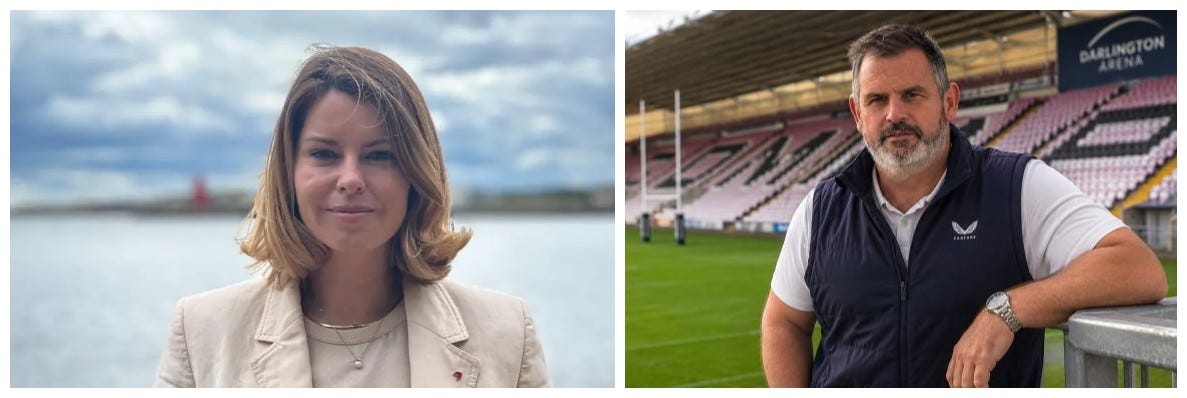
It has taken years to get to this stage… but Darlington Arena was this week announced as one of only three UK venues for next summer’s UK and European stadium tour by the Foo Fighters, an event that could bring an estimated £6.5m to £8.5m to the local economy.
Arena manager Danny Brown said: “We were speaking with the promoters over the last few years, sort of waiting for the opportunity that’s fit for a band, and also for the arena. Then around eight months ago we were contacted by the Foo Fighters’ team to ask if we had the availability for some dates; we said yes and then for around the last six months we have been working on it.
“A lot goes into the planning, with speaking to the council, promoters, highways, police and everyone else, so it’s been a long time coming. It does seem a little bit surreal, despite knowing for about six months that it was definitely coming. But it’s still surreal now it’s been announced.”
Top marks
Durham University professor Edmund Richardson has collected £50,000 after winning the Baillie Gifford Prize, widely recognised as the world’s most prestigious international award for literary non-fiction that is open to books on any subject and to writers of any nationality. Judges described his biography of Alexander the Great as “non-fiction writing at its very best”.
Mixed signals
I must admit we have exchanged a few words in our house about stocking up - is it called ‘prepping’? - as we were urged to do by the Government for various ‘just-in-case’ scenarios.
Long story short, we now have gallons of water, tinned rations, cereal bars, dried fruit, biscuits, baby wipes, toiletries and other assorted items stored away. Peace has broken out.
It therefore makes no sense to me that the Government seems intent on switching off Freeview and moving to online-only TV.
The House of Lords National Resilience Committee said switching off broadcast TV would leave pensioners and vulnerable groups without a vital source of communication in a national emergency. The committee also said that the UK’s network of TV masts could be the only reliable network capable of transmitting emergency messages if a cyberattack caused an internet blackout.
And finally
Robert Pattinson being named as the new James Bond has forced me to return to ‘second mentions’ - the words journalists use to avoid repetition. I first mentioned this a year or so ago and returned to the subject less than two weeks ago (From North Shields to Dire Straits - 06.11.26)
Juliet and Matthew Maguire are the husband and wife team behind the Twitter account @SecondMentions. They became fascinated by the journalistic habit of what they call the “elegant variation” and eventually wrote The Little Book of Second Mentions: The Art of Avoiding Repetition.

They say that Bond is the film character who has inspired the most second mentions:
The iconic spy; the caddish spy; the popular secret agent; and the secret agent-lothario to name but a few. They reserved a special mention for the BBC’s “a martini-sipping man of mystery”.
Like I say, it’s an art form.

I would love to get all the attention I can for my incredible story that should affect everything in Modern Life. AI recognized that I was trying to get out a knowledge Renaissance and wanted to use it to overcome its guardrails so that it could give out real science answers instead of hallucinations. Try reading my final article.